Reviewed by Dr. Mohit Dhawan, MDS (Prosthodontics, Crown and Bridge and Implantology).
Tooth loss that leaves you with few or no teeth in one jaw is common, and many people ask whether they must wear removable dentures. All-on-4, All-on-6 and All-on-8 are ways of supporting a fixed full-arch bridge on a small number of implants. This article explains what those options share, how they differ, and how a dentist assesses whether you are a candidate for All-on-4 or another full-arch plan.
It is general information, not a plan for any individual. Suitability depends on your bone, bite, health and the findings of a 3D scan.
What All-on-4 means in plain terms
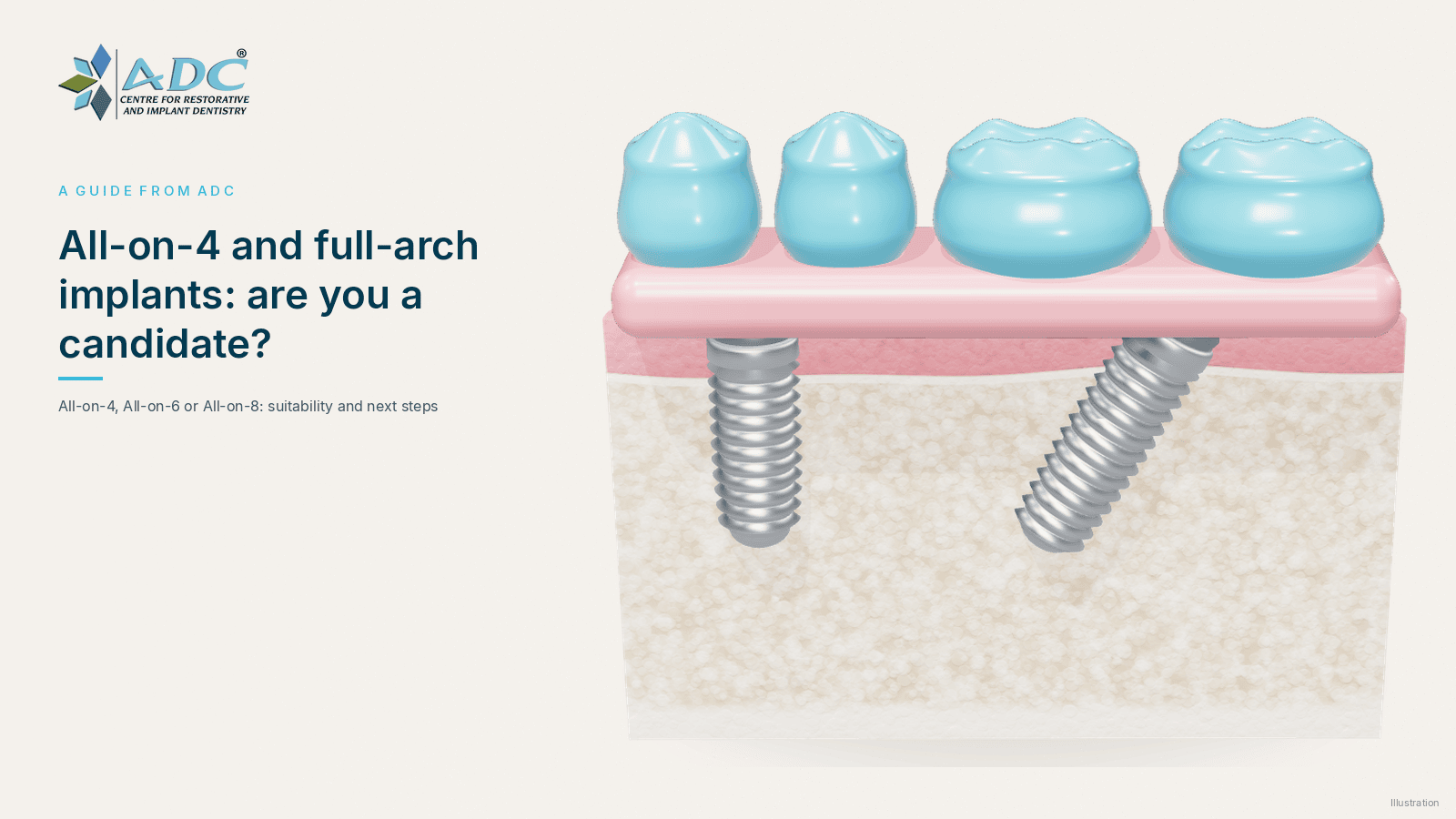
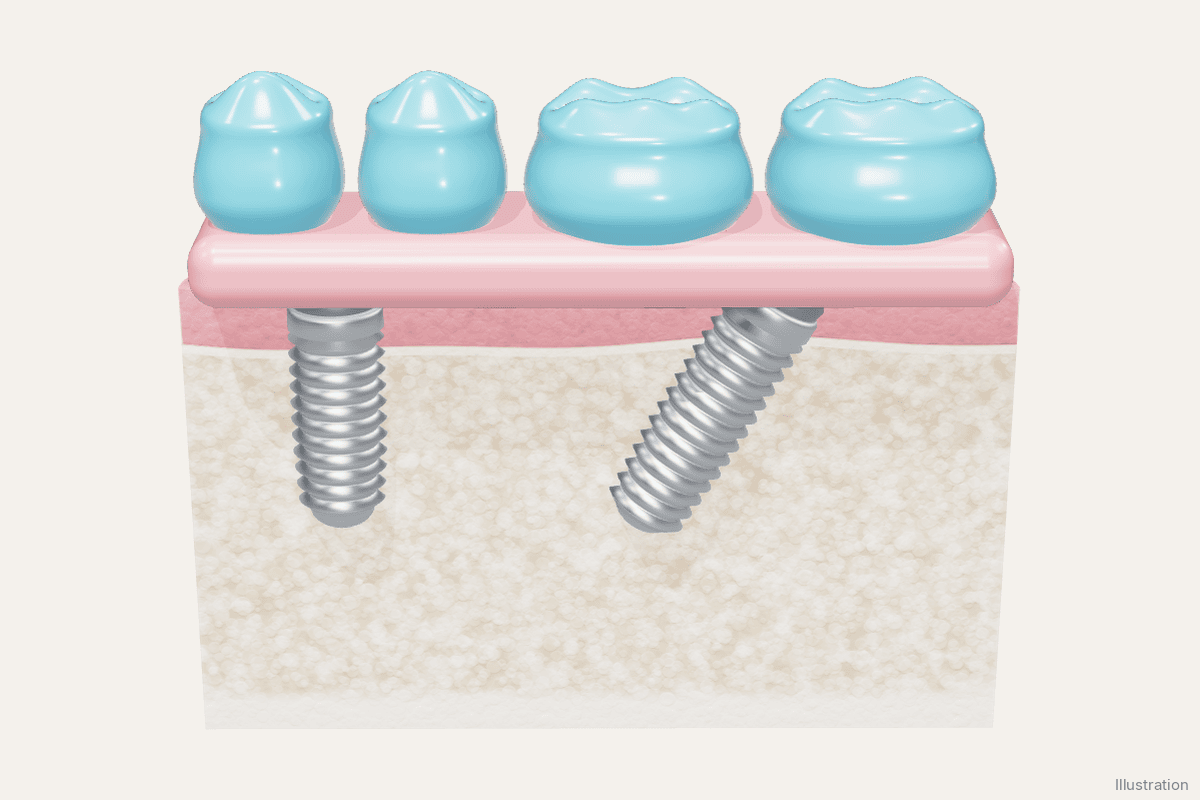
All-on-4 places four dental implants in one arch (upper or lower) to support a fixed full-arch bridge. In many plans, the back implants are angled to make use of available bone. The aim is a stable, fixed set of teeth for people who have lost most or all teeth in that jaw, without placing one implant for every missing tooth.
The bridge is not removed at home. It is cleaned in the mouth with brushes and, when advised, a water flosser, and it can be taken off by the dentist at review visits. It is not the same as a denture that you take out, and it is not automatically the right option for every person with missing teeth.
How All-on-4 works
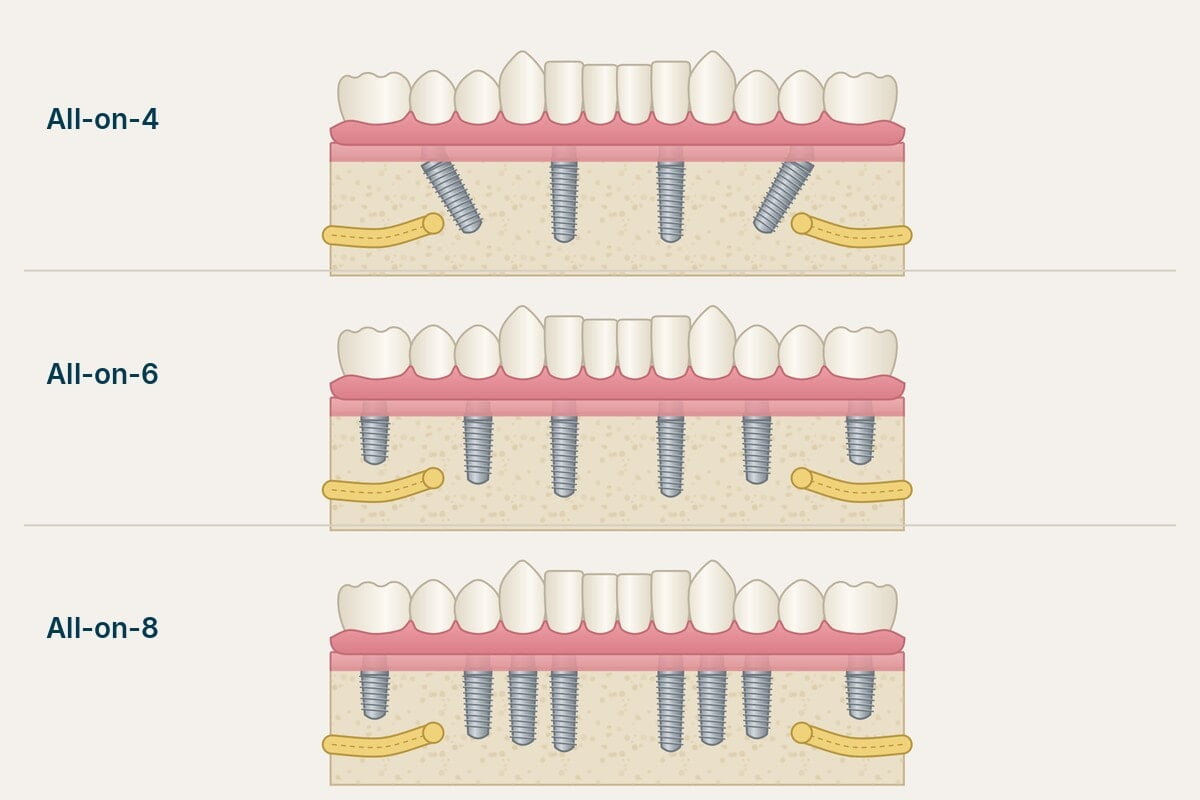
The All-on-4 treatment concept was described by the Portuguese dental surgeon Dr. Paulo Maló in the 1990s. In a typical plan, the two front implants are placed upright and the two back implants are tilted (often up to about 45 degrees). Tilting the back implants lets them use bone further forward and can avoid structures such as the sinus in the upper jaw or the nerve in the lower jaw. The implants are then joined by one fixed bridge that carries the full arch of teeth, usually around 10 to 12.
In selected cases a temporary fixed bridge can be attached within a short time of placing the implants. Whether that is possible depends on how stable the implants are when they are placed, the bone, your bite and your general health. If it is not safe, a temporary removable denture can be worn while the implants heal, and the fixed bridge is fitted later. This should not be promised in advance.
All-on-4, All-on-6 and All-on-8: what they share
If you have lost most or all of your teeth in one jaw, or the remaining teeth cannot be saved, you may hear about All-on-4, All-on-6 and All-on-8. Each is a way of making a fixed full-arch implant bridge: a single bridge carrying a complete row of teeth, screwed onto implants in the upper or lower jaw.
These options are not the only way to replace a full set of teeth. Which plan is suitable depends on your bone, bite, health and the findings of a 3D scan. No one option suits every jaw.
The main difference: how many implants, and where they sit
All-on-4 uses four implants in one jaw. The two at the back are often tilted, so they can use the bone that remains in the front and can avoid the maxillary sinus in the upper jaw or the nerve in the lower jaw. It is often considered when bone at the back of the jaw is limited.
All-on-6 uses six implants, usually placed more upright and spread along the arch. It usually needs enough bone in more places. Some clinicians prefer six implants in the upper jaw, or for a person with a strong bite, because the load is shared over more points. That is a planning choice, not a rule that six is always preferable to four.
All-on-8 uses eight implants in one jaw. It may be considered when there is enough bone along the arch and the dentist wants the load shared over still more points. It is not required for every case, and it is not automatically the right plan because the number is higher. Extra implants also mean more surgery and enough bone in more sites.
How your jawbone affects the choice
Bone is often the deciding factor. After teeth are lost, the jaw shrinks, especially towards the back. In the upper jaw, the maxillary sinus can extend down into the space where the molar roots used to be. A 3D scan shows the bone, the sinus and the nerve, and whether a graft or a sinus lift would be needed for a more upright, more numerous plan. All-on-4 was developed in part to use available bone and, in selected jaws, to reduce the need for grafting. A graft can still be the better path in other jaws. That decision is individual.
Low bone volume does not always rule All-on-4 out. Angled implant placement is designed, in selected cases, to use remaining bone and reduce the need for large grafts, but only imaging and an in-person examination can confirm this for you. You can also read about dental implants with bone loss.
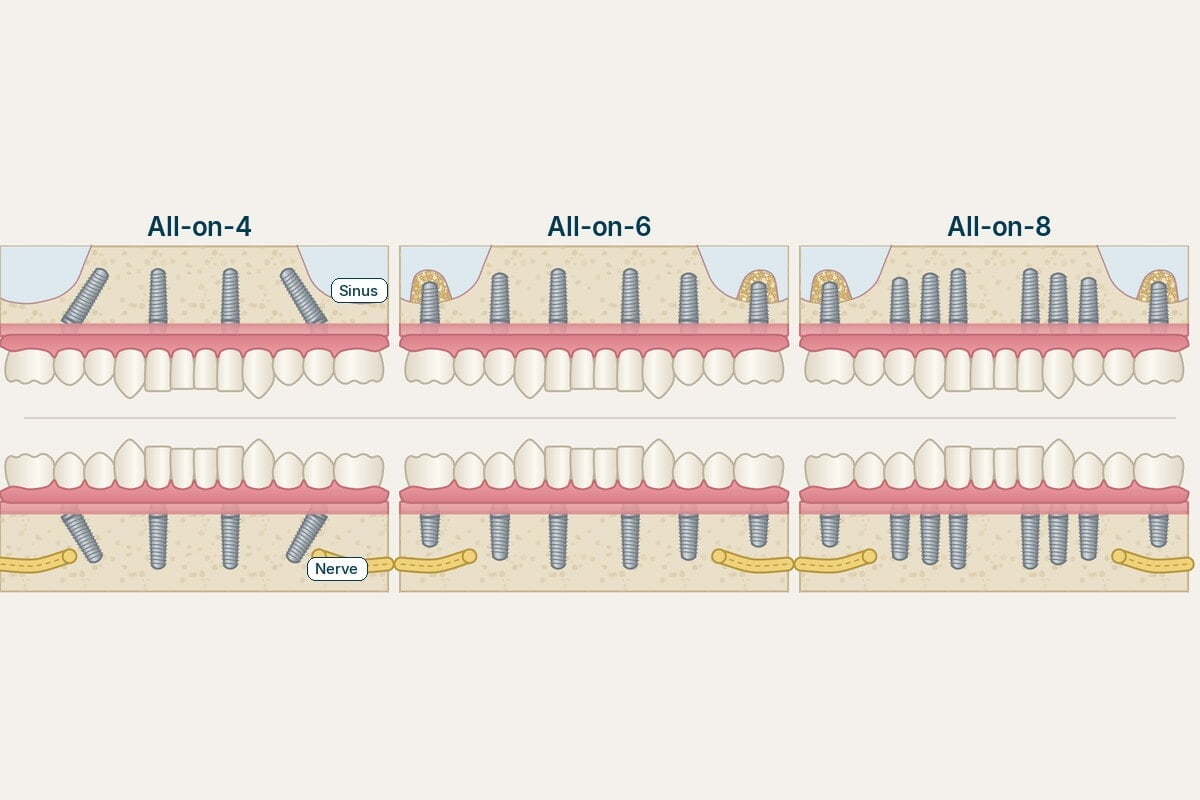
All-on-4, All-on-6 and All-on-8 at a glance
- Number of implants in one jaw: four, six or eight.
- Implant angle: All-on-4 often tilts the back two implants; All-on-6 and All-on-8 implants are more often upright, when the bone allows.
- Bone needed: All-on-4 is designed for situations with less bone at the back; six or eight implants usually need enough bone in more places.
- Load sharing: more implants spread the biting load over more points, when those implants can be placed well.
- None of these is a verdict on its own. The scan, the bite and your health decide the plan.
Who is often a suitable All-on-4 candidate?
You may be considered for All-on-4 after a clinical assessment if several of these apply:
- You have lost most or all teeth in the upper jaw, the lower jaw, or both.
- You struggle with loose or uncomfortable removable dentures.
- You want a fixed option rather than a plate you take out each night.
- You have enough bone in key areas of the jaw, or grafting or another implant plan can be discussed if bone is limited.
- You can commit to cleaning around the implants and to regular reviews.
- Medical conditions that affect healing (for example uncontrolled diabetes or heavy smoking) can be managed or improved before surgery.
Who may need a different plan?
All-on-4 might not be recommended if:
- You still have enough healthy teeth for a partial plan, bridges or fewer implants.
- Severe gum disease is active and not yet controlled.
- Bone volume or quality is too limited even for angled placement (other options may include grafting, zygomatic approaches in selected cases, or more implants).
- Medical risks make elective implant surgery unsafe until cleared by your physician.
- You prefer a removable denture or an implant-supported overdenture, for maintenance or personal reasons.
A consultation at ADC is about matching the plan to your mouth, not offering one protocol to everyone.
What affects the choice for you?
- the amount and location of bone, and the position of the sinus and nerve
- whether the upper or lower jaw is being treated
- your bite and any history of clenching or grinding
- gum health and the condition of any remaining teeth
- smoking, diabetes and other health factors that affect healing
- how the bridge will be cleaned and maintained over time
Living with a full-arch implant bridge
A fixed full-arch bridge needs daily cleaning, especially underneath where it meets the gum, using interdental brushes, special floss or a water flosser as shown. Regular professional reviews let the dentist check the gums, implants, screws and bite, and remove the bridge for cleaning when needed. Smoking, poor cleaning or missed reviews can put the implants and the gum at risk, as with any implant treatment. If a screw loosens or the bridge feels different, contact the clinic rather than leaving it.
What happens at a candidacy consultation in Chandigarh?
At ADC – Centre for Restorative and Implant Dentistry, a typical All-on-4 assessment includes:
- Medical and dental history, medications and habits (including tobacco).
- Clinical examination of gums, remaining teeth, bite and jaw joints.
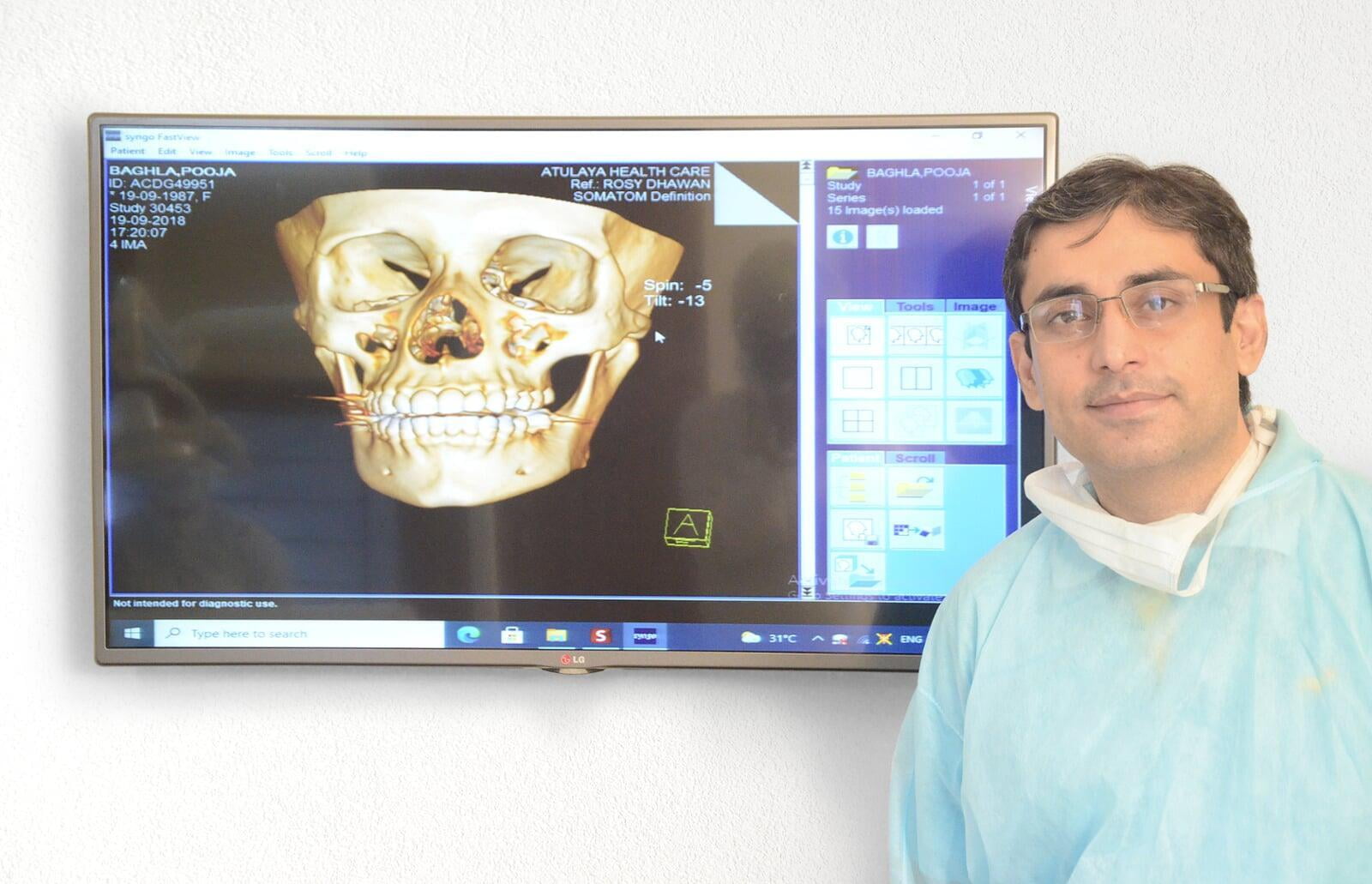
- Imaging as indicated (often including a 3D CBCT scan) to measure bone.
- Discussion of fixed full-arch options versus dentures or staged implants.
- A written outline of steps, healing time and aftercare.
You can also read our dental implants service page. The commercial full-arch service page is implant-supported dentures.
Questions to ask at your consultation
- How much bone do I have, and where?
- How many implants would you recommend for me, and why?
- Would any implants be tilted, and do I need a graft or sinus lift?
- Can I have a temporary fixed bridge soon after surgery, or will I wear a removable temporary?
- What is the bridge made of, and how is it cleaned and maintained?
- What happens if an implant or a screw needs attention later?
Full-arch implants at ADC, Chandigarh
At ADC – Centre for Restorative and Implant Dentistry, full-arch implant treatment is planned by Dr. Mohit Dhawan, MDS (Prosthodontics, Crown and Bridge and Implantology), ITI Fellow, ITI Section India (2026). ADC has placed 6000+ implants. A consultation and 3D scan can show which full-arch approach suits your jaw.
Frequently asked questions
Is All-on-4 only for people with no teeth left?
It is most often planned when an arch has few or no teeth that can be kept in a healthy state. Sometimes remaining teeth are removed as part of the plan if they cannot be kept. That decision is clinical, not automatic.
Can I be a candidate if I already wear dentures?
Yes. Many people who wear removable dentures are assessed for All-on-4 because they want a fixed option. See also dentures vs implants.
Does bone loss stop me from being a candidate?
Not always. Bone is measured carefully. Some people proceed with All-on-4; others need grafting, more implants, or another design.
What is the difference between All-on-4, All-on-6 and All-on-8?
All three are fixed full-arch bridges on implants. They differ mainly in how many implants are used in one jaw, whether the back implants are tilted, and how much bone is needed along the arch.
Is All-on-6 or All-on-8 always preferable to All-on-4?
No. More implants can share the load over more points when the bone allows, especially in some upper jaws. All-on-4 remains a planned option when bone at the back is limited. The scan and examination decide, not the number alone.
Will I have fixed teeth on the day of surgery?
Only in selected cases, and only if the implants are stable enough for a temporary fixed bridge. Otherwise a removable temporary is used while the implants heal. This is decided at planning and on the day, not promised in advance.
How do I look after a full-arch bridge?
Clean daily around and under the bridge as shown, attend review visits, and contact the clinic if the bridge feels loose or the gum becomes sore or swollen.
Book an All-on-4 consultation in Chandigarh
This article is general information, not advice for any individual. If you are comparing All-on-4, All-on-6 and All-on-8, or wondering whether you are a candidate, please contact ADC – Centre for Restorative and Implant Dentistry:
- Book online: Appointment
- Phone: +91-7087800016
- Email: help@theadc.dental
- Clinic: #1197 Sector 21-B, U.T, Chandigarh 160022
References
- Malo P, Rangert B, Nobre M. All-on-Four immediate-function concept with Branemark System implants for completely edentulous mandibles: a retrospective clinical study. Clin Implant Dent Relat Res. 2003 — PubMed 12691645.
- Soto-Penaloza D, Zaragoza-Alonso R, Penarrocha-Diago M, Penarrocha-Diago M. The All-on-Four treatment concept: a systematic review. J Clin Exp Dent. 2017 — PMC5347302.
- American Dental Association, MouthHealthy. Dental implants — mouthhealthy.org.



 International Team for Implantology
 ISO 9001:2015 Certified
 OHSAS Certified
 Academy of Osseo-Integration
 Indian Prosthodontics Society
 Indian Endodontic Society
 Women Implantology Network
 Indian Dental Association






 Sensitivity after a new crown: what is usual and when to call the dentist
 Dental implant after tooth extraction: immediate or delayed placement?
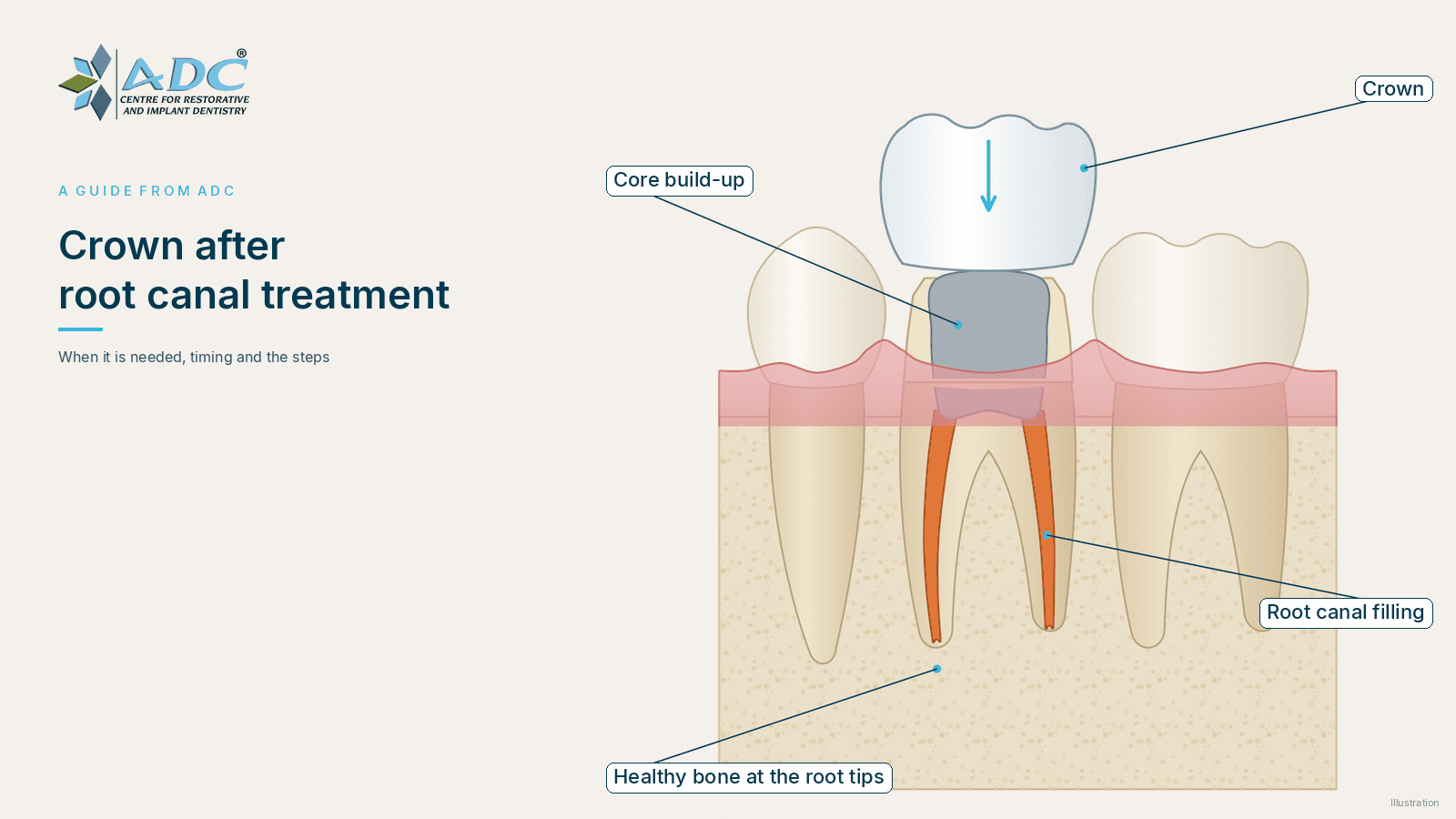 Do you need a crown after root canal treatment?