
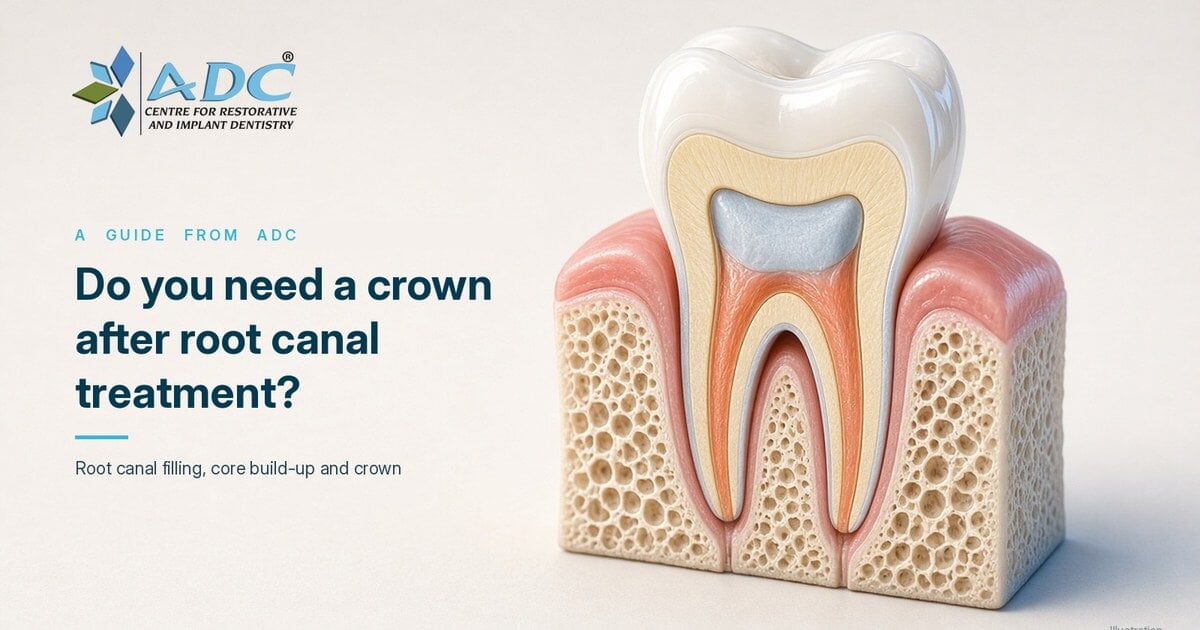
 After root canal treatment, many people are told the tooth will need a crown, and many then ask whether that is always true. The answer depends on the tooth. A crown after root canal treatment is often recommended for back teeth, while some front teeth can be restored with a filling alone. This article explains, in general terms, how dentists make that decision, why timing matters and what the crown process usually involves.
Why a tooth may need extra protection after root canal treatment
Root canal treatment removes inflamed or infected pulp from inside a tooth, then cleans, shapes and seals the canals. The treatment addresses the inside of the tooth. It does not replace tooth structure that has already been lost.
By the time a tooth needs root canal treatment, it has often lost structure to decay, a crack or a large old filling, and the treatment itself needs an opening through the top of the tooth. The walls that remain can be thin. When chewing forces act on a weakened tooth, the cusps can flex and, over time, a crack can develop or part of the tooth can break. The final restoration is chosen to seal the tooth and to protect what remains.
Back teeth: molars and premolars
Molars and premolars do most of the chewing, so they carry heavier, repeated forces. For this reason, a restoration that covers and protects the cusps (known as cuspal coverage) is commonly advised for root-canal-treated back teeth. The European Society of Endodontology's 2021 position statement on restoring root-filled teeth recommends cuspal coverage for premolars and molars in most cases where at least one side wall of the tooth is missing, while keeping the design as conservative as possible.
Cuspal coverage does not always mean a full crown. An onlay covers the cusps but keeps more of the outer tooth when the side walls are sound. When a back tooth has only a small opening, thick walls and no cracks, a bonded filling may occasionally be considered. These decisions are made tooth by tooth.
Front teeth
Front teeth (incisors and canines) usually take lighter forces than back teeth, and their appearance matters more. The American Association of Endodontists advises that if the only tooth structure lost from a front tooth is a small access opening, a bonded tooth-coloured filling can be adequate. If the tooth has been weakened by a large opening, decay or large fillings on its sides, a crown should be considered.
A crown may also be discussed when a front tooth has darkened after treatment, when a person grinds or clenches their teeth, or when the tooth is needed to support a bridge.
What the dentist looks at when deciding
The choice between a crown, an onlay and a filling is based on an examination and, usually, an X-ray. The main factors are:
- How much healthy tooth remains, above and around the gum line.
- How many walls are intact. A missing side wall on a back tooth makes cuspal coverage more likely.
- Cracks. A crack may change the plan, and a deep crack can affect whether the tooth can be restored at all.
- Bite forces, including grinding or clenching.
- Existing fillings and their condition.
- The tooth's role, for example whether it supports a bridge or a partial denture.
Timing: why the final restoration should not be delayed
After root canal treatment, the tooth is usually sealed with a temporary filling. A temporary filling is not designed to last. If it wears or leaks, bacteria from the mouth can find their way back into the cleaned canals, and an unprotected tooth is more likely to crack. The American Association of Endodontists advises that a root-canal-treated tooth should be restored as soon as possible after treatment.
Until the final restoration is in place:
- avoid biting hard on the treated tooth, and avoid very hard or sticky foods on that side
- brush and clean between the teeth as usual, gently around the treated tooth
- contact the clinic if the temporary filling comes out, the bite feels uneven, or pain or swelling increases
What the crown process usually involves
The exact steps vary, but crown treatment after root canal treatment commonly follows this sequence:
- Core build-up. The missing inner part of the tooth is rebuilt with a filling material so that the crown has a stable base.
- A post, only if needed. A post is placed inside a root only when too little tooth is left to hold the core. A post does not strengthen the tooth.
- Preparation. The outer surface is shaped so the crown can fit over it, removing only what the chosen material requires.
- Impression or digital scan of the tooth, its neighbours and the bite.
- Temporary crown to protect the tooth while the final crown is made.
- Fitting. The fit, contacts, colour and bite are checked before the crown is cemented or bonded.
The NHS notes that root canal treatment itself usually takes two or more appointments. The crown stages are further visits, and the sequence is planned with you in advance. Our earlier article on root canal treatment in Chandigarh describes the root canal stages themselves.
At ADC, root canal treatment is usually carried out by Dr. Rosy Dhawan, and crowns are carried out by Dr. Mohit Dhawan.
Crowns, onlays and fillings: an overview
- A full crown covers all the visible surfaces of the tooth. It is typically considered when a large amount of tooth structure has been lost.
- An onlay (partial coverage) covers the cusps and keeps more of the natural outer tooth when the walls are sound.
- A bonded filling seals the access opening and is mainly used where the tooth is largely intact, such as some front teeth.
Crowns and onlays can be made from different materials, including ceramics and metal-ceramic. The material is chosen according to the tooth's position, the bite and appearance. Once fitted, a crown needs the same daily cleaning as natural teeth; see how to care for dental crowns and bridges.
Frequently asked questions
Do I always need a crown after root canal treatment?
No. Many back teeth need a restoration that covers the cusps, which may be a crown or an onlay. Some teeth, particularly front teeth with a small access opening, can be restored with a bonded filling. The decision is made after an examination.
How soon after root canal treatment should the crown be placed?
As soon as it can reasonably be arranged, once the dentist confirms the tooth is ready. A long wait with a temporary filling increases the chance of leakage and of the tooth cracking. Your dentist will advise on the timing for your tooth.
Can I eat normally before the crown is fitted?
Chew on the other side where possible, avoid hard or sticky foods on the treated tooth, and do not use it for heavy biting until the final restoration is in place.
Does a front tooth need a crown after root canal treatment?
Not always. A front tooth with only a small access opening may be restored with a bonded filling. A crown is more likely to be suggested if the tooth has large fillings, has lost a significant amount of structure, is cracked or has darkened.
Will the crown procedure be uncomfortable?
Local anaesthetic is used when needed during preparation. Some people notice mild tenderness of the gum or the bite for a few days afterwards. Contact the clinic if discomfort increases, the bite feels high or a temporary crown comes off.
Booking a consultation
This article is general information, not advice for any individual. Please speak with your dentist about your own situation.
If you have had root canal treatment, or have been told you may need it, and would like to understand the options for your tooth, you are welcome to request a consultation with Dr. Mohit Dhawan or Dr. Rosy Dhawan at ADC – Centre for Restorative and Implant Dentistry, #1197 Sector 21-B, Chandigarh 160022, through the appointment page. Saturday hours are 10:00 AM to 5:00 PM.