
When a tooth is lost, the problem is not only the gap you can see. The bone that used to hold the tooth root also begins to shrink. Over time this jaw bone loss after tooth loss can let neighbouring teeth drift, make dentures loose and make it harder to replace the tooth later. So do dental implants prevent bone loss? They can help, because an implant replaces the root as well as the tooth, which a bridge or a denture resting on the gum does not. This guide explains why the bone shrinks, how implants help, and what can be done if bone has already been lost.
Why does the jaw bone shrink after a tooth is lost?
The part of the jaw that holds the teeth is called the alveolar bone. It exists to support the teeth, and it is kept healthy partly by the forces that pass through the tooth roots when you bite and chew. Once a tooth is removed, the thin bone that lined the socket is resorbed and the ridge becomes narrower and lower. Animal research showed this process in detail (Araújo and Lindhe, 2005), and studies in people have measured it.
Most of this change happens early. In a study that followed single-tooth extraction sites for 12 months, the width of the ridge reduced by about half, and around two-thirds of that reduction happened in the first three months (Schropp and colleagues, 2003). A review of human studies found that both the width and the height of the ridge reduce within the first six months after an extraction (Tan and colleagues, 2012).
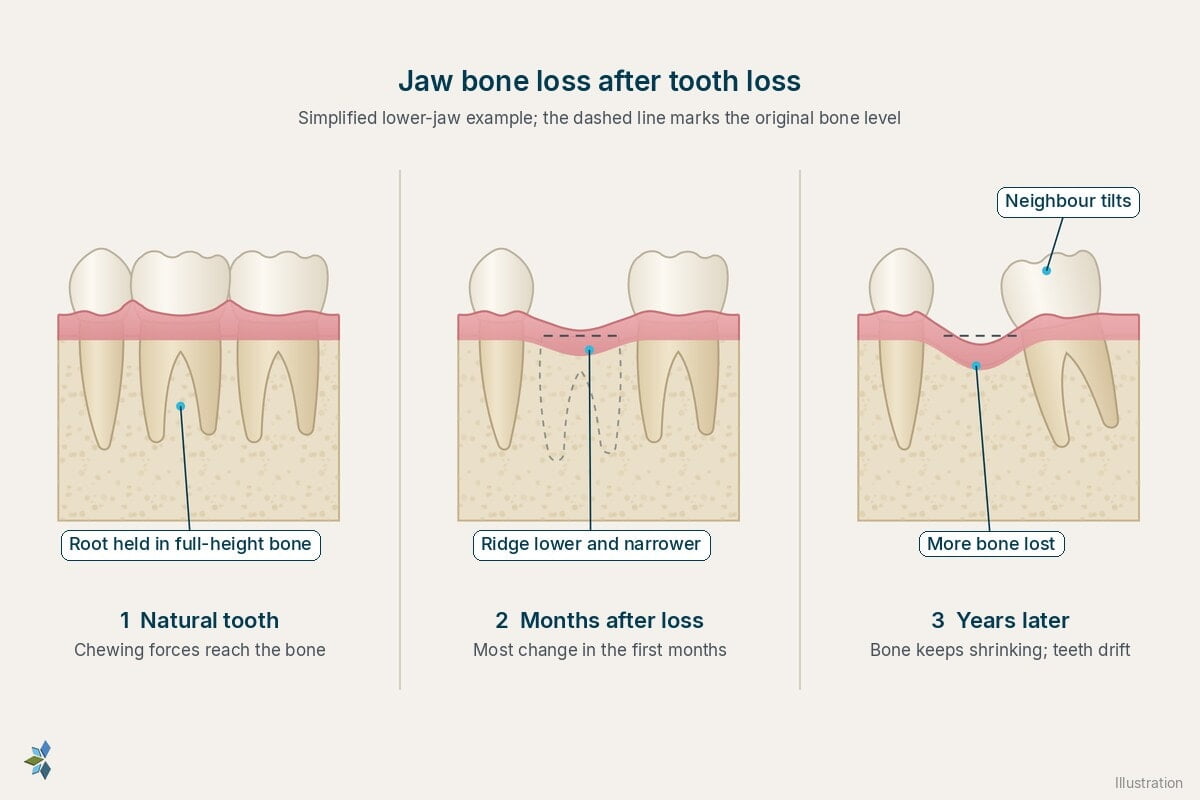
Illustration: how the bone ridge can shrink after a tooth is lost, and how neighbouring teeth can tilt into the gap. Simplified. Not a patient photograph.
What can jaw bone loss lead to?
- Teeth drifting: neighbouring teeth can tilt into the gap, and the tooth opposite the gap can move into the space, which affects the bite and makes cleaning harder.
- Harder tooth replacement later: if too much bone is lost, extra treatment such as bone grafting may be needed before an implant can be placed.
- Loose dentures: without roots to stimulate it, the ridge under a denture continues to reduce over many years, which is one reason dentures can become loose over time (Tallgren, 1972).
- Changes in the face: when several or all teeth are lost, loss of bone and support can make the lips and cheeks look sunken.
You can read more in why replacing lost teeth is important.
Do dental implants prevent bone loss?
A dental implant is a small titanium post placed in the jaw bone where the root used to be. Over the following weeks and months the bone heals in close contact with the implant surface, a process called osseointegration; at ADC this healing usually takes about two to six months, depending on the bone and the site. Read about the stages of dental implant osseointegration.
Once the crown is fitted, the forces of biting and chewing pass through the implant into the bone around it. This can help limit further loss of bone around the implant. It is important to be clear about what an implant can and cannot do:
- An implant helps preserve the bone it sits in; it does not regrow bone that has already been lost.
- A small amount of bone remodelling is normal around implants, especially in the first year.
- Long-term bone health around an implant depends on daily cleaning, avoiding tobacco and regular reviews.
Implants, bridges and dentures: which replace the root?
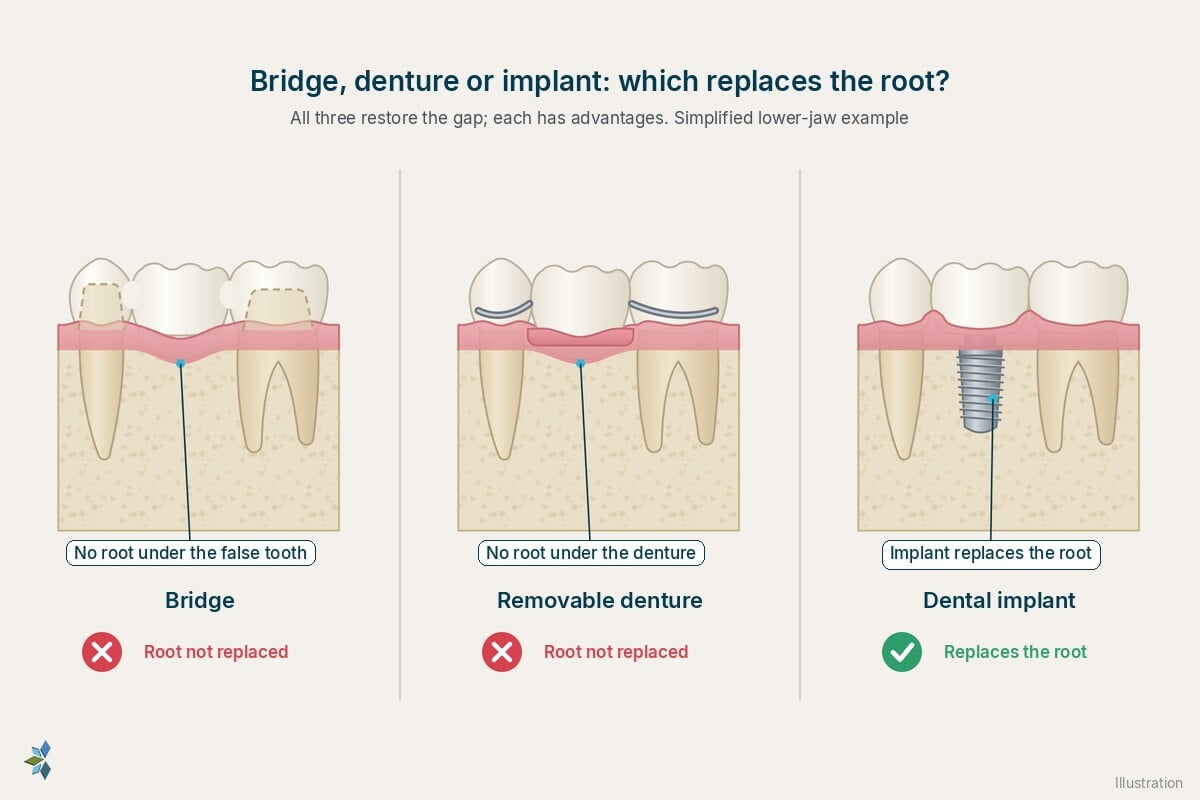
Illustration: a bridge and a denture replace the visible tooth; an implant also replaces the root in the bone. Simplified. Not a patient photograph.
- Bridge: a false tooth is attached to the neighbouring teeth. It restores the gap and the bite, but there is no root under the false tooth, so the bone under it can continue to shrink. The neighbouring teeth are usually reshaped for crowns. A bridge can also be held by implants instead of natural teeth; see our implant-supported bridges article.
- Removable denture: a denture rests on the gum. It is often the simplest and least costly option, but it does not replace the roots, and the ridge underneath continues to reduce over the years. See dentures vs implants: how to choose.
- Dental implant: the implant replaces the root, so chewing forces pass into the bone again. Where several teeth are missing, implants can also support a bridge or hold a denture firmly; see implant-supported dentures.
Each option has advantages, and the right choice depends on your mouth, health, budget and preferences. Your dentist can explain them for your situation; see our tooth replacement page.
Does timing matter?
Yes. Because most bone loss happens in the first months after an extraction, it helps to plan the replacement early, ideally before the tooth is removed. Depending on the site, your dentist may suggest:
- placing the implant at the time of the extraction, in selected cases
- a bone graft in the socket at the time of the extraction (socket or ridge preservation) to limit shrinkage until an implant is placed; see what to expect with bone grafting
- letting the socket heal for a period first and then placing the implant
If you are having a tooth removed, follow our instructions after tooth extraction and ask about replacement options at the same visit.
What if I have already lost bone?
Many people who have had missing teeth for years, worn dentures for a long time or had gum disease can still be assessed for implants, once their gums, general health and medicines have been checked. Your dentist first measures the bone, usually with a 3D CBCT scan. Options may include:
- Bone grafting to rebuild width or height before or during implant placement
- a sinus lift in the upper back jaw, where the sinus limits the bone height; see what to expect during a sinus lift and our sinus lift page
- in some cases, shorter or narrower implants, or an implant-supported bridge or denture planned around the available bone
Read more on our bone loss page and in dental implants with bone loss.
Who is suitable for dental implants?
Most adults in reasonable general health can be considered. Your dentist will check:
- your gums, which should be healthy or treated first
- the amount and quality of bone
- medical conditions and medicines, for example diabetes, which should be well controlled
- smoking and tobacco use, which increase the risk of implant problems; see smoking and dental implants
Keeping the bone healthy around an implant
- Brush twice a day and clean around the implant daily with floss, interdental brushes or a water flosser, as your dentist shows you
- Do not smoke
- Attend regular check-ups and professional cleaning
- Tell your dentist promptly about bleeding, swelling or soreness around an implant, which can be early signs of inflammation
Dental implants at ADC, Chandigarh
At ADC – Centre for Restorative and Implant Dentistry, dental implants are placed by Dr. Mohit Dhawan, and ADC has placed over 6000 dental implants. Treatment is planned with CBCT scans and surgical guides where needed, the Straumann implant system is used, and implant stability is measured with an ISQ device before the final tooth is fitted. Learn more on our dental implants in Chandigarh page, in the complete guide to dental implants and in why Straumann dental implants. For costs, read cost of dental implants. The clinic is in Sector 21, Chandigarh, within easy reach of Mohali, Panchkula and Zirakpur.
For dentists
If you would like to learn more about implant planning, bone and osseointegration, see the ADC Basic Implantology Course and Beyond Osseointegration on the ADC E-Learning Hub.
Frequently asked questions
How soon does bone loss start after a tooth is removed?
It starts within weeks. Most of the change happens in the first few months, which is why it is worth planning the replacement early.
Can a dental implant regrow lost bone?
No. An implant helps preserve the bone around it, but it cannot rebuild bone that has already been lost. If there is not enough bone, grafting may be needed.
Do dentures cause bone loss?
Dentures do not replace the roots, so the ridge under them continues to reduce over the years. Implant-supported dentures can help by passing some of the chewing forces into the bone.
Is it too late for an implant if my tooth was removed years ago?
Not necessarily. A CBCT scan shows how much bone is left, and grafting or other options can often make an implant possible.
How long does an implant take to heal?
The bone usually takes about two to six months to heal around the implant, depending on the bone and the site. Instalment and financing options are available; ask our team for details.
Book an implant consultation in Chandigarh
This article is general information, not advice for any individual. Please speak with your dentist about your own situation. If you have a missing tooth or are worried about jaw bone loss, you are welcome to book a consultation with Dr. Mohit Dhawan at ADC – Centre for Restorative and Implant Dentistry:
- Online booking: ADC Zoho Bookings
- Phone: +91-708-780-0016
- Email: help@theadc.dental
- Clinic: ADC- Centre for Restorative and Implant Dentistry, 1197, Sector 21B, Sector 21, Chandigarh, 160022, India
Mon–Fri 10:00 AM–6:30 PM; Sat 10:00 AM–5:00 PM; Sunday closed. You can also request a consultation online.
Reviewed by Dr. Mohit Dhawan, MDS (Prosthodontics, Crown & Bridge and Implantology).
References
- Araújo MG, Lindhe J. Dimensional ridge alterations following tooth extraction. An experimental study in the dog. J Clin Periodontol. 2005 — PubMed 15691354
- Schropp L, Wenzel A, Kostopoulos L, Karring T. Bone healing and soft tissue contour changes following single-tooth extraction: a clinical and radiographic 12-month prospective study. Int J Periodontics Restorative Dent. 2003 — PubMed 12956475
- Tan WL, Wong TL, Wong MC, Lang NP. A systematic review of post-extractional alveolar hard and soft tissue dimensional changes in humans. Clin Oral Implants Res. 2012 — PubMed 22211303
- Tallgren A. The continuing reduction of the residual alveolar ridges in complete denture wearers: a mixed-longitudinal study covering 25 years. J Prosthet Dent. 1972 — PubMed 4500507
- Cleveland Clinic. Dental bone graft — clevelandclinic.org