Being told that you have “bone loss” can make dental implants sound impossible.
A common question patients ask is, “If I don’t have enough bone, does that mean I can’t get an implant?”
Not necessarily.
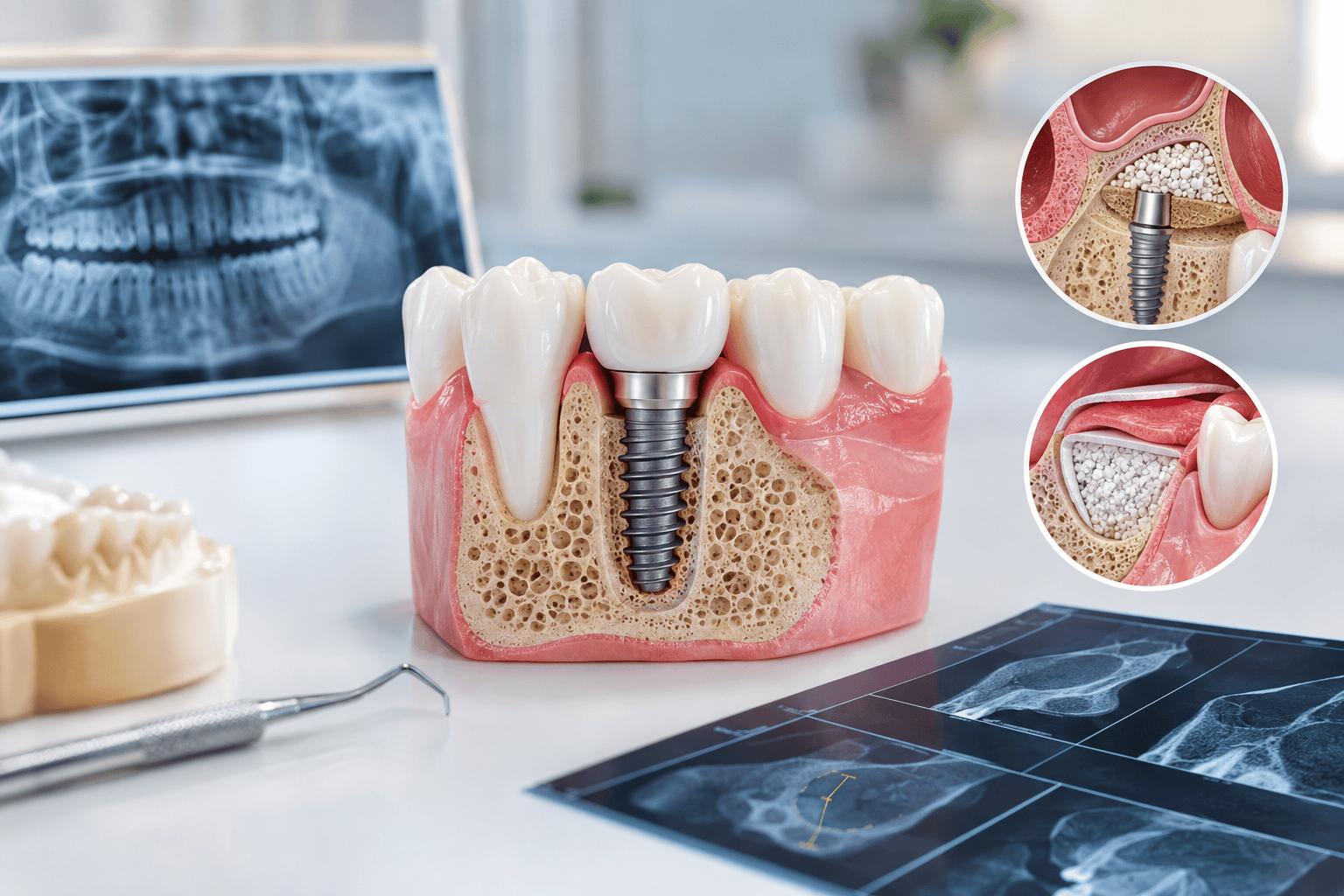
Dental implants need enough healthy jawbone around the planned implant site to provide stability. When some of that bone has been lost, your treatment plan may need an additional step to rebuild the area before, or sometimes at the same time as, implant placement. Depending on where the bone is missing and how much has been lost, this may involve bone grafting, guided bone regeneration or a sinus lift.
The important thing is that “bone loss” is not a treatment plan by itself. The amount, location and quality of the remaining bone need to be assessed before deciding what can be done.
Why does bone loss happen?
Jawbone does not simply disappear for no reason. There is usually a history behind it.
One of the most common situations is losing a tooth and leaving the area without a replacement for some time. After a tooth is removed, the bone that once supported its root can gradually reduce in volume.
Bone loss can also be associated with gum disease, previous infection, trauma, earlier surgery or other changes in the jaw. In the upper back part of the mouth, the natural position and size of the sinus can also limit the amount of bone available for an implant. ADC specifically notes tooth extraction-related resorption, severe gum-related bone loss and a large sinus or thin jawbone among situations where additional bone may be needed.
This is why two people who have both lost a tooth may end up with completely different implant plans.
Does bone loss mean you cannot have an implant?
Usually, the answer is not automatically.
The real question is whether there is enough bone in the right position to support an implant safely and restore the tooth properly.
A dental implant is placed into the jawbone and acts as an artificial tooth root. Because of that, the dentist needs to understand the available bone before placing it. Your overall oral health, gums, remaining teeth, bite and the condition of the treatment area also matter.
Sometimes there is enough bone for the implant as it is.
Sometimes only a small amount of additional bone is needed.
And in more advanced cases, the area may need to heal after a larger graft before the implant can be placed.
So rather than asking, “Do I have bone loss?”, it is more useful to ask:
“Do I have enough bone at the exact site where the implant needs to go?”
How do dentists find out?
This is where proper treatment planning becomes important.
A clinical examination and dental X-rays are commonly used during the initial assessment. In some cases, a CBCT scan may be advised because it provides three-dimensional information about the jaw and surrounding anatomy. The International Team for Implantology identifies CBCT as the imaging tool of choice for 3D assessment of an implant site, while also emphasizing that its use should be based on the individual patient's needs after clinical examination.
A detailed assessment can help the dentist understand:
- how much bone is available
- the width and height of the ridge
- the position of nearby structures
- the relationship of the upper back teeth to the sinus
- whether grafting is required
- whether the implant can be placed immediately or needs a separate healing phase
This is one reason an implant consultation should be about planning, not simply choosing an implant brand.
What is bone grafting?
Think of bone grafting as rebuilding an area that does not currently provide enough bone for the planned implant.
A graft does not simply act like a permanent block that replaces your jawbone. Depending on the technique and material used, it creates a framework or adds bone volume that allows new bone to develop in the treatment area. There are different grafting approaches, and the choice depends on the amount of bone missing and the anatomy of the site.
For dental implants, your dentist may discuss procedures such as guided bone regeneration, ridge augmentation or other forms of bone grafting.
The treatment is therefore not the same for everyone.
A person with a small area of bone deficiency may need a relatively limited procedure, while someone with substantial bone loss may need a more involved approach and a longer healing period.
What is a sinus lift?
A sinus lift is a different procedure, although it also relates to creating enough bone for a dental implant.
It is mainly used in the back part of the upper jaw, where the maxillary sinus can leave limited bone height after the loss of upper premolar or molar teeth.
During the procedure, the sinus lining is gently lifted and bone-grafting material is placed underneath it, creating additional space for bone in the area where an implant may later be supported. A sinus lift can be carried out before implant placement or, in selected situations, at the same time as the implant.
In simple terms:
Bone grafting can be used to rebuild deficient jawbone in different areas.
A sinus lift is a specific procedure used when the sinus limits available bone in the upper back jaw.
They are related, but they are not exactly the same thing.
Will I need the bone graft before the implant?
That depends on the amount and location of the missing bone.
In some cases, a small graft can be performed at the time of implant placement.
When more substantial augmentation is required, the graft may need time to heal before the implant is placed. Patient guidance from Cambridge University Hospitals notes that more extensive grafting may be carried out at least four months before implant placement, while other hospital guidance describes typical healing periods of several months depending on the procedure.
There is therefore no single “bone graft waiting period” that applies to everyone.
Your dentist should explain:
what is being grafted, why it is needed, how much healing is expected and when the implant can be placed.
Can the implant and graft be done together?
Sometimes, yes.
If there is enough existing bone to provide initial stability, grafting and implant placement may be possible during the same surgical appointment.
In other situations, there is not enough bone to safely stabilise the implant at that stage. The area may need to be rebuilt first and allowed to heal before implant placement. The American Association of Oral and Maxillofacial Surgeons describes both approaches in implant reconstruction, depending on the amount and type of bone deficiency.
That distinction is important because patients often hear about someone who “got an implant and bone graft on the same day” and assume the same approach should work for them.
It may not.
Implant treatment has to be planned around your anatomy, not someone else's timeline.
What if I have severe bone loss?
Even significant bone loss does not always mean that tooth replacement is impossible.
Depending on the situation, a dentist may discuss different approaches, which can include bone reconstruction, alternative implant designs, bridges, dentures or other treatment options. Hospital guidance for implant patients also lists alternatives such as bridges and dentures when conventional implant placement is not suitable.
The right choice depends on factors such as the condition of the remaining teeth, gum health, available bone, bite, overall health and what you want to achieve.
This is why a good consultation should include alternatives, rather than making the discussion only about implants.
Is bone grafting painful?
Bone grafting is a surgical procedure, so some discomfort, swelling or bruising can occur during recovery.
The exact recovery experience depends on the type and extent of the procedure. Cambridge University Hospitals lists swelling, bruising, pain and bleeding among possible effects, while also explaining that more serious complications are less common. Smoking can also increase the risk of graft failure.
Your dentist should give you specific aftercare instructions for eating, cleaning the area, medication, activity and follow-up appointments.
What if I was told “you don't have enough bone”?
Don't assume that means your implant journey is over.
Instead, ask the dentist a few practical questions:
Where exactly is the bone missing?
How much bone is available now?
Do I need a bone graft or a sinus lift?
Can the implant be placed at the same time?
How long is the expected healing period?
What alternatives do I have if I don't choose grafting?
These questions can give you a much clearer picture of your treatment instead of leaving you with the vague statement that you “don't have enough bone.”
Dental implants with bone loss in Chandigarh
If you are considering dental implants in Chandigarh and have previously been told that you have bone loss, the next step is a proper implant assessment rather than assuming you are not a candidate.
ADC – Centre for Restorative and Implant Dentistry lists bone grafting andsinus lift procedures as part of its implant-related treatment services. The practice also lists Dr. Mohit Dhawan's areas of expertise as minimally invasive dental implant surgery and computer-guided dental implant surgery.
The useful question is not simply whether an implant is possible.
It is what your particular bone condition allows, what preparation is necessary, and which treatment option makes sense for your mouth.
Frequently asked questions
Can I get dental implants if I have bone loss?
Possibly. Bone loss does not automatically rule out dental implants. If there is insufficient bone, grafting or another treatment approach may be considered before implant placement.
Is a sinus lift the same as a bone graft?
No. A sinus lift is a specific procedure used to create more bone height in the back of the upper jaw by lifting the sinus lining and placing graft material underneath it.
Does everyone with bone loss need a bone graft?
No. Some patients have enough bone for implant placement without grafting, while others may need limited or extensive augmentation. The decision is based on individual anatomy and treatment planning.
How long does bone grafting take to heal?
Healing varies according to the procedure, the amount of grafting required and the individual patient. More extensive grafting can require several months before implant placement.
Can a sinus lift and dental implant be done together?
In selected cases, yes. When there is enough existing bone to obtain initial implant stability, implant placement may be performed at the same time as sinus augmentation. In other cases, the graft needs to heal first.
Final thought
Being told that you have bone loss can sound like a dead end, but it is really the beginning of a more detailed treatment-planning discussion.
Some patients can receive an implant without additional procedures. Others may need bone grafting, a sinus lift or a different restorative option.
What matters is knowing how much bone you have, where it is missing and what can be done safely in that particular area.
A proper clinical examination and appropriate imaging can help determine the available options. This article is intended for general education and does not replace an examination or personalised advice from a qualified dental professional.
Practice: ADC – Centre for Restorative and Implant Dentistry, Chandigarh