How long does a root canal last? It is one of the first questions people ask once they are told a tooth needs root canal treatment. There is no fixed expiry date. A tooth that has been treated well, sealed properly and protected with a suitable filling or crown can often last for many years, and many last for life. How long yours lasts depends on the tooth, the treatment, the restoration on top and how the tooth is looked after. This guide explains what affects the lifespan of a root-canal-treated tooth, why the crown matters, the signs that a root canal may be failing and what can be done if it does.
If you are still deciding whether you need treatment, start with do I need a root canal? how dentists decide. For what happens at each visit and how to choose a clinic, see our guide to root canal treatment in Chandigarh.
What root canal treatment does
Inside every tooth is the pulp, a soft tissue with nerves and blood vessels. Deep decay, a crack, a knock to the tooth or repeated dental work can let bacteria reach the pulp, which then becomes inflamed or infected. In root canal treatment the dentist removes the damaged pulp, cleans and shapes the canals, disinfects them and fills them, usually with a rubber-like material called gutta-percha and a sealer. The opening in the tooth is then sealed and the tooth is rebuilt with a filling or a crown.
The tooth no longer has a living pulp, but it stays in the bone, held by its own root and gum, and can keep working like your other teeth. For the full sequence, read what happens during a root canal, step by step.
How long does a root canal last?
Most root-canal-treated teeth last a long time. A systematic review of tooth survival after root canal treatment found that most treated teeth were still in place when they were checked several years later. These are averages from research studies, not a promise for any one tooth, and they say nothing about how long the crown or filling on top will last.
In practice, a root canal can last for many years and often for life when:
- the canals were cleaned and sealed well, close to the root tip
- the tooth was rebuilt soon afterwards with a well-fitting restoration
- enough healthy tooth structure remains
- the gums and bone around the tooth stay healthy
What does "root canal success rate" mean?
You may see a "root canal success rate" quoted online. Studies measure two different things. Success usually means the infection has healed: the tooth is comfortable and the bone around the root tip looks healthy on an X-ray. Survival simply means the tooth is still in the mouth. Survival figures tend to be higher than strict success figures, and both vary between studies, teeth and patients. Your dentist can tell you how your own tooth is likely to do after looking at it and its X-rays.
What affects how long a root canal lasts?
How well the canals were cleaned and sealed
The aim is to remove as much infected tissue and bacteria as possible and then seal the canals so bacteria cannot get back in. Teeth with curved, narrow or extra canals are harder to treat, which is one reason some back teeth take longer.
The crown or filling on top
This is one of the biggest factors. A root canal seals the inside of the tooth, but the restoration seals the top. If the temporary filling is left too long, or the final restoration leaks, bacteria can reach the root filling again. Research has linked crown placement with better long-term survival of root-canal-treated back teeth. Read more in do you need a crown after root canal treatment?
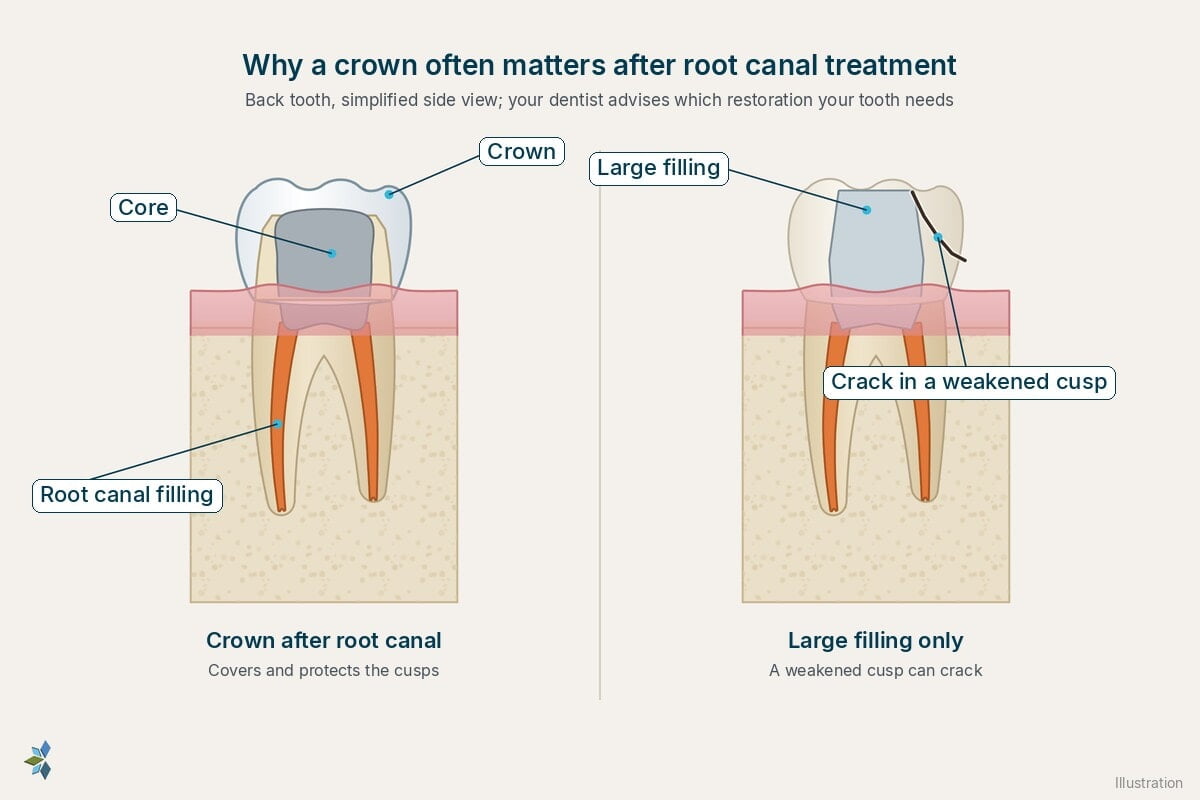
Illustration: a root-canal-treated back tooth protected by a crown, and one with a large filling where a weakened cusp has cracked. Simplified side view. Not a patient photograph.
Which tooth it is and how hard you bite
Molars and premolars take most of the chewing force, so they are more likely to crack if they are not protected. Front teeth with little missing structure can sometimes be restored with a filling alone. Clenching or grinding adds extra load; if you grind your teeth, ask about bruxism and night guards.
How much tooth is left
Large old fillings, deep decay or cracks leave thinner walls. A tooth with very little structure left may need a core build-up and a crown, and in some cases the dentist may advise that it cannot be restored reliably. Cracks are covered in cracked tooth treatment in Chandigarh.
Gum health, daily care and general health
A treated tooth can still get new decay at the edge of a crown or filling, and it can still be lost to gum disease. Smoking and some medical conditions, such as poorly controlled diabetes, may slow healing. Brushing, cleaning between the teeth and regular check-ups protect the tooth and its restoration.
Crown after root canal: how long does the crown last?
The lifespan of the crown and the lifespan of the tooth are not the same thing. A crown can wear, chip or develop decay at its edge over the years and may need replacing, while the root-canal-treated tooth underneath stays healthy. At your check-ups the dentist looks at the crown edges, your bite and the X-rays, so that a crown can be replaced before a leak affects the root filling. The crowns and bridges page explains the options.
Root canal failure signs
Most treated teeth settle well. Mild tenderness for a few days after treatment is common and is not a sign of failure. Contact your dentist if you notice:
- pain or tenderness on biting that does not settle, or comes back months or years later
- swelling of the gum or face near the treated tooth
- a small pimple-like bump on the gum, which may release pus or a bad taste
- a crown or filling that feels loose, has a gap, or has broken
- a crack or a piece breaking off the tooth
Some problems cause no symptoms and are only found on an X-ray, which is another reason to keep up with check-ups.
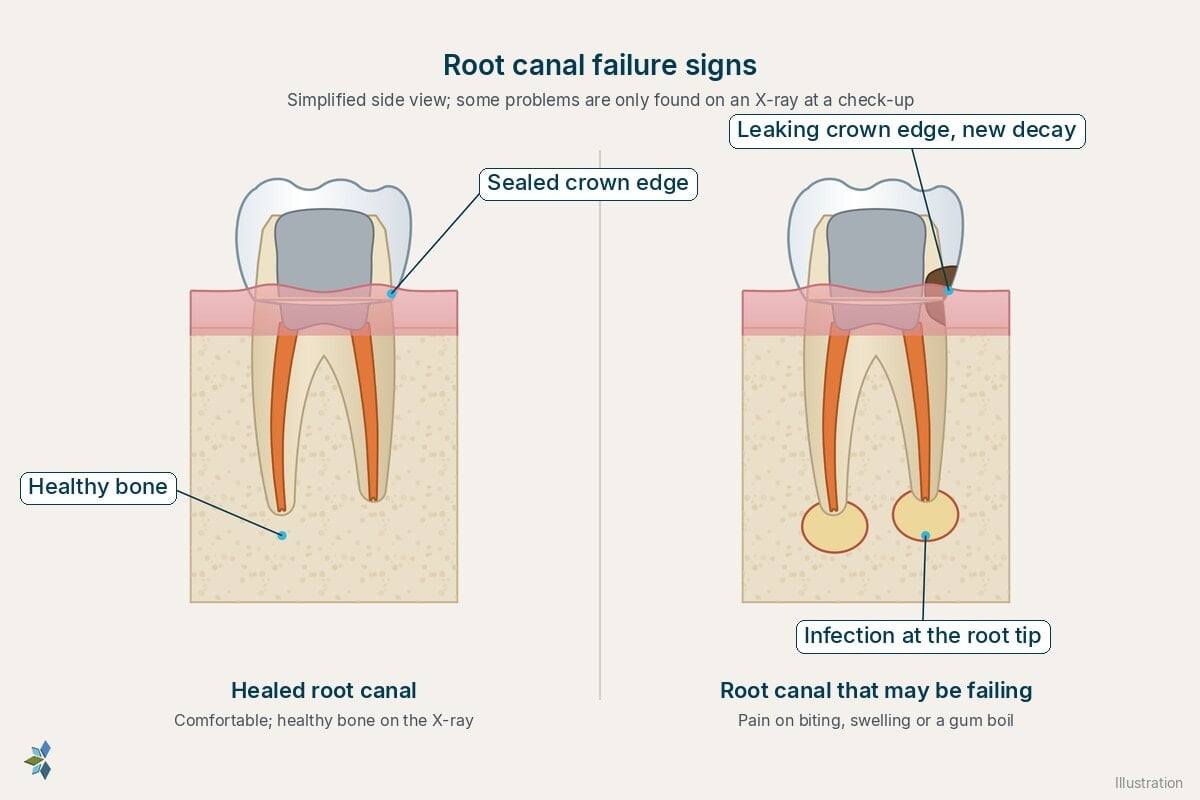
Illustration: a healed root canal compared with one where a leaking crown edge has let bacteria back in and an infection has formed at the root tip. Simplified side view. Not a patient photograph.
What can be done if a root canal fails?
A root canal that has problems can often still be saved. Your dentist will explain the options for your tooth:
- Root canal retreatment: the old filling is removed, the canals are cleaned again and resealed, and the tooth is restored. Read root canal retreatment: when is it necessary?
- Apicoectomy (root-end surgery): in selected cases, the infected tissue and the very tip of the root are removed through the gum and the end of the canal is sealed.
- Extraction and replacement: if the tooth is badly cracked or cannot be restored, it may need to be removed. A dental implant, bridge or denture can then be considered; see how to replace a missing tooth after extraction.
How to help your root canal last
- Have the final filling or crown placed when your dentist advises, and do not leave a temporary filling in place for longer than planned.
- Chew on the other side until the tooth is fully restored, and follow your instructions after root canal treatment.
- Avoid biting very hard things such as ice, hard sweets, nut shells or bones with the treated tooth.
- Brush twice a day with a fluoride toothpaste and clean between your teeth every day.
- Wear a night guard if your dentist advises one for grinding.
- Keep up with regular check-ups and X-rays when your dentist recommends them.
Root canal treatment and crowns at ADC, Chandigarh
At ADC, root canal treatment is usually carried out by Dr. Rosy Dhawan, MDS (Conservative Dentistry and Endodontics), and crowns are carried out by Dr. Mohit Dhawan, MDS (Prosthodontics). Planning the root canal and the restoration together helps the tooth get the protection it needs. You can read more on our root canal treatment page, and if you are worried about discomfort, read is root canal treatment painful?
Frequently asked questions
How long does a root canal last?
There is no fixed number. With a good seal and a well-fitting restoration, a root-canal-treated tooth can last for many years and often for life. Research reviews report that most treated teeth are still in place years later.
Can a root canal last a lifetime?
Yes, many do. The chances are better when the tooth is restored promptly, has enough healthy structure left, and the gums and the restoration are looked after.
Do I need a crown after a root canal?
Back teeth usually benefit from a crown or another restoration that covers the cusps, because they take heavy chewing forces. Some front teeth can be restored with a filling. Your dentist will advise after checking how much tooth is left.
How long does a crown after a root canal last?
It varies with the material, your bite and your oral hygiene. A crown may need replacing at some point even when the tooth underneath is healthy. Regular check-ups help catch a worn or leaking crown early.
Can a root canal fail years later?
It can, though it is not common. New decay, a leaking or broken restoration, a crack, or bacteria left in a hard-to-reach canal can cause a problem years after treatment. Many of these teeth can be retreated.
Is a root-canal-treated tooth weaker?
The treatment itself does not make the root weak, but the decay, old fillings and the access opening remove tooth structure. That is why a treated back tooth is usually protected with a crown.
Book a root canal consultation in Chandigarh
If you have had root canal treatment and something does not feel right, or you have been told a tooth may need treatment, a consultation at ADC – Centre for Restorative and Implant Dentistry can check the tooth, its restoration and the X-rays, and explain your options. ADC is in Sector 21, Chandigarh, within easy reach of Mohali, Panchkula and Zirakpur. Book with Dr. Mohit Dhawan's team:
- Online booking: ADC Zoho Bookings
- Phone: +91-708-780-0016
- Email: help@theadc.dental
- Clinic: 1197, Sector 21B, Sector 21, Chandigarh 160022
Mon–Fri 10:00 AM–6:30 PM; Sat 10:00 AM–5:00 PM; Sunday closed.
Reviewed by Dr. Mohit Dhawan.
References
- NHS. Root canal treatment — nhs.uk
- American Dental Association, MouthHealthy. Root canals — mouthhealthy.org
- Ng YL, Mann V, Gulabivala K. Tooth survival following non-surgical root canal treatment: a systematic review of the literature. Int Endod J. 2010 — PubMed 20158529
- Aquilino SA, Caplan DJ. Relationship between crown placement and the survival of endodontically treated teeth. J Prosthet Dent. 2002 — PubMed 11941351




 International Team for Implantology
 ISO 9001:2015 Certified
 OHSAS Certified
 Academy of Osseo-Integration
 Indian Prosthodontics Society
 Indian Endodontic Society
 Women Implantology Network
 Indian Dental Association






 Sensitivity after a new crown: what is usual and when to call the dentist
 Dental implant after tooth extraction: immediate or delayed placement?
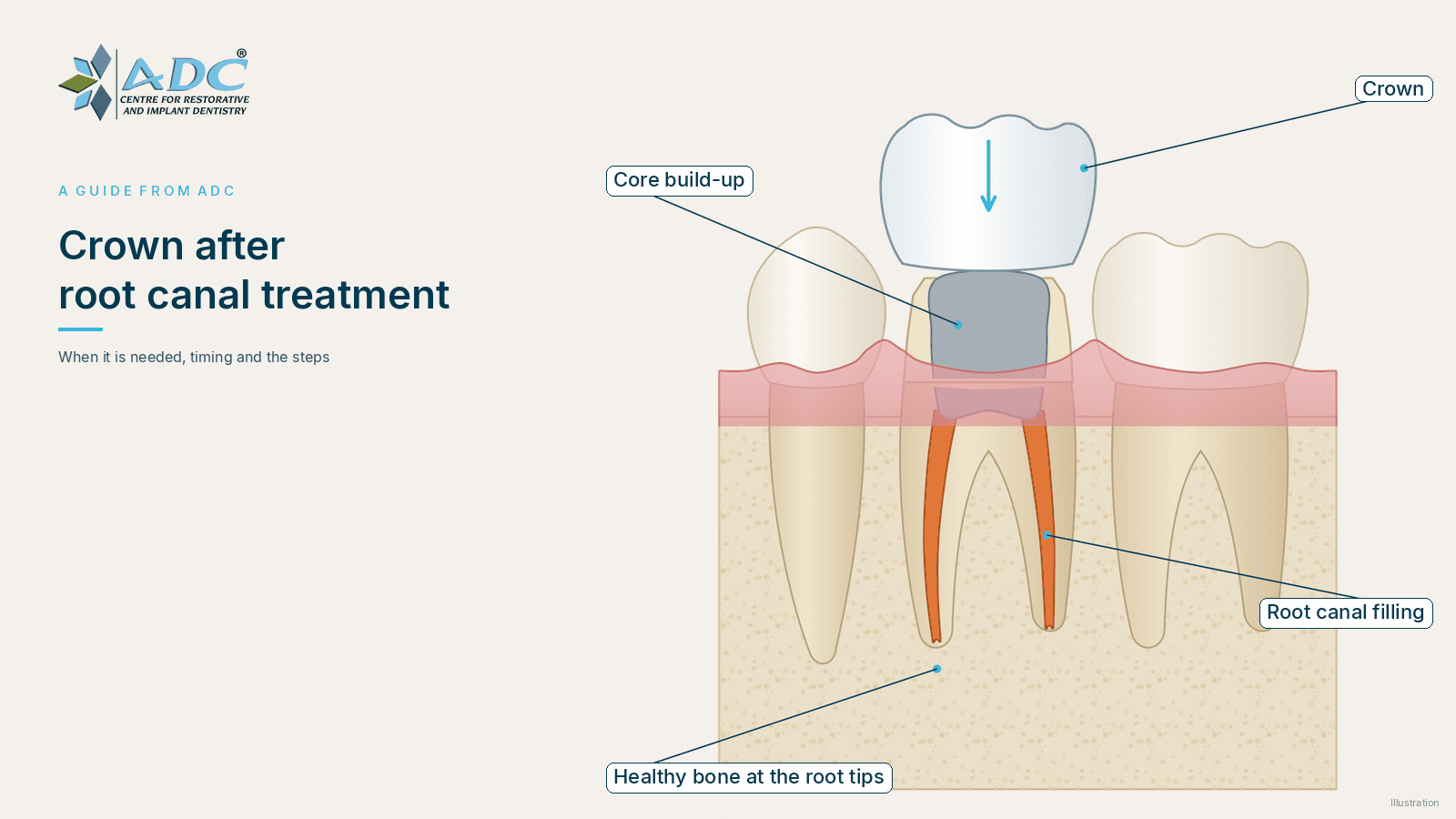 Do you need a crown after root canal treatment?