Reviewed by Dr. Mohit Dhawan, MDS (Prosthodontics, Crown and Bridge and Implantology).
This article sets out the pros and cons of laser root canal therapy: what a laser adds, what the evidence shows, and what a laser does not change.
What a laser adds to root canal treatment
Laser root canal treatment usually means a standard root canal with one extra step: a thin laser fibre or tip is used inside the cleaned canals to help disinfect them. The laser does not replace the files and rinsing solutions that do most of the work. It is an add-on that some dentists use for selected teeth.
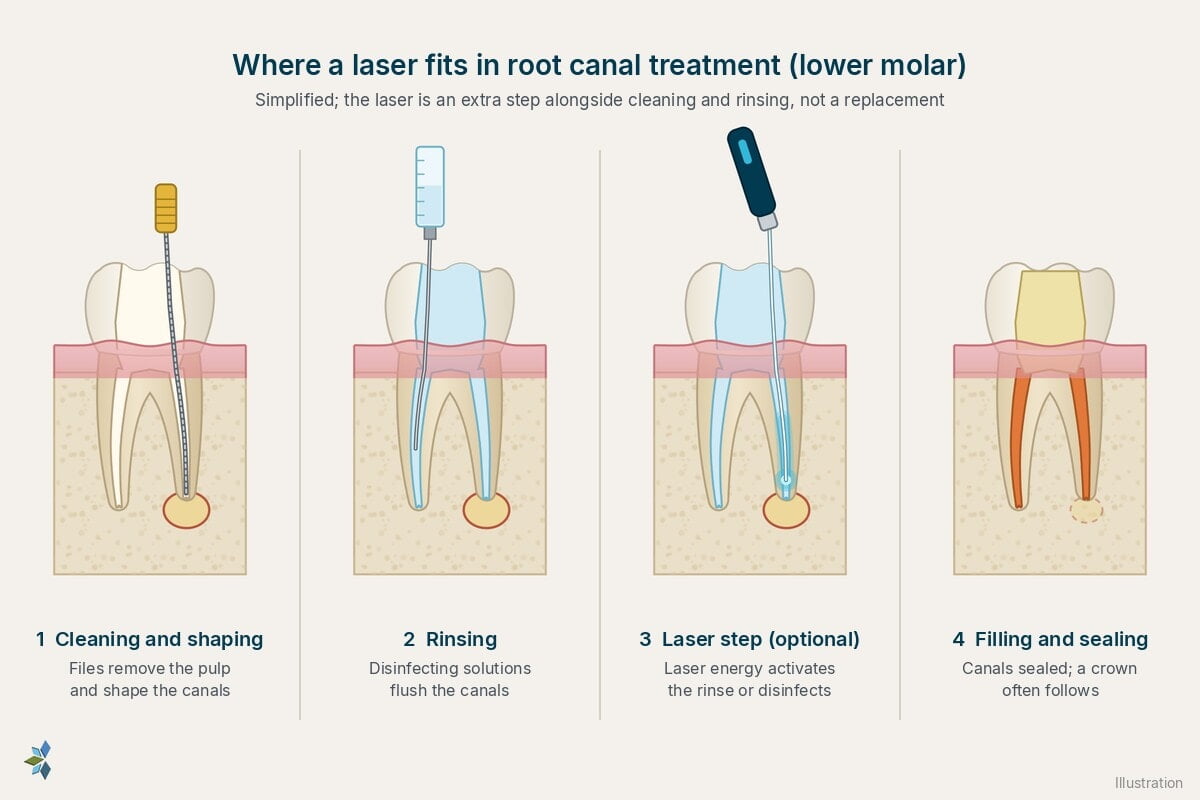
Root canal treatment removes infected or inflamed pulp, cleans and shapes the canals, disinfects them and then seals them so bacteria are less likely to return. In laser-assisted treatment, laser energy is added during the disinfection stage, in one of two ways:
- Laser-activated irrigation: the laser tip sits in the rinsing solution and helps the solution move through the canal, including into narrow spaces.
- Direct canal irradiation: a thin fibre is passed down the canal and moved slowly as it is withdrawn, to act on bacteria on the canal walls.
Different lasers may be used, such as diode, Nd:YAG and Er:YAG lasers. The choice depends on the equipment and the dentist's training.
If you are still unsure whether you need a root canal, start with do I need a root canal? How dentists decide. For the treatment in plain steps, read what happens during a root canal, step by step.
Why disinfection matters
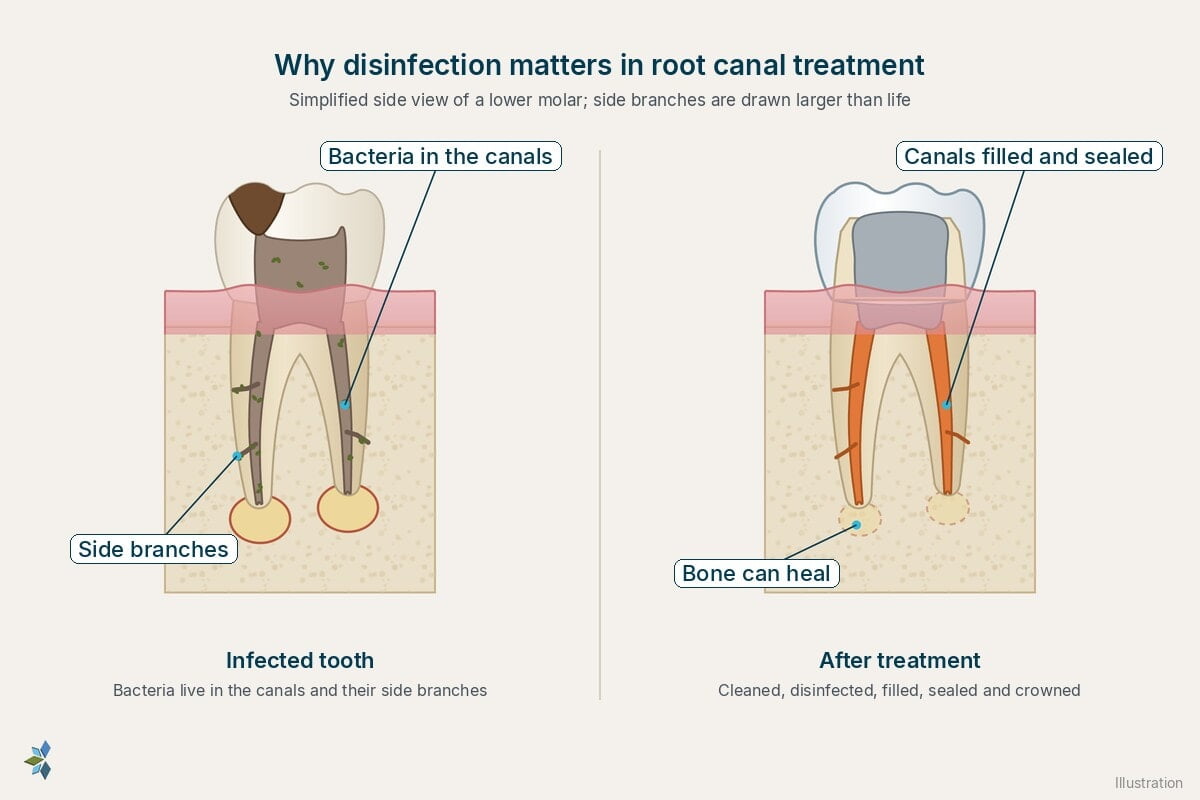
The main canals have small side branches and many tiny tubes in the dentine. Bacteria can live in these spaces, where files cannot reach. Most of the cleaning is done by rinsing solutions such as sodium hypochlorite. A laser step, when it is used, is intended to help that disinfection, not to stand in for it.
What the evidence shows, and what a laser does not change
Research on lasers in root canal treatment is still developing. Laboratory studies on extracted teeth suggest that laser-activated rinsing can improve the removal of debris in some canal spaces. Clinical studies report mixed results, and a laser step is not required for every tooth.
A laser does not change the following:
- The tooth still needs local anaesthetic. The laser does not make injections unnecessary. Modern local anaesthesia keeps most root canal visits comfortable.
- Some soreness afterwards is still usual. Tenderness when biting for a few days is common after any root canal.
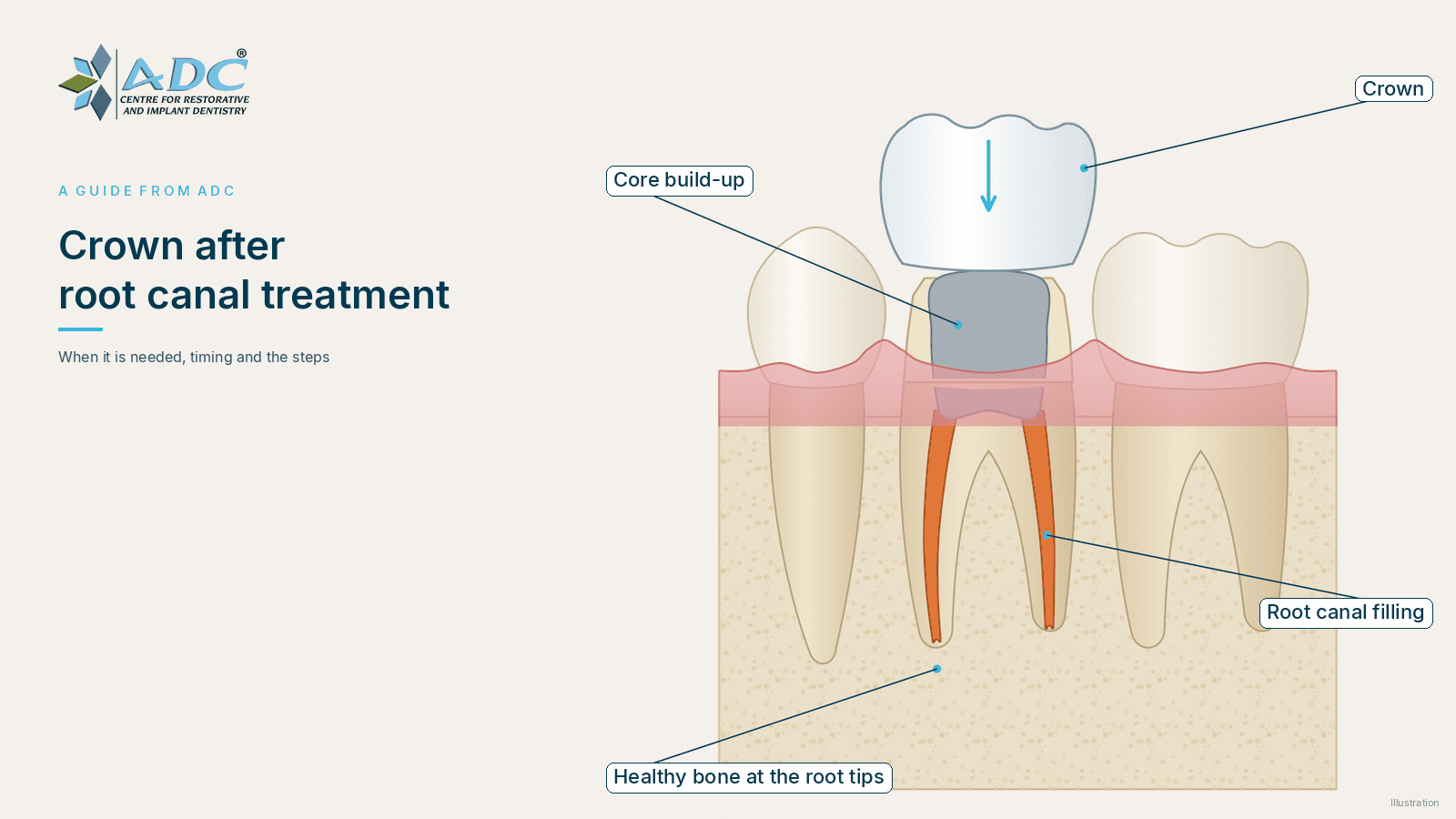
- A crown may still be needed afterwards to protect the tooth. See do you need a crown after root canal treatment?
The laser root canal process, step by step
- Examination and X-rays. The dentist checks the tooth and takes X-rays, and sometimes a CBCT (3D) scan, to see the roots and any infection.
- Local anaesthetic and isolation. The tooth is numbed and is usually isolated with a rubber sheet (dental dam) to keep it clean and dry.
- Access, cleaning and shaping. An opening is made in the tooth. Files and rinsing solutions clean and shape the canals.
- Laser disinfection, when it is used. A thin fibre or tip is used in the canals as an extra disinfection step, either to activate the rinse or to irradiate the canal walls.
- Filling and a temporary or final restoration. The canals are sealed. A temporary filling may be placed, or a core and crown may be planned.
The number of visits varies with the tooth and the infection. Ask your dentist how many visits to expect in your case.
Who may benefit from a laser step
A dentist may suggest a laser step for teeth with complex canals, for long-standing infection, or for a tooth being treated again after an earlier root canal. Read more about root canal retreatment. For other teeth, thorough cleaning and rinsing without a laser is often enough. The decision is individual.
Questions to ask before treatment
- Does this tooth need a root canal, or are there other options?
- How many visits will it take?
- Will a laser or another activation method be used for this tooth, and why?
- Will I need a crown afterwards?
- What should I expect in the first few days?
Root canal treatment at ADC, Chandigarh
At ADC – Centre for Restorative and Implant Dentistry, root canal treatment, including laser-assisted root canal treatment, is usually carried out by Dr. Rosy Dhawan, MDS (Conservative Dentistry and Endodontics). Crowns after root canal treatment are planned by Dr. Mohit Dhawan, MDS (Prosthodontics, Crown and Bridge and Implantology). The service page is root canal treatment.
Frequently asked questions
Is laser root canal treatment safe?
When it is used by a trained dentist, with the right settings and with the tooth isolated, a laser step is an accepted add-on to standard root canal treatment. As with any dental procedure, it must be used with care so that heat does not harm the tooth or nearby tissue. Your dentist will decide whether it is suitable for your tooth.
Does a laser replace ordinary root canal cleaning?
No. Files and rinsing solutions still do most of the cleaning. The laser, when used, is an extra disinfection step.
Will I be comfortable during the visit?
Root canal treatment is done under local anaesthetic. Most people feel pressure rather than pain during the visit. Some tenderness afterwards is still usual, with or without a laser step.
Does a laser-assisted root canal smell unusual?
Some people notice a brief warm or burnt smell if the laser is used on tissue. This is a known effect of the laser and does not, on its own, mean that something has gone wrong. Tell the dentist if it bothers you.
Book a root canal consultation in Chandigarh
This article is general information, not advice for any individual. If you have tooth pain or have been told you need a root canal, please contact ADC – Centre for Restorative and Implant Dentistry:
- Book online: Appointment
- Phone: +91-7087800016
- Email: help@theadc.dental
- Clinic: #1197 Sector 21-B, U.T, Chandigarh 160022
References
- NHS. Root canal treatment — nhs.uk
- American Dental Association, MouthHealthy. Root canals — mouthhealthy.org
- Meire MA, Bronzato JD, Bomfim RA, Gomes BPFA. Effectiveness of laser-assisted irrigation in endodontics: a systematic review. Int Endod J. See PubMed 36156804.




 International Team for Implantology
 ISO 9001:2015 Certified
 OHSAS Certified
 Academy of Osseo-Integration
 Indian Prosthodontics Society
 Indian Endodontic Society
 Women Implantology Network
 Indian Dental Association






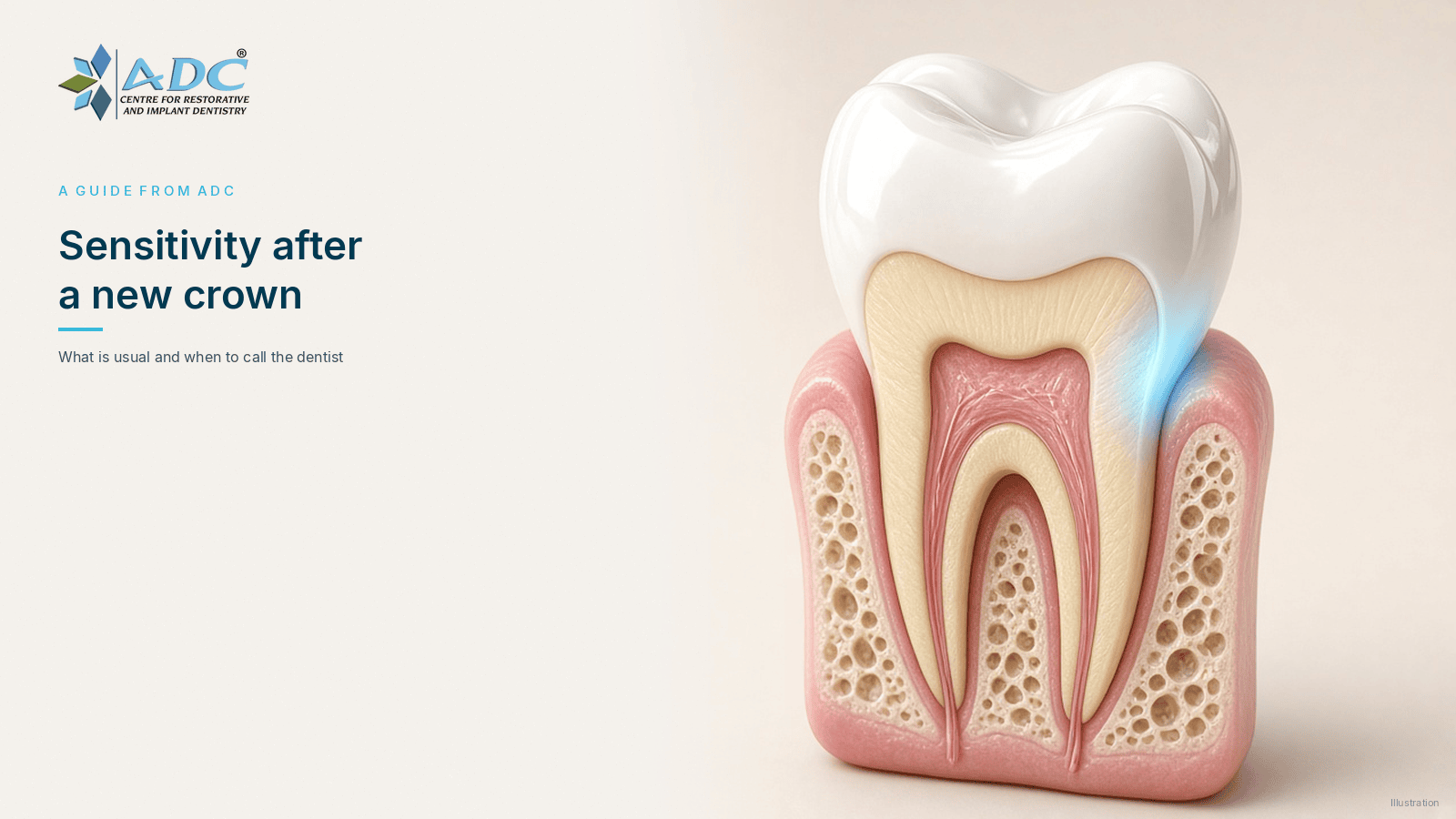 Sensitivity after a new crown: what is usual and when to call the dentist
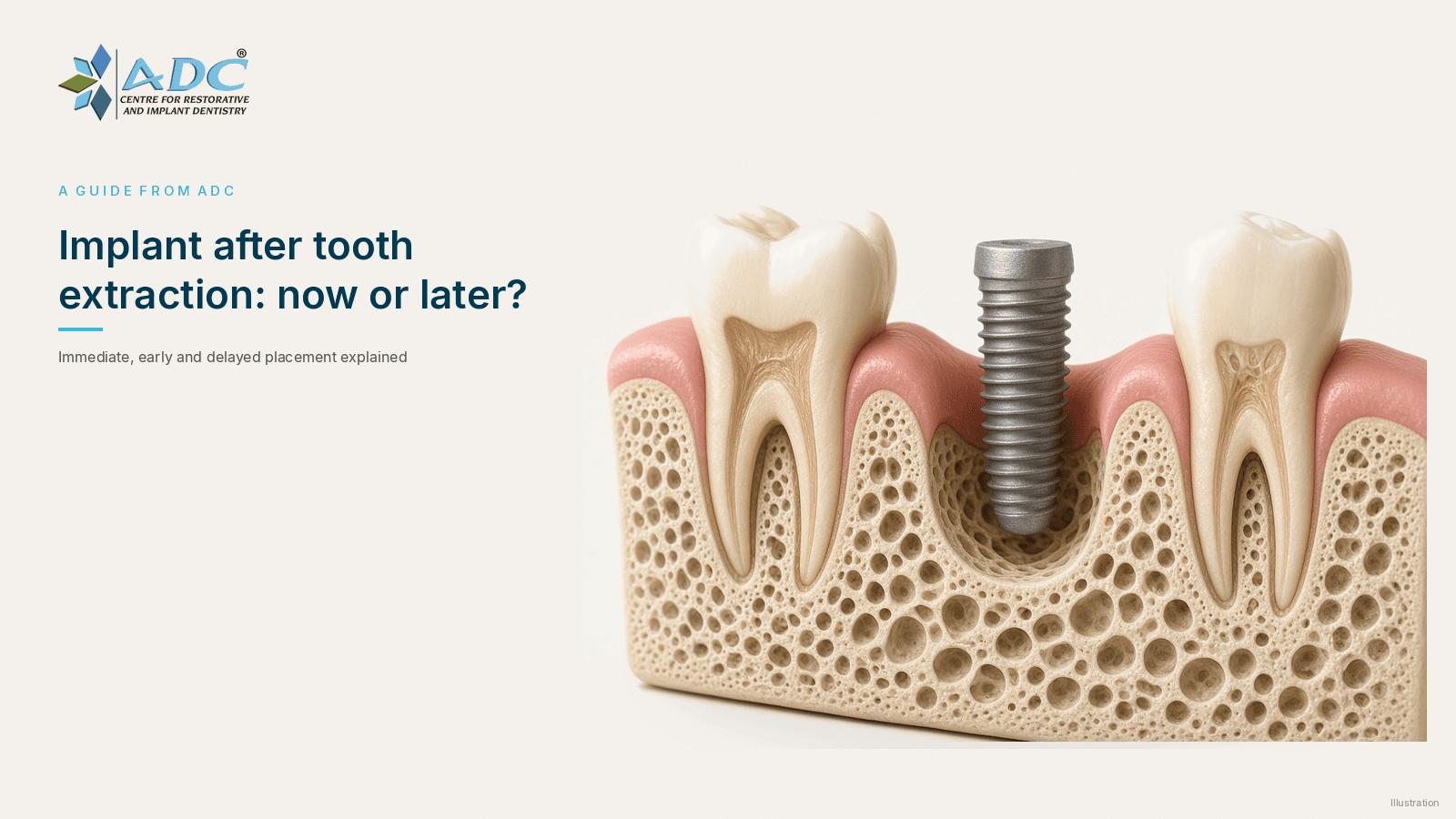 Dental implant after tooth extraction: immediate or delayed placement?
 Do you need a crown after root canal treatment?