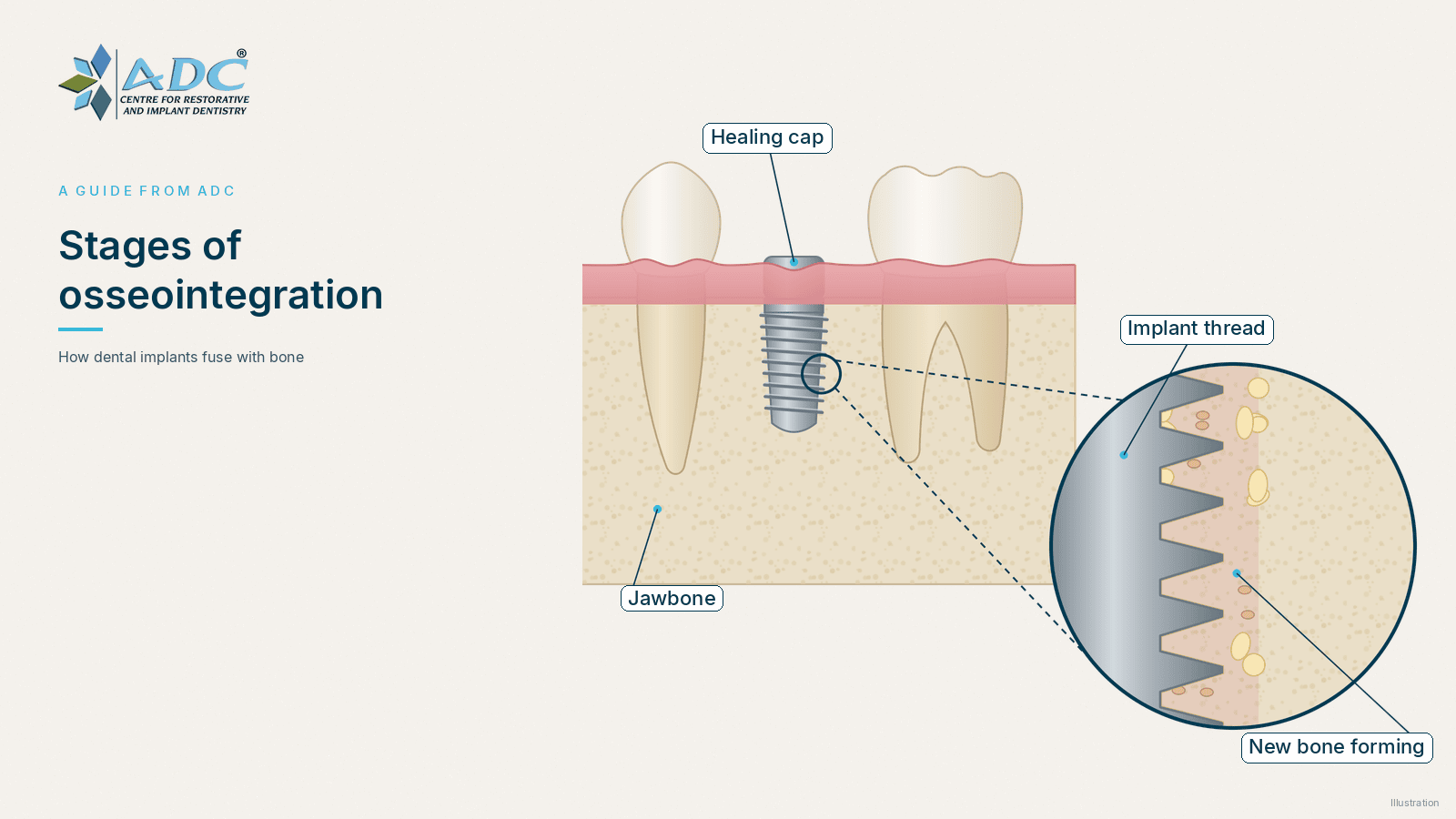
Osseointegration is the process by which a dental implant becomes firmly anchored in the jawbone. It is what allows an implant to support a crown, bridge or denture during chewing. The process happens in overlapping stages, much like the healing of any wound in bone, and it takes weeks to months rather than days. This guide explains the four osseointegration stages in plain language, how long each one usually takes, what can affect healing and how your dentist checks that the implant has fused with the bone.
What is osseointegration?
The term was introduced by Professor Per-Ingvar Brånemark and colleagues in Sweden, whose research from the 1960s onwards showed that bone can grow into close, direct contact with a titanium surface. In a 1981 paper they described the conditions needed for a lasting, direct bone-to-implant anchorage, including a biocompatible implant material, a suitable implant design and surface, healthy bone, a careful surgical technique and protection from excessive load while healing (Albrektsson and colleagues, 1981).
Today, most dental implants are made of titanium or a titanium alloy; implants made of zirconia (a ceramic) are also available for selected cases. In both cases, the implant does not "grow into" the bone by itself. The body heals around it, and new bone forms on and around the implant surface.
Osseointegration stages: how implants fuse with bone
Researchers describe osseointegration as a sequence of overlapping healing stages (Terheyden and colleagues, 2012). The timings below come mainly from experimental studies and are approximate; in people, healing varies with the bone, the site and general health.
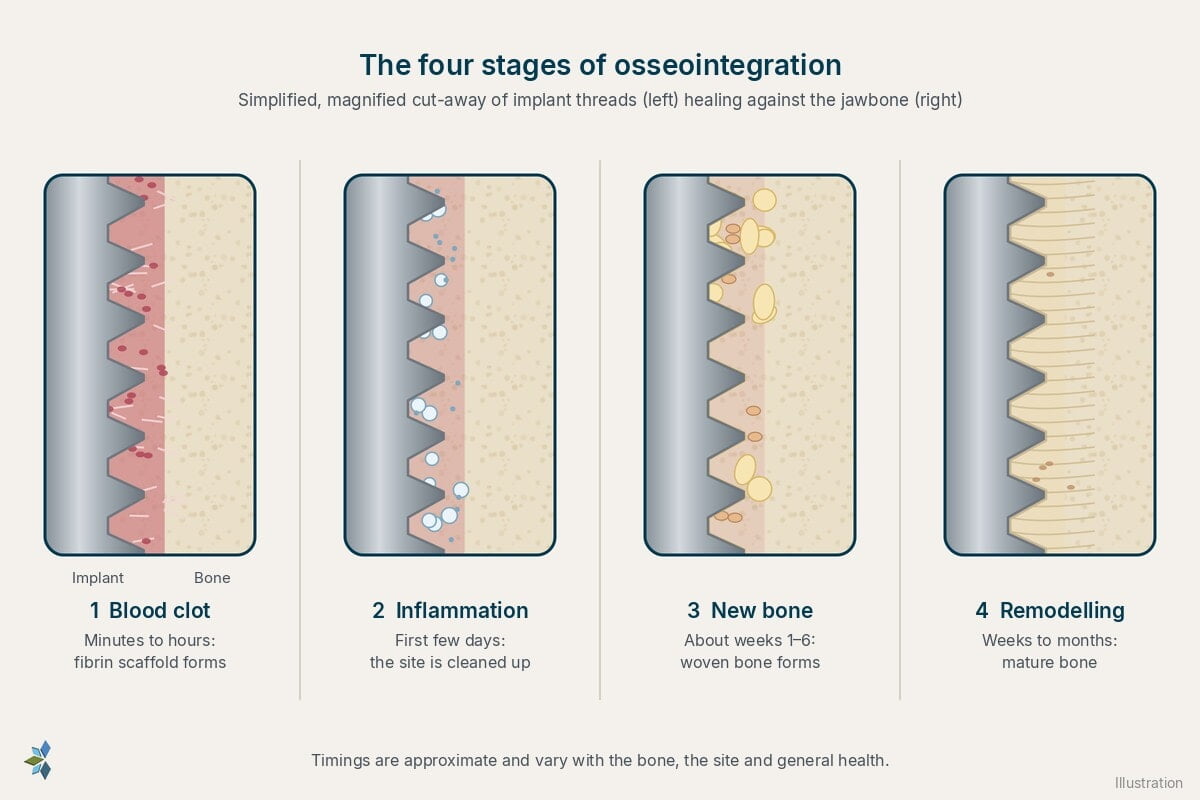
You can edit text on your website by double clicking on a text box on your website. Alternatively, when you select a text box a settings menu will appear. your website by double clicking on a text box on your website. Alternatively, when you select a text boxIllustration: a blood clot, an early inflammatory clean-up, new bone formation and remodelling into mature bone. Timings are approximate and vary. Simplified. Not a patient photograph.
Stage 1: Haemostasis and the blood clot (minutes to hours)
When the implant is placed, blood fills the small spaces between the implant and the bone. Proteins from the blood coat the implant surface within seconds, and a clot forms. The clot is held together by a network of fibrin, which acts as a scaffold. Healing cells travel along this scaffold towards the implant surface (Davies, 2003). This is why a stable clot and a clean, careful surgical technique matter.
Stage 2: Inflammation (the first few days)
In the first days, white blood cells move into the area to clear damaged tissue and any bacteria. This short inflammatory phase is a normal part of healing. The mild swelling and soreness many people notice after implant surgery come mainly from the surgery itself and usually settle within a few days if you follow the pain relief and care instructions your dentist gives you.
Stage 3: Proliferation and new bone formation (about the first one to six weeks)
Precursor cells arrive and develop into bone-forming cells (osteoblasts). These attach to the implant surface and to the surrounding bone and lay down new, loosely organised bone called woven bone. In an experimental study, new bone could be seen on the implant surface after about one week, and woven bone continued to form over the following weeks (Berglundh and colleagues, 2003). During this time, the original bone that was in contact with the implant is also being remodelled, so the implant's mechanical grip can briefly become less tight before new bone takes over. This is expected. Reviews of early healing describe this change from the initial "mechanical" stability (how tightly the implant was fitted) to "biological" stability (support from new bone) (Raghavendra and colleagues, 2005).
Stage 4: Remodelling and maturation (weeks to months)
The woven bone is gradually replaced by stronger, more organised lamellar bone, and the bone around the implant adapts to the forces it carries. This remodelling begins within weeks and continues for several months. After that, smaller changes carry on throughout life, as they do in the rest of the skeleton. It is the stage that gives the implant its long-term support.
How long does osseointegration take?
There is no single timeline that fits everyone. Many implants are left to heal for about two to six months before the final crown, bridge or denture is fitted, with the exact time depending on the bone quality, the site in the mouth, whether bone grafting or a sinus lift was needed and the implant used. Read more about why giving implants adequate healing time is important.
In selected cases, a temporary tooth can be attached to the implant soon after surgery (immediate or early loading). Reviews support this as an option when the implant is very stable at placement and the rest of the case is suitable; it remains an individual decision made by your dentist (Gallucci and colleagues, 2018). Even then, the implant still goes through the same healing stages underneath.
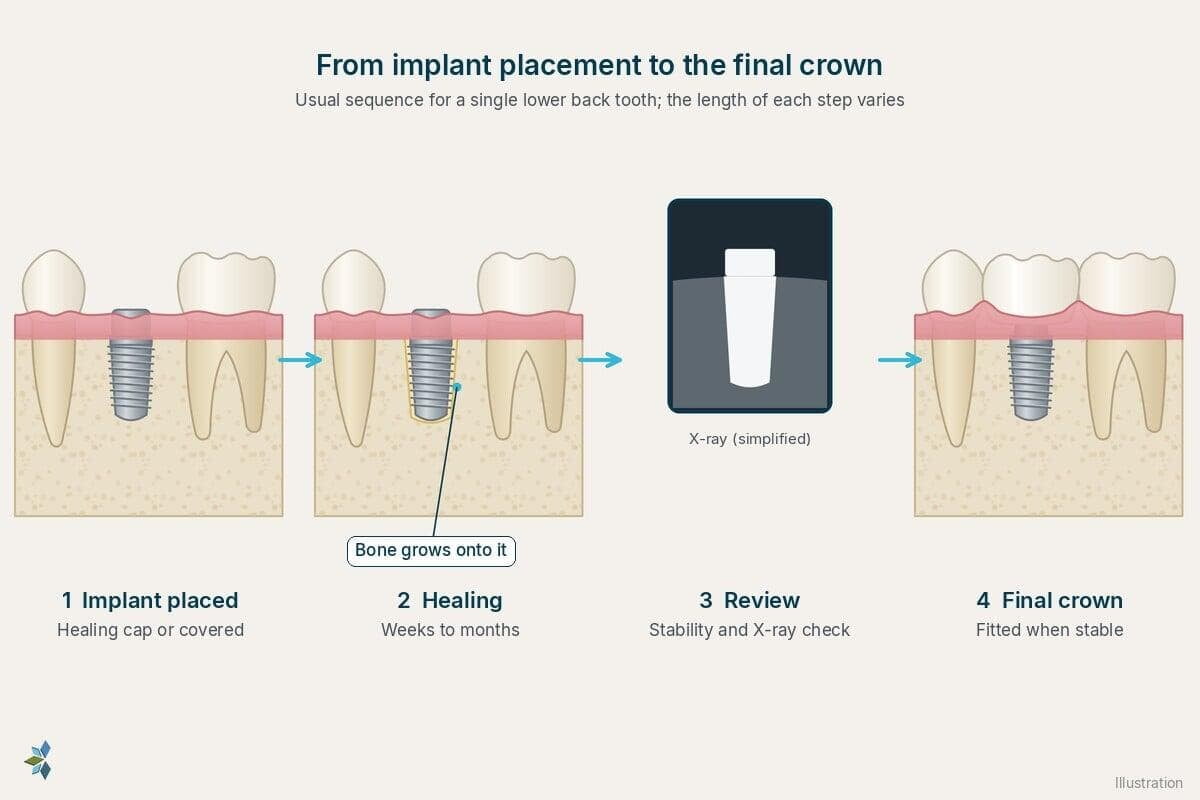
You can edit text on your website by double clicking on a text box on your website. Alternatively, when you select a text box a settings menu will appear. your website by double clicking on a text box on your website. Alternatively, when you select a text boxIllustration: the usual sequence from implant placement, through healing, to the final crown. The length of each step varies. Simplified. Not a patient photograph.
What can affect osseointegration?
Several factors can help or hinder healing:
- Stability at placement. An implant that is firmly held in the bone on the day of surgery (primary stability) is in a good position to heal undisturbed.
- Bone quantity and quality. Thin or soft bone may need grafting or a longer healing time. See dental implants with bone loss.
- Surgical technique. Gentle drilling with cooling reduces the risk of overheating the bone, which can damage the cells needed for healing.
- The implant surface. Modern roughened and treated surfaces are designed to support early bone formation. Read about SLActive implants and why Straumann dental implants.
- Movement during healing. Too much force or movement on a healing implant can disturb bone formation, which is why your dentist may advise a soft diet or avoiding chewing on that side.
- Smoking. Smoking reduces blood flow and is linked to a higher risk of implant failure. See smoking and dental implants.
- General health and medicines. Poorly controlled diabetes, some medicines (for example, certain drugs for osteoporosis or cancer) and radiotherapy to the jaws can affect bone healing. Always tell your dentist about your health and medicines. Vitamin D levels have also been studied; see the role of low vitamin D in implant healing.
- Infection and oral hygiene. Keeping the area clean, as instructed, helps the gum to seal and reduces the risk of infection while the bone heals.
How your dentist checks that an implant has fused with the bone
Osseointegration cannot be seen directly in the mouth. At review visits, your dentist checks that the gum around the implant is healthy and that the implant is not tender or loose, and takes an X-ray to look at the bone level around it. An X-ray cannot show the microscopic bond itself, but a stable, comfortable implant with healthy-looking bone levels is the usual basis for moving on. Some clinicians also measure implant stability with a dedicated device; at ADC, implant stability is measured with an ISQ (implant stability quotient) device. When the implant is stable and the bone looks healthy, the next stage of treatment can be planned. Our FAQs from 4 to 6 months after implant surgery cover this stage.
Contact your dentist promptly if pain or swelling gets worse after the first few days instead of better, if there is pus or a bad taste, or if the implant or healing cap feels loose. These can be signs that healing is not going as planned, and early review gives the best chance of managing the problem. Read more about failed dental implants.
Dental implant healing at ADC, Chandigarh
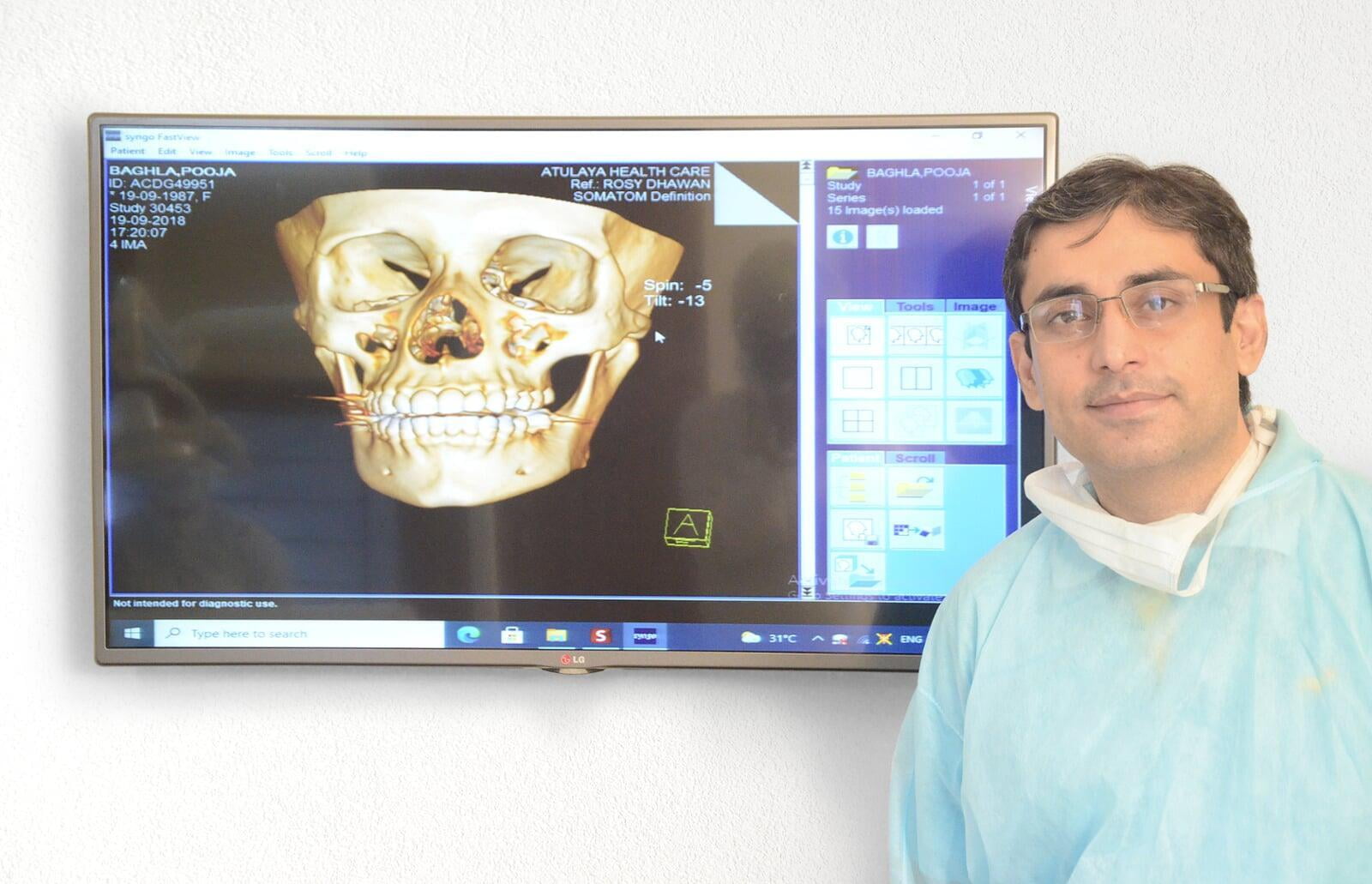
At ADC – Centre for Restorative and Implant Dentistry, implant treatment is led by Dr. Mohit Dhawan. Before surgery, your health, bone and gums are assessed, with a 3D CBCT scan and a surgical guide where needed. ADC works with the Straumann implant system. The healing time recommended for your implant, and whether a temporary tooth can be fitted early, is explained for your case. Learn more on our dental implants in Chandigarh page and in our complete guide to dental implants. The clinic is in Sector 21, Chandigarh, within easy reach of Mohali, Panchkula and Zirakpur.
For dentists: the ADC E-Learning Hub offers Beyond Osseointegration and the Basic Implantology Course.
Frequently asked questions
What are the stages of osseointegration?
Osseointegration is usually described in four overlapping stages: haemostasis and clot formation, inflammation, proliferation with new bone formation, and remodelling into mature bone.
How long does it take for a dental implant to fuse with the bone?
It varies. Many implants are allowed to heal for about two to six months before the final tooth is fitted, depending on the bone, the site and any grafting. Your dentist will tell you the healing time for your case.
Can I have a temporary tooth while the implant heals?
In many cases, yes. Depending on the case, this may be a removable temporary tooth, a bridge on neighbouring teeth or, in selected cases, a temporary crown on the implant itself. Your dentist will explain which option is suitable.
Does osseointegration hurt?
The healing of bone around the implant is not something you feel as a separate pain. Soreness and swelling after surgery come from the operation itself and usually settle within a few days. Pain that increases later should be checked by your dentist.
How much do dental implants cost?
The fee depends on the number of implants, any grafting and the type of crown, and is explained in a written estimate after your consultation. See our cost of dental implants post. Instalment and financing options are available; ask our team for details.
Book a consultation in Chandigarh
This article is general information, not advice for any individual. Please speak with your dentist about your own situation. If you are considering dental implants or have questions about your implant healing, you are welcome to book a consultation with Dr. Mohit Dhawan at ADC – Centre for Restorative and Implant Dentistry:
- Online booking: ADC Zoho Bookings
- Phone: +91-708-780-0016
- Email: help@theadc.dental
- Clinic: ADC- Centre for Restorative and Implant Dentistry, 1197, Sector 21B, Sector 21, Chandigarh, 160022, India
Mon–Fri 10:00 AM–6:30 PM; Sat 10:00 AM–5:00 PM; Sunday closed. You can also request a consultation online.
Reviewed by Dr. Mohit Dhawan, MDS (Prosthodontics, Crown & Bridge and Implantology).
References
- Albrektsson T, Brånemark PI, Hansson HA, Lindström J. Osseointegrated titanium implants. Requirements for ensuring a long-lasting, direct bone-to-implant anchorage in man. Acta Orthop Scand. 1981 — PubMed 7246093
- Terheyden H, Lang NP, Bierbaum S, Stadlinger B. Osseointegration — communication of cells. Clin Oral Implants Res. 2012 — PubMed 22092345
- Davies JE. Understanding peri-implant endosseous healing. J Dent Educ. 2003 — PubMed 12959168
- Berglundh T, Abrahamsson I, Lang NP, Lindhe J. De novo alveolar bone formation adjacent to endosseous implants. Clin Oral Implants Res. 2003 — PubMed 12755774
- Raghavendra S, Wood MC, Taylor TD. Early wound healing around endosseous implants: a review of the literature. Int J Oral Maxillofac Implants. 2005 — PubMed 15973954
- Gallucci GO, Hamilton A, Zhou W, Buser D, Chen S. Implant placement and loading protocols in partially edentulous patients: a systematic review. Clin Oral Implants Res. 2018 — PubMed 30328194
Click here: To read the post-operative instructions for proper care and recovery after dental implant surgery
Join the movement #paperless
Going Paperless can help save the Earth from climate change and biodiversity loss. It is a big task, but we know we can do it together. Get Help in going Paperless.



 International Team for Implantology
 ISO 9001:2015 Certified
 OHSAS Certified
 Academy of Osseo-Integration
 Indian Prosthodontics Society
 Indian Endodontic Society
 Women Implantology Network
 Indian Dental Association





 Sensitivity after a new crown: what is usual and when to call the dentist
 Dental implant after tooth extraction: immediate or delayed placement?
 Do you need a crown after root canal treatment?