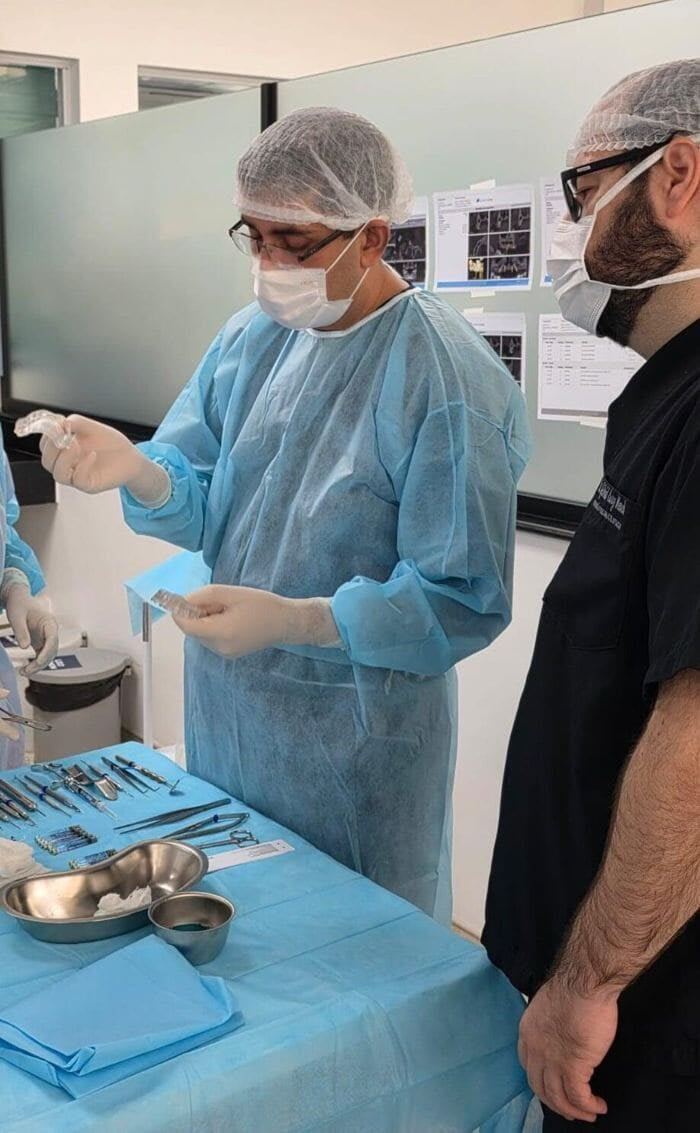
After the root canal final stage (Stage III), your tooth may feel tender for a few days, especially when you chew, and your lips and tongue may stay numb for several hours. This is normal. The most important next step is the final restoration: a crown or bridge is recommended after root canal treatment to protect the tooth. This guide covers the days after root canal final stage (Stage III) treatment, care after root canal completion and why the crown after RCT should not be delayed.
What happens at the final root canal stage (Stage III)
Stage III is the final stage of root canal treatment. Before starting it, your dentist checks that the earlier stages were successful; see our guides to RCT Stage I and what to expect after the second root canal visit.
At this visit, the cleaned and shaped root canals are filled and sealed with a special filling material called gutta-percha. Sealing the canals helps prevent bacteria from entering the tooth again. The top of the tooth is then closed with a filling until the crown or bridge is made.
Numbness after the appointment
The local anaesthetic used to numb the tooth also numbs your lips, tongue and nearby teeth for several hours. While they are numb, it is easy to bite your lip, cheek or tongue. Avoid chewing anything on the side of the treated tooth until the numbness has completely worn off.
Tenderness after root canal final stage
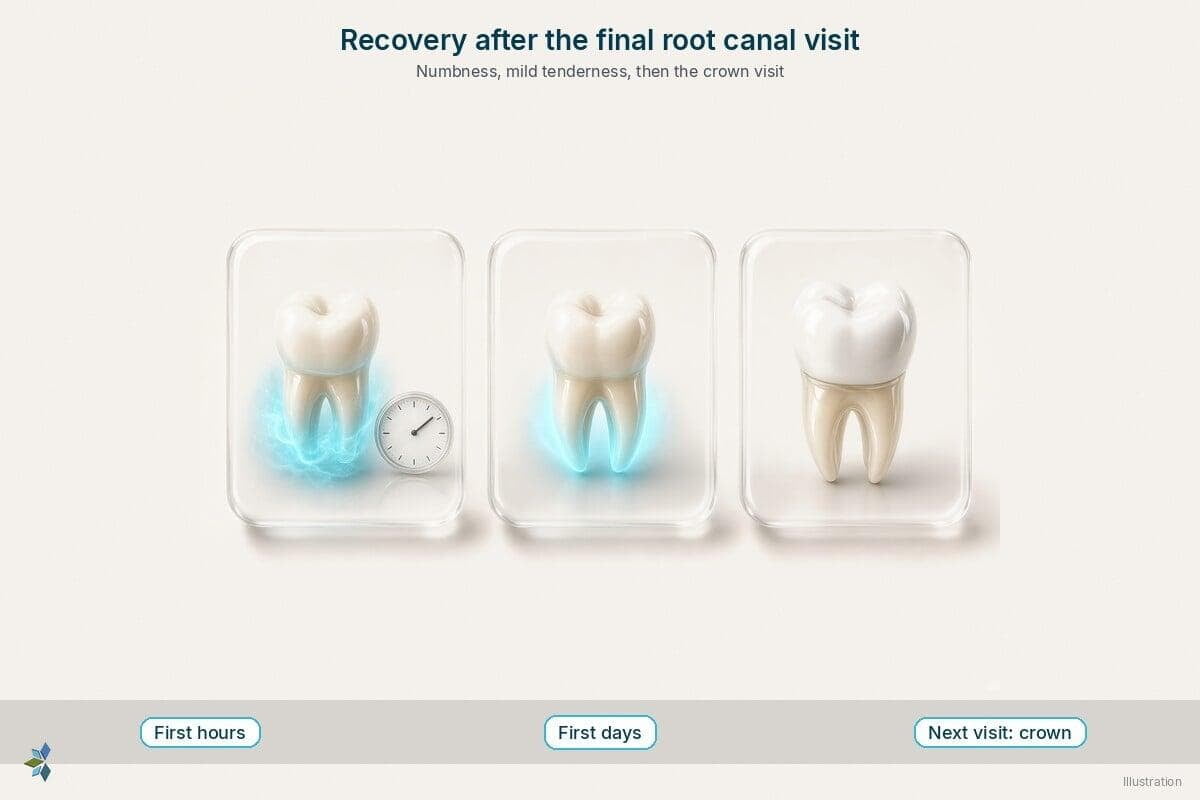
Illustration: the usual course after the final root canal visit, from numbness in the first hours and mild tenderness on chewing in the first days to the crown visit. Simplified. Not a patient photograph.
Some discomfort after the Stage III appointment is normal, especially while chewing. You may notice mild tenderness or a dull ache in the tooth. This tenderness is expected and is not an emergency. The tooth and the area around it may feel sensitive for a few days (ADA MouthHealthy), and it should gradually ease rather than get worse.
Care after root canal completion
Medicines
- Take any medicines exactly as your dentist recommends. If antibiotics have been prescribed, take them for the full number of days indicated, even if you have no discomfort or signs of infection.
- If no painkiller was prescribed and you have sharp pain after the appointment, you can take an over-the-counter painkiller that is suitable for you, following the directions on the pack.
- If the discomfort is not controlled with painkillers, or swelling develops suddenly, please call us straight away.
Warm salt water rinses
To reduce pain, swelling or discomfort, rinse with warm salt water at least 3 to 5 times a day. Dissolve a teaspoon of common salt in a cup of lukewarm water, then rinse, swish and spit. Read more about salt water rinses. Continue to brush and floss normally.
Eating and protecting the tooth
Until the final crown or bridge is fitted, the tooth is more likely to break:
- Avoid biting hard foods and chewing sticky foods such as chewing gum, caramels and ice.
- Avoid biting your fingernails, pencils or pens.
- If possible, chew on the other side of your mouth.
Crown after RCT: why the final restoration matters
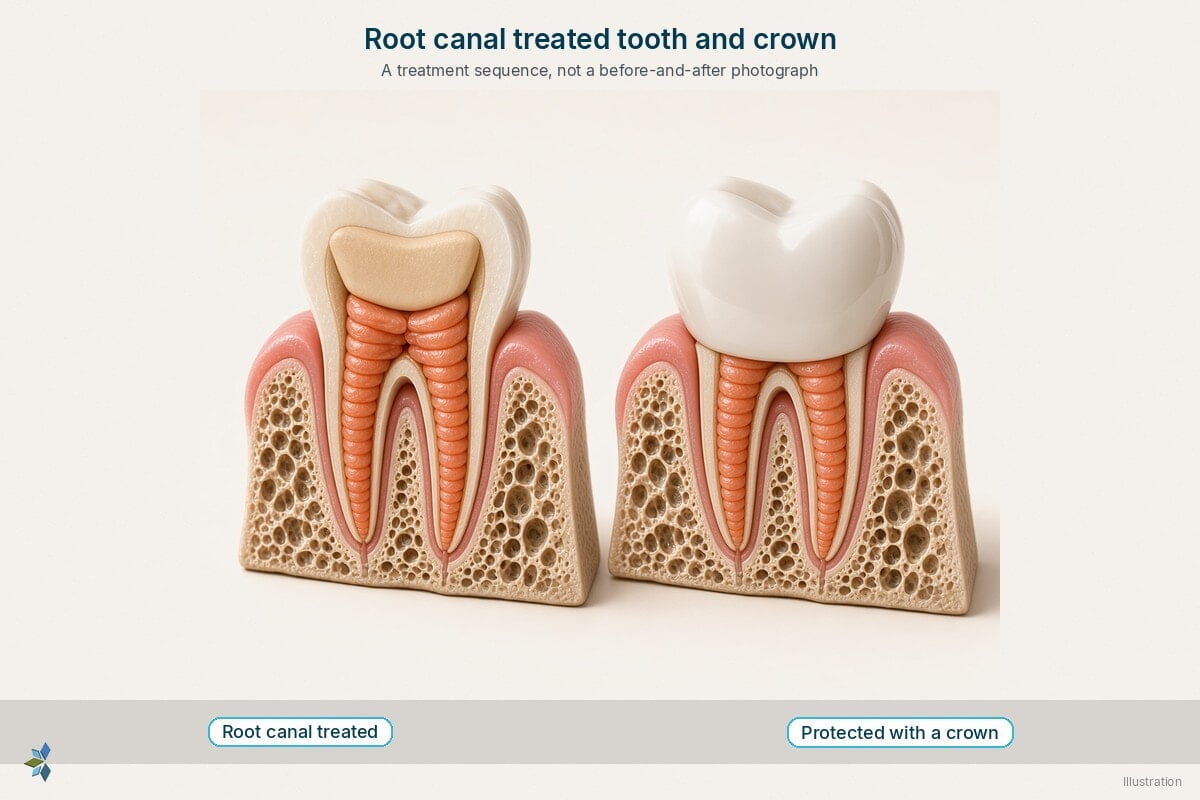
Illustration: a root canal treated molar (left) and the same tooth protected with a dental crown (right). A treatment sequence, not a before-and-after photograph.
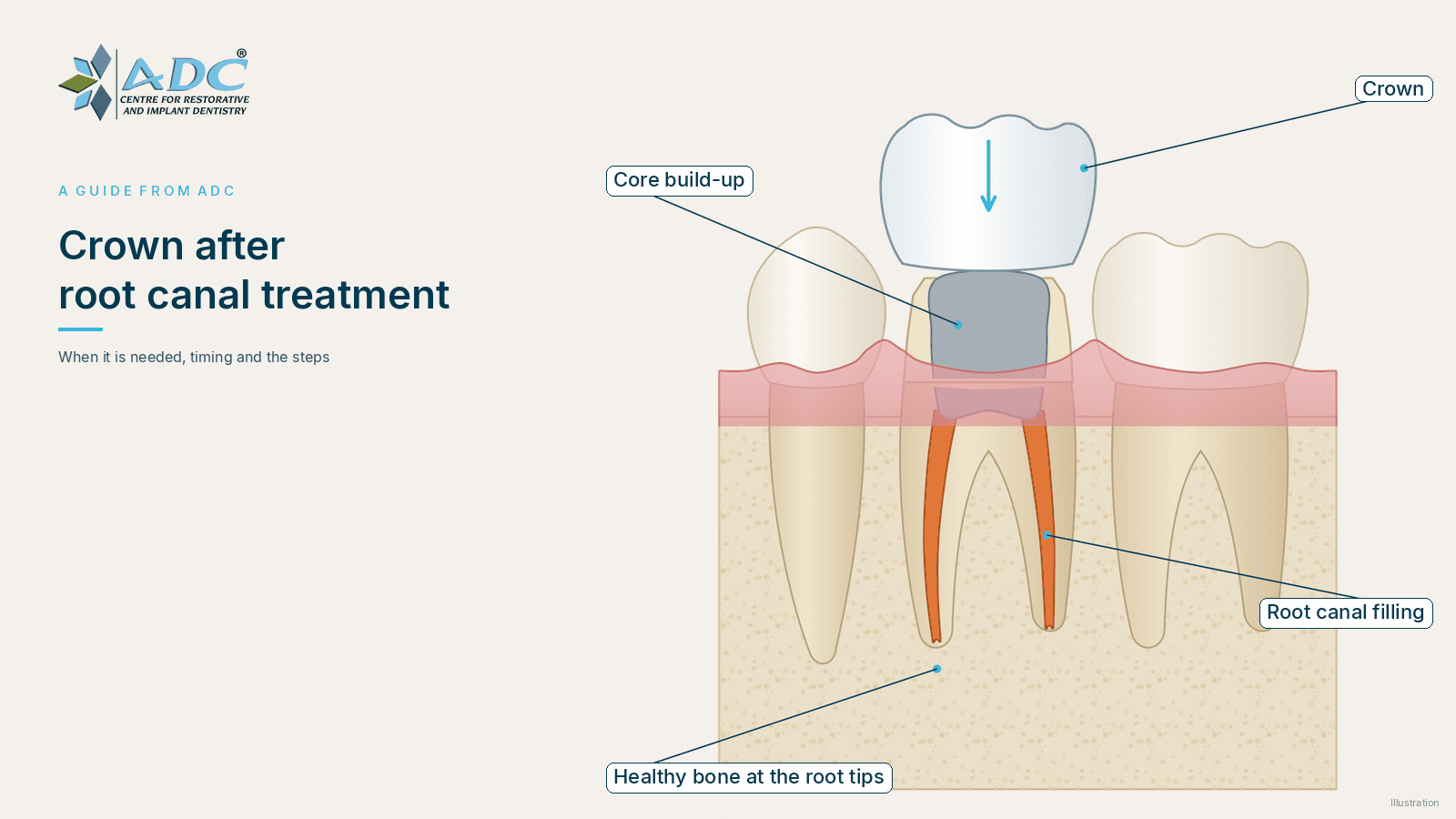
A final crown or bridge is recommended after root canal treatment, and this may need additional appointments. A crown restores the damaged tooth and protects it from breaking. Any delay in the final restoration (crown or bridge) can result in a fracture and possible loss of the tooth. Leaving the treatment incomplete can also lead to re-infection, or re-contamination through leakage. Your dentist will advise which restoration suits your tooth and when it can be done.
Read more in do you need a crown after root canal treatment?, see our dental crowns and bridges page, and once your crown is fitted, follow our instructions after crown and bridge cementation and tips to care for crowns and bridges. Some people notice mild sensitivity after a crown for a short time.
Check-ups after root canal treatment
A root canal treated tooth can still decay, so keep up good daily care: brush twice a day, clean between your teeth and keep your regular check-ups. A periodic examination after 6 to 12 months is essential so that your dentist can confirm that the tooth has healed properly.
Most root canal treated teeth heal well, but a small number need re-treatment to achieve a good result. Read more about how long a root canal lasts and root canal re-treatment.
When to contact ADC
Please call us promptly if:
- the pain is not controlled with painkillers, or it gets worse instead of better
- swelling develops suddenly
- the filling on top of the tooth breaks or comes out before your crown is fitted
- the tooth cracks or a piece breaks off
- your bite feels high or uneven when you close your teeth together
Get urgent medical help if you have swelling that affects your breathing or swallowing.
Root canal treatment and crowns at ADC, Chandigarh
At ADC – Centre for Restorative and Implant Dentistry, root canal treatment is usually carried out by Dr. Rosy Dhawan, and crowns are carried out by Dr. Mohit Dhawan. Because both treatments are done in the same clinic, the root canal treatment and the crown can be planned together. Learn more on our root canal treatment page, or watch our video on how root canal treatment is performed. The clinic is in Sector 21, Chandigarh, within easy reach of Mohali, Panchkula and Zirakpur.
Frequently asked questions
How long will my tooth be sore after the final root canal stage?
Mild tenderness, especially when chewing, is common for a few days and should ease gradually. Call us if the pain is not controlled with painkillers, gets worse or comes with sudden swelling.
Do I need a crown after root canal treatment?
A final crown or bridge is recommended after root canal treatment to restore the tooth and protect it from breaking. Your dentist will advise which restoration suits your tooth.
How soon should the crown be fitted after RCT?
As soon as your dentist advises. Any delay in the final restoration can result in a fracture and possible loss of the tooth.
Can I eat normally after my root canal is completed?
Wait until the numbness has worn off. Until your crown is fitted, chew on the other side and avoid hard or sticky foods.
Do I need check-ups after root canal treatment?
Yes. A root canal treated tooth can still decay, and a periodic examination after 6 to 12 months lets your dentist confirm that it has healed properly.
Book a consultation in Chandigarh
This article is general information, not advice for any individual. If you have questions about care after root canal completion or would like to plan your crown after RCT, please contact ADC – Centre for Restorative and Implant Dentistry:
- Online booking: ADC Zoho Bookings
- Phone: +91-708-780-0016
- Email: help@theadc.dental
- Clinic: ADC- Centre for Restorative and Implant Dentistry, 1197, Sector 21B, Sector 21, Chandigarh, 160022, India
Mon–Fri 10:00 AM–6:30 PM; Sat 10:00 AM–5:00 PM; Sunday closed. You can also request a consultation online.
Reviewed by Dr. Mohit Dhawan, MDS (Prosthodontics, Crown & Bridge and Implantology).
References
- NHS. Root canal treatment — nhs.uk
- American Dental Association, MouthHealthy. Root canals — mouthhealthy.org
- Aquilino SA, Caplan DJ. Relationship between crown placement and the survival of endodontically treated teeth. J Prosthet Dent. 2002 — PubMed 11941351




 International Team for Implantology
 ISO 9001:2015 Certified
 OHSAS Certified
 Academy of Osseo-Integration
 Indian Prosthodontics Society
 Indian Endodontic Society
 Women Implantology Network
 Indian Dental Association






 Sensitivity after a new crown: what is usual and when to call the dentist
 Dental implant after tooth extraction: immediate or delayed placement?
 Do you need a crown after root canal treatment?