
Tooth pain that keeps you awake, or a tooth that hurts every time you bite, can make it hard to think about anything else. If a dentist has told you that you need root canal treatment in Chandigarh, you probably have practical questions: what will actually happen, how many visits it takes, what affects the cost, and how to choose who treats you. This guide answers those questions in plain language, so you can walk into your consultation knowing what to ask.
If you are not yet sure whether your tooth needs a root canal at all, read do I need a root canal? how dentists decide. If you have already had one and want to know how long it will last, see how long does a root canal last?
What is root canal treatment?
Root canal treatment (RCT, also called endodontic treatment) saves a tooth whose pulp is badly inflamed or infected. The pulp is the soft tissue inside the tooth that contains nerves and blood vessels. It can be damaged by deep decay, a crack, an injury or repeated dental work. Once the pulp is beyond repair, a filling alone will not solve the problem, and without treatment the infection can spread to the bone around the root tip and form an abscess.
During treatment, the damaged pulp is removed, the root canals are cleaned, shaped and disinfected, and the canals are filled and sealed. The tooth is then rebuilt with a filling or a crown so it can be used for chewing again. Keeping a natural tooth that can be restored is generally preferred over removing it, but your dentist will explain whether your tooth can be saved.
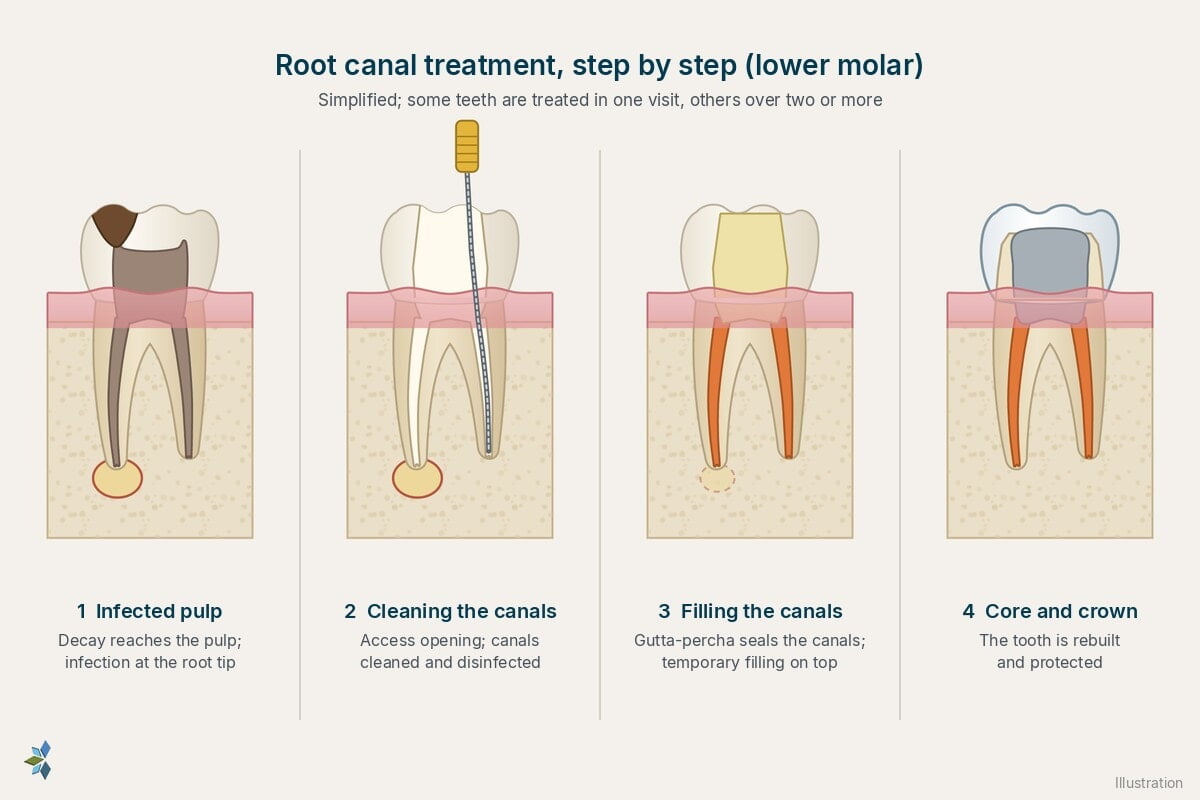
Illustration: the main stages of root canal treatment on a lower back tooth. Simplified side view; the number of visits varies. Not a patient photograph.
When is root canal treatment recommended?
A dentist may recommend root canal treatment when tests and X-rays suggest the pulp cannot recover, or when there is infection at the root tip. Common reasons include lingering pain after hot or cold, throbbing or night-time pain, pain on biting, a swollen gum or a gum boil, or a tooth that has darkened after an injury. Some infected teeth cause no pain at all and are found on an X-ray. Not every toothache needs a root canal; see 10 signs you need a root canal treatment for the symptoms to watch for.
Root canal treatment, step by step
Every tooth is different, but treatment usually follows these steps:
- Examination and X-rays: your symptoms and medical history are discussed, the tooth is tested and X-rays are taken. A CBCT (3D) scan may be suggested for complex teeth.
- Local anaesthesia: the tooth and the area around it are numbed.
- Isolation: a thin rubber sheet (rubber dam) is placed around the tooth to keep it clean and dry.
- Access: a small opening is made through the top of the tooth to reach the pulp chamber.
- Cleaning and shaping: fine instruments remove the pulp and shape each canal while disinfecting solutions flush out bacteria and debris. The length of each canal is measured.
- Medicine between visits (if needed): when treatment is spread over more than one visit, a medicine is placed in the canals and the tooth is sealed with a temporary filling.
- Filling the canals: the clean canals are filled to near the root tip with gutta-percha and a sealer.
- Restoring the tooth: the access opening is sealed and the tooth is rebuilt with a filling or a core and a crown, which protects it from cracking and leaking.
For more detail, read what happens during a root canal, step by step. After each stage you will be given aftercare advice, such as our instructions after the first root canal visit.
Single sitting root canal or more than one visit?
Many people ask for a single sitting root canal. Some teeth can be treated in one visit, while others are better treated over two or more. The choice depends on the tooth and how many canals it has, how much infection or swelling there is, how easy the canals are to clean, and how comfortable you are with a longer appointment.
A Cochrane systematic review that compared single-visit and multiple-visit root canal treatment found no clear evidence that either approach gives better healing. Single-visit treatment saves time and appointments, but the review found that people treated in one visit were somewhat more likely to have pain later after treatment and to need painkillers. Your dentist will suggest the approach that suits your tooth.
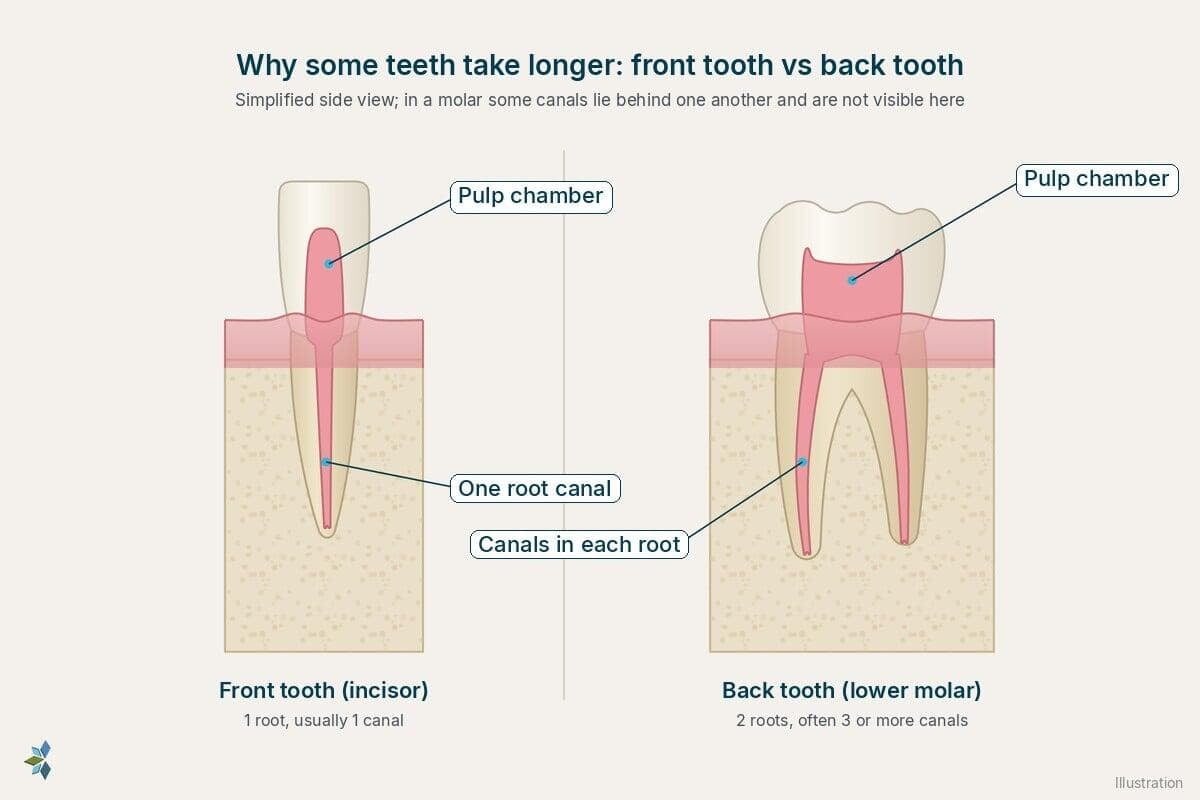
Illustration: a front tooth usually has one root and one canal; a lower molar has two roots and often three or more canals, some lying behind one another in this side view. Simplified. Not a patient photograph.
Root canal specialist in Chandigarh: who does the treatment?
Root canal treatment is carried out by general dentists and by endodontists. An endodontist is a dentist with postgraduate specialist training in diagnosing tooth pain and treating the pulp and root canals; in India this is the MDS in Conservative Dentistry and Endodontics. Teeth with curved or blocked canals, previous root fillings or unclear symptoms are often treated or reviewed by a specialist.
At ADC, root canal treatment is usually carried out by Dr. Rosy Dhawan, MDS (Conservative Dentistry and Endodontics), and crowns are carried out by Dr. Mohit Dhawan, MDS (Prosthodontics). This means the root canal and the crown that protects it can be planned together.
How to choose a clinic for root canal treatment in Chandigarh
Online rankings of clinics are not a reliable guide. Instead, look for a clinic that explains your diagnosis and options clearly. Useful questions to ask at your consultation:
- Who will carry out the root canal, and what is their training?
- What did the tests and X-rays show, and is a CBCT scan needed for my tooth?
- Will a rubber dam be used to isolate the tooth?
- How many visits are likely, and how long is each one?
- What restoration will the tooth need afterwards, a filling or a crown, and who will place it?
- What will the whole treatment cost, including the crown, and can I have that in writing?
- What should I expect afterwards, and whom do I contact if I have pain or swelling?
- What are the alternatives, including what happens if I wait or choose extraction?
A clinic that answers these questions openly, keeps good infection control and plans the final restoration from the start gives your tooth a good chance of lasting.
What affects root canal cost in Chandigarh?
The cost of root canal treatment is not the same for every tooth. It depends mainly on:
- which tooth it is: molars have more canals and take longer than front teeth
- how complex the canals are: curved, narrow or blocked canals need more time
- whether it is a first treatment or a retreatment of an older root filling
- the number of visits and any imaging, such as a CBCT scan
- the final restoration: a filling, a core build-up, a post, and the type of crown material
You will be given an estimate after your examination, once the dentist knows what your tooth needs. Ask whether the estimate includes the crown, because the root canal and the restoration are often priced separately. Saving the tooth is often simpler than replacing it later with an implant or bridge, but your dentist should explain the options and their costs for your situation.
Is root canal treatment painful?
With good local anaesthesia, most people find the treatment feels much like having a filling. The tooth may be tender for a few days afterwards, and this usually settles with the pain relief your dentist advises. A badly infected tooth often hurts more before treatment than after it. Read is root canal treatment painful? myths vs. facts for more.
After root canal treatment
Avoid chewing hard food on the tooth until the final restoration is in place, keep the area clean, and go back for the crown or filling when advised. A treated tooth that is well sealed and protected can last for many years; our guide on how long a root canal lasts explains what helps and the warning signs to watch for. If a crown is planned, see do you need a crown after root canal treatment?
Frequently asked questions
Can root canal treatment be done in a single sitting?
Sometimes. Many teeth can be treated in one visit, while teeth with more infection, swelling or complex canals may need two or more. Your dentist will advise after examining the tooth.
How long does each visit take?
It varies with the tooth. Front teeth usually take less time than molars, which have more canals. Your dentist can give you an idea at the consultation.
Do I need a crown after root canal treatment?
Back teeth usually need a crown or a restoration that covers the cusps, because they take heavy chewing forces. Some front teeth can be restored with a filling.
Can I go to work after a root canal?
Most people return to normal activities the same day or the next day, once the numbness wears off. Avoid chewing on the treated side until the tooth is restored.
How much does root canal treatment cost in Chandigarh?
It depends on the tooth, the number of canals, whether it is a retreatment, the number of visits and the final restoration. You will receive an estimate after your examination.
How do I find a root canal specialist in Chandigarh?
Ask who will treat you and what their training is. An endodontist has postgraduate training in root canal treatment (MDS in Conservative Dentistry and Endodontics in India).
Book a root canal consultation in Chandigarh
If you have tooth pain or have been told you need a root canal, a consultation at ADC – Centre for Restorative and Implant Dentistry can examine the tooth, explain what the X-rays show and talk you through the options, including the restoration afterwards. ADC is in Sector 21, Chandigarh, within easy reach of Mohali, Panchkula and Zirakpur. Book with Dr. Mohit Dhawan's team:
- Online booking: ADC Zoho Bookings
- Phone: +91-708-780-0016
- Email: help@theadc.dental
- Clinic: 1197, Sector 21B, Sector 21, Chandigarh 160022
Mon–Fri 10:00 AM–6:30 PM; Sat 10:00 AM–5:00 PM; Sunday closed. Learn more on our root canal treatment and crowns and bridges pages.
Reviewed by Dr. Mohit Dhawan.
References
- NHS. Root canal treatment — nhs.uk
- American Dental Association, MouthHealthy. Root canals — mouthhealthy.org
- Manfredi M, Figini L, Gagliani M, Lodi G. Single versus multiple visits for endodontic treatment of permanent teeth. Cochrane Database Syst Rev. 2016 — PubMed 27905673