A toothache has a way of taking over your whole day. Perhaps the tooth only hurts when you drink something cold. Perhaps it aches when you bite, or the pain suddenly gets worse at night. For many people the first thought is: do I need a root canal? Sometimes the answer is yes, but tooth pain does not always mean root canal treatment. Different problems can cause similar symptoms, and the right treatment depends on what is happening inside and around the tooth. This guide explains how dentists decide, what reversible and irreversible pulpitis mean, and when a filling may be enough.
Why does my tooth hurt?
Tooth pain has many causes. A small cavity may first cause short sensitivity to cold or sweet foods. As decay goes deeper, the pain can become more frequent or more intense. But the problem is not always decay: a cracked tooth, gum disease, an old or leaking filling, exposed roots from gum recession, grinding, an injury, or even a blocked sinus can all cause discomfort in a tooth. Our pages on toothache and sensitive teeth cover the common causes.
Do I need a root canal? What your symptoms may suggest
The type of pain gives your dentist clues, but it cannot give a diagnosis on its own:
- Brief sensitivity to cold that stops within seconds: often linked with exposed dentine, early decay or gum recession.
- Pain that lingers after hot or cold drinks: may mean the pulp is more deeply irritated.
- Pain when biting: may be linked with a crack, a high filling, or inflammation or infection around the root.
- Throbbing, spontaneous or night-time pain: may mean the pulp is badly inflamed or infected.
- Swelling, a gum boil or a bad taste: can be signs of an abscess and should be checked promptly.
- No pain at all: some infected teeth cause no symptoms and are found on an X-ray, or the pain may stop when the pulp dies, even though the infection remains.
The key point is that symptoms alone do not tell the whole story. For a checklist of warning signs, see 10 signs you need a root canal treatment.
Reversible vs irreversible pulpitis
Inside every tooth is the pulp, a soft tissue with nerves and blood vessels. When the pulp is irritated, for example by decay, it becomes inflamed. This is called pulpitis, and dentists describe it in two broad stages:
- Reversible pulpitis: the pulp is irritated but can recover once the cause is removed. Typically there is sharp, short pain to cold or sweet that stops soon after the trigger goes away. Removing the decay and placing a filling is often enough.
- Irreversible pulpitis: the pulp is too inflamed to recover. Pain often lingers after hot or cold, comes on by itself or wakes you at night. The usual treatment to keep the tooth is root canal treatment; in selected cases, dentists may try to keep part of the pulp alive (vital pulp therapy).
If the pulp dies, bacteria can spread to the bone around the root tip and form an abscess. At that stage root canal treatment or extraction is needed, and antibiotics alone do not fix the cause.
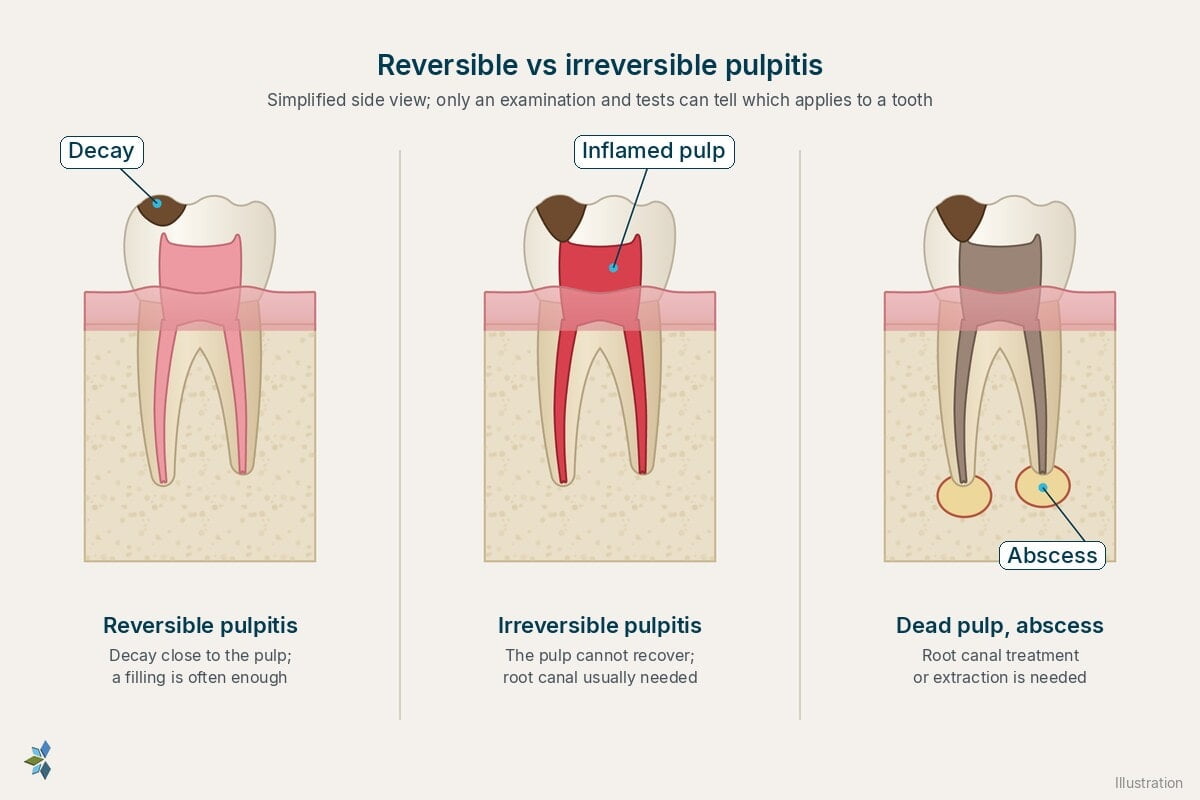
Illustration: reversible pulpitis (decay close to the pulp), irreversible pulpitis (decay has reached an inflamed pulp) and a dead pulp with an abscess at the root tips. Simplified side view; only an examination and tests can tell which applies to a tooth. Not a patient photograph.
Tooth pain: root canal or filling?
Whether a painful tooth needs a filling or a root canal depends on the health of the pulp, not just on how much it hurts. A deep cavity that has not reached the pulp, in a tooth with reversible pulpitis, can often be treated with a filling, sometimes with a protective lining underneath. Once the pulp is irreversibly inflamed or has died, a filling alone usually will not stop the pain or the infection, and root canal treatment is the way to save the tooth. Some teeth need a crown after either treatment because of how much structure is missing.
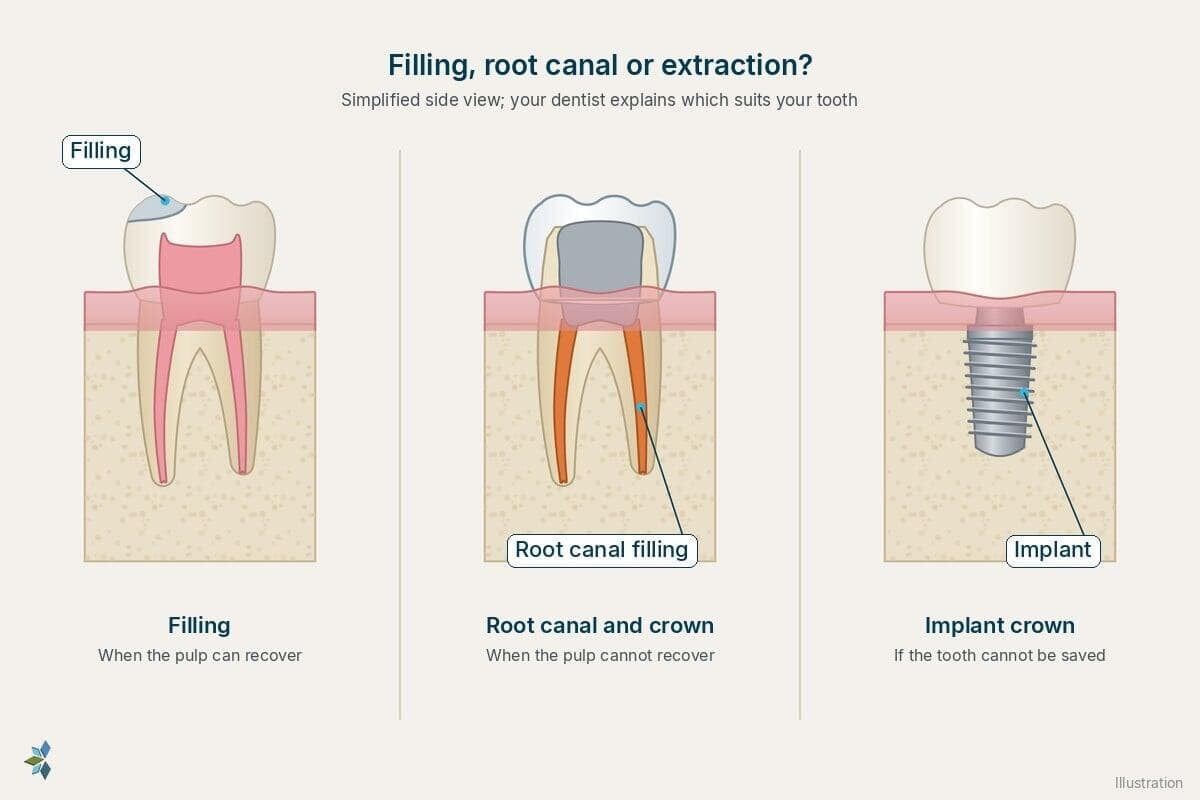
Illustration: the same tooth treated with a filling, with root canal treatment and a crown, or, if it cannot be saved, replaced with an implant crown. Simplified side view. Not a patient photograph.
How dentists decide if you need a root canal
A careful examination is more useful than trying to diagnose the problem yourself. Your dentist will usually:
- ask when the pain started, what triggers it and how long it lasts
- look at the tooth, the fillings and the gums, and check for cracks
- gently tap the tooth and ask you to bite on a small instrument
- test how the tooth responds to cold, compared with the teeth next to it
- take an X-ray to look at the decay, the pulp space and the bone at the root tip
ADC's consultation visit includes digital intra-oral X-rays and, when the doctor recommends it, a 2D panoramic X-ray or a 3D CBCT scan. Pain that is hard to pin down, or that seems to move between teeth, sometimes comes from somewhere else, such as the jaw muscles or the sinuses, so a dentist will rule these out before starting treatment.
What if the tooth cannot be saved?
Not every tooth can be kept. A tooth with very extensive decay, a crack running down the root, severe gum disease or repeated infections may be better removed. Extraction is not the automatic first choice, and ADC aims to keep natural teeth wherever this is realistic. If a tooth does need to come out, a gap can affect chewing and the teeth around it, so options such as a dental implant, a bridge or a denture can be discussed. See how to replace a missing tooth after extraction and cracked tooth treatment in Chandigarh.
Why waiting can make it harder
It is common to notice a little sensitivity, ignore it, start chewing on the other side, and only see a dentist when the pain becomes severe. By then, a problem that might have needed a filling may need root canal treatment, or the tooth may no longer be restorable. Not every toothache gets worse, but persistent or worsening pain deserves attention. You do not have to wait until you cannot sleep.
Fear of the treatment is a common reason for delay. With good local anaesthesia, most people find a root canal feels much like having a filling; read is root canal treatment painful? and our tips on dental anxiety.
What to note before your appointment
These details help your dentist work out what is going on:
- When did the pain begin, and is it constant or does it come and go?
- Does cold, heat or sweet food trigger it, and how long does it last afterwards?
- Does the tooth hurt when you bite or chew?
- Does the pain wake you at night?
- Have you noticed swelling, a gum boil or a bad taste?
- Has the tooth had a large filling, a crown or an injury?
And do ask questions: "Can my tooth be saved?", "Do I definitely need a root canal?", "What are the alternatives?" and "What happens if I wait?"
Root canal treatment in Chandigarh at ADC
If an examination shows that your tooth needs root canal treatment, the next guide explains what happens at each visit, single-sitting and multi-visit treatment, and what affects the cost: root canal treatment in Chandigarh: a patient's guide. At ADC, root canal treatment is usually carried out by Dr. Rosy Dhawan, MDS (Conservative Dentistry and Endodontics), and crowns by Dr. Mohit Dhawan, MDS (Prosthodontics). To understand how long a treated tooth can last, read how long does a root canal last?
Frequently asked questions
Does every toothache mean I need a root canal?
No. Many toothaches come from sensitivity, a cavity that can be filled, a cracked or high filling, or gum problems. A root canal is needed when the pulp cannot recover or has become infected.
How do I know if I need a root canal or a filling?
Only an examination can tell. Your dentist uses your symptoms, a cold test, a bite or tap test and X-rays to judge whether the pulp can recover (often a filling) or not (usually a root canal).
What is the difference between reversible and irreversible pulpitis?
In reversible pulpitis the pulp is irritated but can heal once the cause is treated; pain is short and stops when the trigger goes. In irreversible pulpitis the pulp cannot recover; pain tends to linger, start on its own or wake you at night.
Can antibiotics fix a tooth that needs a root canal?
Antibiotics do not remove the infected or dead pulp inside the tooth, so they do not fix the cause. They may be prescribed in some cases, such as spreading swelling, alongside treatment of the tooth.
My tooth stopped hurting. Do I still need to see a dentist?
Yes. Pain can stop because the pulp has died, while the infection continues at the root tip. It is worth having the tooth checked.
What happens if I do not get a root canal when I need one?
The infection can spread to the bone and form an abscess, the tooth may break down further, and it may eventually need to be removed.
Book a dental examination in Chandigarh
If your tooth hurts and you are not sure what treatment you need, an examination at ADC – Centre for Restorative and Implant Dentistry can find the cause and explain your options before any treatment starts. ADC is in Sector 21, Chandigarh, within easy reach of Mohali, Panchkula and Zirakpur. Book with Dr. Mohit Dhawan's team:
- Online booking: ADC Zoho Bookings
- Phone: +91-708-780-0016
- Email: help@theadc.dental
- Clinic: 1197, Sector 21B, Sector 21, Chandigarh 160022
Mon–Fri 10:00 AM–6:30 PM; Sat 10:00 AM–5:00 PM; Sunday closed. Learn more on our root canal treatment page. If you have facial swelling, a fever or difficulty swallowing or breathing, seek urgent medical help.
Reviewed by Dr. Mohit Dhawan.
References
- NHS. Toothache — nhs.uk
- NHS. Dental abscess — nhs.uk
- American Dental Association, MouthHealthy. Root canals — mouthhealthy.org
- Edwards D, Allison JR, Coulter J, et al. Symptomatic irreversible pulpitis and other orofacial pain: overcoming challenges in diagnosis and management. Br Dent J. 2025 — PMC11991903




 International Team for Implantology
 ISO 9001:2015 Certified
 OHSAS Certified
 Academy of Osseo-Integration
 Indian Prosthodontics Society
 Indian Endodontic Society
 Women Implantology Network
 Indian Dental Association






 Sensitivity after a new crown: what is usual and when to call the dentist
 Dental implant after tooth extraction: immediate or delayed placement?
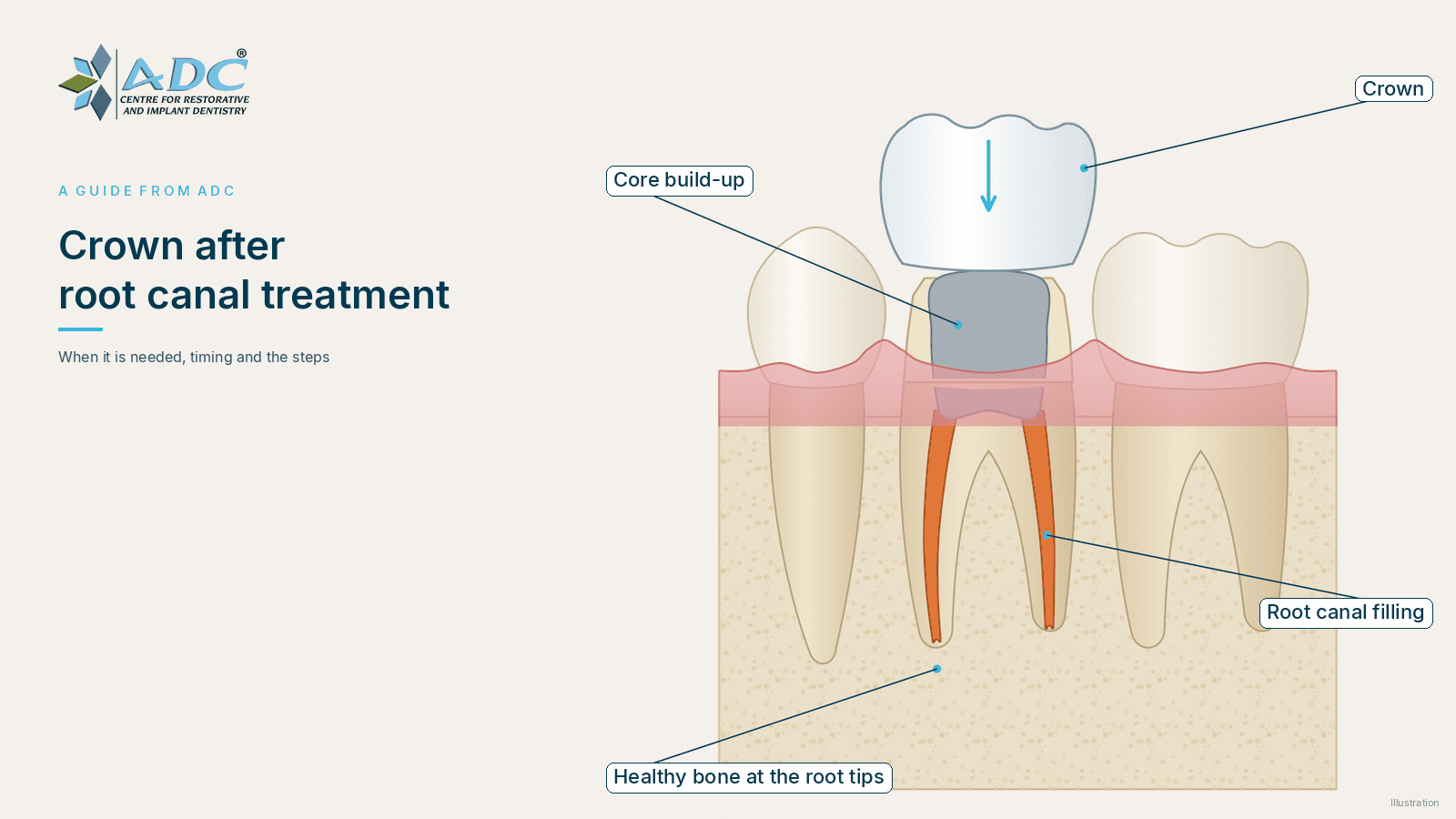 Do you need a crown after root canal treatment?