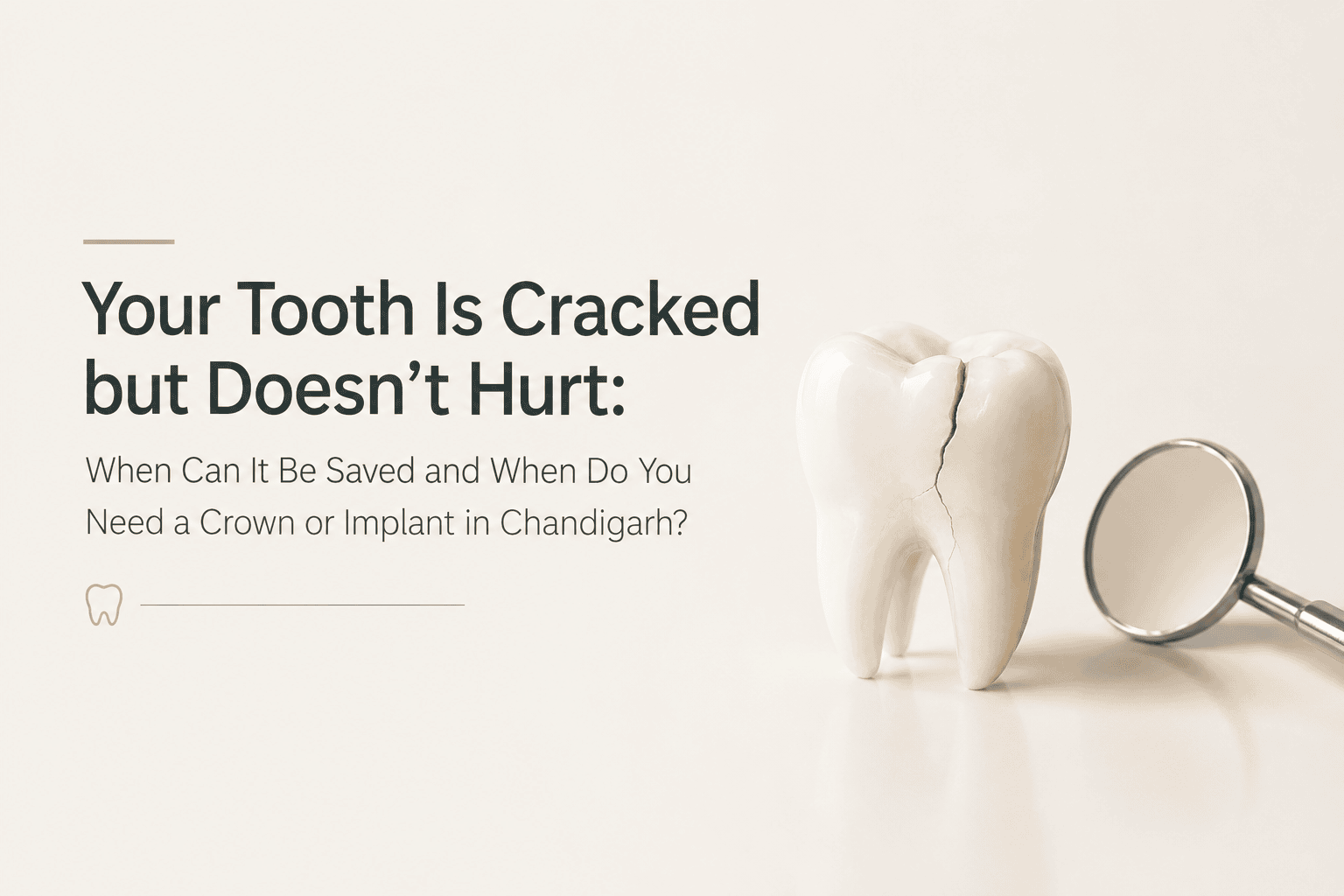
A cracked tooth does not always hurt. In fact, one of the most common misconceptions about dental cracks is that if there is no pain, there is no serious problem.
A tooth can develop a crack without causing immediate discomfort. However, cracks can sometimes progress gradually and may eventually affect the inner pulp, surrounding tissues or the tooth's ability to withstand normal chewing forces.
So, if you have been told that you have a cracked tooth but it doesn't hurt, should you simply wait and watch?
Not necessarily.
The appropriate treatment depends on where the crack is located, how deep it is, whether the tooth can be restored, and whether the nerve and supporting tissues are affected. In some cases, a cracked tooth can be protected with a crown. In more advanced cases, root canal treatment may be required. If the tooth cannot be predictably restored, extraction followed by a dental implant in Chandigarh may be recommended.
Why Can a Cracked Tooth Have No Pain?
Teeth do not always produce immediate symptoms when damaged.
A small crack may initially remain within the outer tooth structure and may not reach the sensitive inner tissues. Some cracks may also produce symptoms only when you bite or release pressure.
Pain can therefore be intermittent—or absent altogether.
This is why regular dental examinations are important, particularly if you notice a visible crack, a chipped tooth, a change in your bite or discomfort when chewing.
What Causes Teeth to Crack?
Several factors can increase the risk of cracked teeth.
Common causes include:
- Biting hard foods such as ice or hard candies
- Accidental trauma
- Teeth grinding or clenching
- Large or old fillings that weaken the remaining tooth structure
- Uneven bite forces
- Age-related changes in tooth structure
- Using teeth to open packages or bite non-food objects
A tooth that has already undergone extensive restoration may be particularly vulnerable to fracture.
Types of Cracks Matter
Not every crack has the same prognosis. The location and extent of the crack are critical in determining whether a tooth can be saved.
Craze Lines
Tiny cracks in the enamel are common in adults. They generally do not cause pain and may not require restorative treatment unless there are other concerns.
Fractured Cusp
A weakened portion of the tooth, often around a large filling, may fracture. Depending on the extent of damage, the tooth may often be restored.
Cracked Tooth
A crack may extend from the chewing surface toward the root. If the crack has not progressed too far, the tooth may sometimes be protected with appropriate treatment.
Split Tooth
If a tooth has fractured into separate segments, saving the entire tooth may not be possible. Depending on the situation, part of the tooth may sometimes be preserved, while in other cases extraction may be required.
Vertical Root Fracture
A crack extending through the root can have a poor prognosis, particularly when it is associated with infection or bone loss. Extraction may be necessary in such cases.
Can a Cracked Tooth Be Saved?
The answer is: sometimes, yes.
The most important question is whether enough healthy tooth structure remains to restore and protect it.
A dentist may evaluate:
- The location of the crack
- Its depth and direction
- Whether the crack extends below the gum line
- The condition of the dental pulp
- The presence of infection
- The amount of remaining healthy tooth structure
- The stability of the tooth
- The condition of the surrounding bone and gums
If the tooth is considered restorable, treatment may focus on protecting it from further fracture.
When Is a Crown Recommended?
A dental crown may be recommended when a tooth has lost significant structural strength but still has enough healthy tooth structure to be restored.
A crown covers the tooth and can help protect the remaining structure from chewing forces.
For certain cracked teeth, a crown may be used after other necessary treatment, such as root canal treatment.
However, a crown cannot "heal" a crack in the way a broken bone heals. Its purpose is to stabilize and protect the remaining tooth structure. The prognosis depends heavily on the extent and location of the crack.b
What If the Nerve Is Affected?
A crack can sometimes allow bacteria to reach the pulp—the soft tissue containing the tooth's nerves and blood vessels.
If the pulp becomes inflamed or infected, you may develop symptoms such as:
- Sensitivity to hot or cold
- Pain when biting
- Spontaneous toothache
- Prolonged sensitivity
- Swelling around the tooth
In such cases, root canal treatment may be required before the tooth is restored, often with a crown.
Importantly, the absence of pain does not guarantee that the pulp is healthy. A dental examination is necessary to assess the condition of the tooth.
When Is Extraction and a Dental Implant Necessary?
Unfortunately, not every cracked tooth can be saved.
If the crack extends deeply into the root, reaches below the gum line or has divided the tooth into separate segments, restoration may not provide a predictable long-term result.
In such cases, extracting the tooth may be recommended.
Once a tooth is removed, replacing it can help restore chewing function and prevent unwanted changes in the surrounding teeth.
One option is a dental implant.
A dental implant replaces the missing tooth root and can support a crown designed to look and function like a natural tooth.
For patients searching for dental implants in Chandigarh, the suitability of implant treatment depends on factors such as bone volume, gum health, general health, the location of the missing tooth and the overall treatment plan.
Crown vs Dental Implant: What's the Difference?
The choice between a crown and an implant is not simply a matter of preference.
A crown is generally considered when the natural tooth can be predictably restored and retained.
A dental implant is considered when the natural tooth cannot be saved or has already been removed.
In simple terms:
Restorable tooth → preserve the natural tooth where possible → restore and protect it.
Non-restorable tooth → extraction may be necessary → consider an appropriate tooth replacement such as an implant-supported crown.
Preserving a natural tooth is generally preferred when it has a good long-term prognosis. However, attempting to save a tooth that cannot be predictably restored may lead to repeated treatment and additional complications.
How Is a Cracked Tooth Diagnosed?
Cracked teeth can sometimes be difficult to diagnose because the crack may be extremely small.
Your dentist may use a combination of:
- Clinical examination
- Bite tests
- Magnification
- Dental X-rays
- Transillumination
- Periodontal examination
- Digital imaging or 3D imaging when appropriate
- Assessment of your bite and dental history
Not every crack will be visible on a conventional X-ray, so the diagnosis often depends on combining clinical findings with imaging and symptoms.
What Should You Do If Your Cracked Tooth Doesn't Hurt?
Don't ignore it simply because you feel fine.
Until you have been evaluated, avoid biting very hard foods with the affected tooth. Maintain good oral hygiene and schedule a dental examination.
Seek prompt dental attention if you develop swelling, increasing sensitivity, pain when biting, a loose tooth or other new symptoms.
Early assessment may allow your dentist to determine whether the tooth can be protected before the crack progresses.
Why Choose ADC | Dental in Chandigarh?
When dealing with a cracked tooth, the goal should not simply be to repair what is visible. The dentist needs to determine why the tooth cracked, how extensive the damage is and whether the tooth can be predictably preserved.
At ADC | Dental, patients can receive a comprehensive assessment of cracked, chipped or structurally compromised teeth. Based on the clinical condition, your dentist can discuss options ranging from restorative treatment and crowns to root canal treatment or tooth replacement with a dental implant when necessary.
Frequently Asked Questions
Can a cracked tooth heal on its own?
A structural crack in a tooth generally does not heal itself. However, some minor enamel craze lines may not require treatment. A dentist should determine the significance of the crack.
Does a painless cracked tooth need treatment?
It may. A painless crack can potentially progress or allow damage to the deeper structures of the tooth. An examination can help determine whether monitoring or treatment is appropriate.
Is a crown better than an implant?
They solve different problems. A crown is used to restore a natural tooth that can still be saved. An implant replaces a missing tooth after extraction. Your dentist should determine which option is appropriate based on the tooth's prognosis.
Can every cracked tooth be saved with a root canal and crown?
No. Root canal treatment and a crown may help save some cracked teeth, but a tooth with a deep, non-restorable fracture may require extraction.
Don't Wait for a Cracked Tooth to Start Hurting
A cracked tooth that doesn't hurt may seem like a minor problem, but symptoms do not always reflect the extent of structural damage.
If you have noticed a crack, chipped tooth or unexplained change in how your teeth bite together, getting it evaluated early can help clarify whether the tooth can be saved.
If you are looking for cracked tooth treatment, dental crowns or dental implants in Chandigarh, consult ADC | Dental for a comprehensive examination and personalized treatment recommendation.
The sooner a cracked tooth is assessed, the sooner you can understand your options—and, when possible, protect and preserve your natural tooth.