Many dentists start looking at implantology courses in the first few years after BDS. Implant treatment is now a routine part of restorative care, patients ask about it, and the undergraduate curriculum gives most graduates only a limited introduction to it. The choice of course matters. A good first course builds safe habits in assessment, planning and prosthetic thinking; a poorly chosen one can leave a clinician confident with a drill but unsure of when not to use it. This article sets out, for young dentists and final-year students, how to judge an implantology course after BDS and the questions worth asking before you enrol.
Start with what you already need to know
Implant dentistry rests on foundations that are taught in BDS but are worth revising before any implant course:
- Surgical anatomy of the maxilla and mandible, including the inferior alveolar canal, the mental foramen, the maxillary sinus and the lingual concavities.
- Radiographic interpretation, especially reading cone-beam CT scans, measuring available bone and recognising anatomical structures in three dimensions.
- Prosthodontic principles: occlusion, restorative space, emergence profile and the difference between a single crown and a full-arch case.
- Periodontal health and medical history, because the condition of the remaining dentition and the patient's systemic health shape every implant plan.
- Infection control and asepsis for a surgical procedure.
A course that assumes these foundations without checking them may move too fast. A course that revisits them in the context of implants is usually a better starting point.
What a sound basic implantology course should cover
Course names vary, but a basic implantology course for general dentists generally covers the following areas:
- Case selection and assessment. Medical and dental history, indications and contraindications, risk factors such as smoking, uncontrolled diabetes and parafunction, and when to refer.
- Prosthetically driven treatment planning. Planning the final tooth position first and placing the implant to support it, rather than placing an implant wherever the bone happens to be.
- Imaging and digital planning. CBCT assessment, planning software and the role of surgical guides.
- Surgical protocol. Flap design, osteotomy preparation, drilling sequences, primary stability and wound closure.
- Healing and loading. Osseointegration, healing periods and the factors that guide the choice between conventional and earlier loading.
- Implant prosthetics. Impressions, abutment selection, screw-retained and cement-retained restorations, and torque control.
- Complications and maintenance. Biological complications such as peri-implant mucositis and peri-implantitis, technical complications such as screw loosening, and the recall and maintenance programme that follows treatment.
- Consent, records and communication. Written informed consent, clear records of the system and components used, and realistic discussion with patients.
If a course outline spends most of its time on placing implants and little on planning, prosthetics and complications, that imbalance is worth noting.
Online, hands-on or both
Online and hands-on learning teach different things, and most clinicians benefit from both.
Online learning suits the theory: anatomy, planning principles, case discussions, recorded surgical demonstrations and complication management. It allows you to learn at your own pace and revisit a lecture when a similar case comes up in practice.
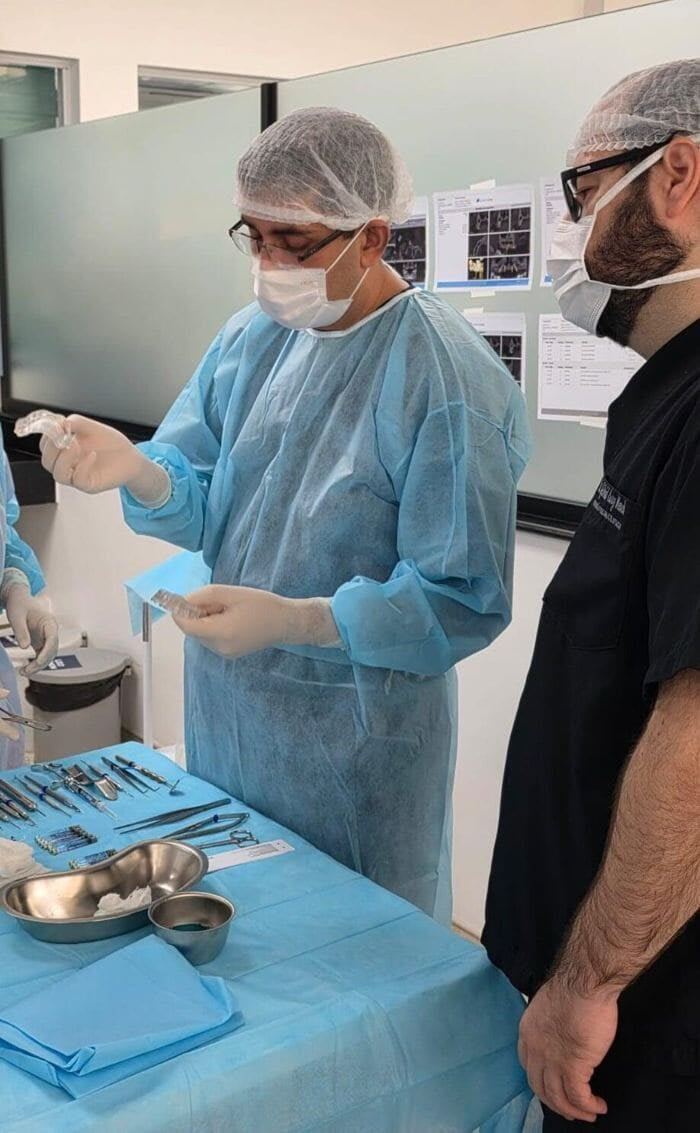
Hands-on training is needed for the manual skills. Work on models or animal jaws develops drilling technique, tissue handling and suturing. Supervised work on patients is a further step, and it raises questions of its own: who selects and consents the patients, who is responsible for the treatment, and what follow-up the patient receives after the course ends.
A sensible path for many young dentists is to build the theory first, then practise on models, then begin with straightforward cases under the guidance of an experienced mentor before treating more complex cases independently.
Questions to ask before you enrol
Before committing time and fees to any implantology course, it is reasonable to ask the provider:
- Who teaches it? What are the faculty's qualifications and clinical experience in implant dentistry, and will they be teaching in person?
- What is the curriculum? Ask for a written outline with the number of sessions, the topics and the balance between theory and practical work.
- What practical work is included? Is it on models, animal jaws or patients? If patients are involved, how are they selected, who consents them and who looks after them afterwards?
- What is the group size? Smaller groups usually allow more supervision during practical sessions.
- Is the course tied to one implant system? Learning on one system is common, but the principles taught should apply across systems.
- What support follows the course? Some providers offer case discussion or mentoring afterwards, which helps when you start treating your own patients.
- Is continuing dental education credit available? In India, continuing dental education is overseen by the Dental Council of India and the state dental councils. If credit points matter to you, ask the provider which body has approved the programme and ask for it in writing.
- What certificate is given, and what does it mean? A certificate of attendance shows that you completed a course. It is not a specialist qualification, and it does not replace clinical judgement or supervised experience.
Building competence after the course
A course is the start of learning implant dentistry, not the end. Competence grows through careful case selection, beginning with straightforward single-tooth cases in good bone, keeping detailed records, reviewing your own outcomes honestly and seeking a second opinion when a case is beyond your experience. Reading the literature, attending case-based study groups and returning for further training in areas such as bone grafting, full-arch rehabilitation or complication management all help. Postgraduate study in prosthodontics, periodontics or oral surgery is another route for those who want implant dentistry to be a major part of their work.
Frequently asked questions
Can I take an implantology course straight after BDS?
Many courses accept dentists soon after BDS. A strong grasp of anatomy, radiography and prosthodontic principles makes the learning far more useful, so revising these first is worthwhile.
Is an online implant course enough on its own?
Online learning covers theory, planning and case discussion well. Surgical skills need hands-on practice, and early clinical cases benefit from guidance by an experienced clinician.
Does one course make me an implantologist?
No. A course gives a foundation. Clinical competence develops over time through supervised experience, careful case selection and continued learning.
Learning implantology with ADC
The ADC E-Learning Hub is the online training platform for dentists run by Dr. Mohit Dhawan and Dr. Rosy Dhawan. Its courses include a Basic Implantology Course and courses on hardware complications in dental implants, analog and digital impressions in implant dentistry, and long-term implant success beyond osseointegration. Lessons are video-based with downloadable notes, a digital certificate is awarded for each completed lecture and module, and offline clinical classes are also offered, with pre-enrolment online. Browse the full list at All courses, and for a worked example of complication management, read Retrieving a fractured abutment screw.
This article is general education for dental professionals and students. It is not individual career, legal or clinical advice, and it does not replace formal training, supervised clinical experience or individual clinical judgement.



 International Team for Implantology
 ISO 9001:2015 Certified
 OHSAS Certified
 Academy of Osseo-Integration
 Indian Prosthodontics Society
 Indian Endodontic Society
 Women Implantology Network
 Indian Dental Association






 Sensitivity after a new crown: what is usual and when to call the dentist
 Dental implant after tooth extraction: immediate or delayed placement?
 Do you need a crown after root canal treatment?