Laser root canal treatment in Chandigarh usually means a standard root canal treatment with one extra step: a thin laser fibre or tip is used inside the cleaned canals to help disinfect them. The laser does not replace the files and rinsing solutions that do most of the work. It is an add-on that some dentists use for selected teeth. This guide explains what a laser can add, what the research shows so far, what the visit involves and what to ask before treatment.
If you are still wondering whether you need a root canal at all, start with do I need a root canal? How dentists decide. For the full treatment in plain steps, read what happens during a root canal, step by step.
What is laser root canal treatment?
Root canal treatment removes infected or inflamed pulp (the soft tissue inside the tooth), cleans and shapes the canals, disinfects them and then seals them so bacteria cannot return. In laser-assisted root canal treatment, laser energy is added during the disinfection stage. Depending on the laser and the technique, it is used in one of two ways:
- Laser-activated irrigation: the laser tip sits in the rinsing solution and makes it move and stream through the canal, helping the solution reach narrow spaces.
- Direct canal irradiation: a thin fibre is passed down the canal and moved slowly as it is withdrawn, to act on bacteria on the canal walls.
Different lasers are used for this, such as diode, Nd:YAG and Er:YAG lasers. The choice depends on the equipment and the dentist's training.
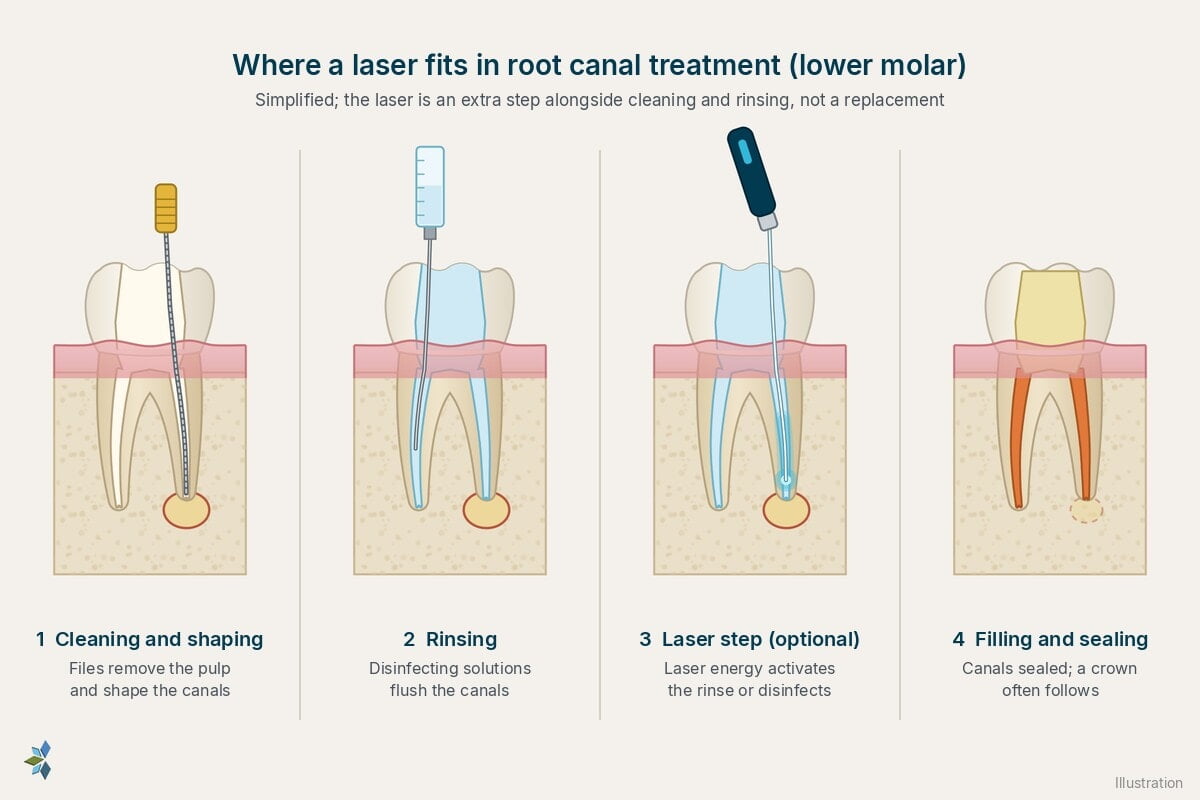
Illustration: the laser is an extra step alongside cleaning and rinsing, not a replacement for them. Simplified side view of a lower molar. Not a patient photograph.
Why disinfection matters
Inside a tooth, the main canals have small side branches and thousands of tiny tubes in the dentine. Bacteria can live in these spaces, where files cannot reach. Most of the cleaning is done by rinsing solutions such as sodium hypochlorite, which dissolve tissue and kill bacteria. Anything that helps these solutions reach further into the canal system may help the tooth heal.
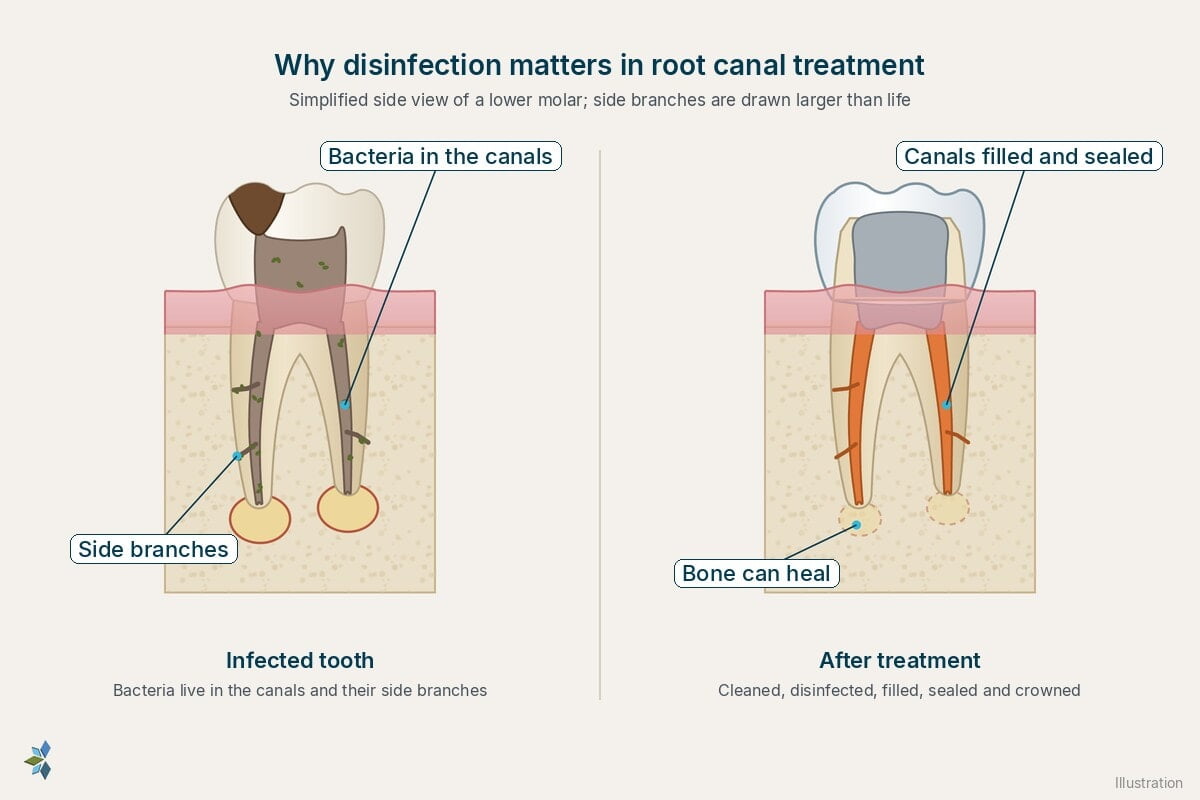
Illustration: bacteria live in the canals and their side branches; after cleaning, disinfection, filling and a crown, the bone around the root tips can heal. Side branches drawn larger than life. Not a patient photograph.
Laser root canal benefits: what the evidence shows
Research on lasers in root canal treatment is active, and the results are encouraging in some areas and unclear in others.
- Cleaning in the laboratory: studies on extracted teeth show that laser-activated rinsing, especially with Er:YAG lasers, can improve the removal of debris and bacteria compared with rinsing by syringe alone. These are laboratory results, and the settings used vary widely.
- Pain after treatment: a 2024 systematic review found that laser-activated irrigation may help reduce pain in the first 48 hours after treatment compared with standard needle rinsing, but most of the studies had a high risk of bias.
- Healing: a 2023 systematic review, carried out to a framework set by the European Society of Endodontology, looked at extra steps such as laser irradiation of the canals, photodynamic therapy, ozone and ultrasonic activation. It found insufficient evidence to recommend any of them for improving the healing of infection at the root tip.
In short, a laser can be a useful addition, but the success of a root canal still depends mainly on a correct diagnosis, careful cleaning and shaping, thorough rinsing, a good seal and a well-fitting restoration on top.
What laser-assisted root canal treatment does not change
- It still needs local anaesthetic. The laser does not make injections unnecessary. Modern local anaesthesia keeps most root canal treatments comfortable.
- Some soreness afterwards is still normal. Tenderness when biting for a few days is common after any root canal, and usually settles with simple painkillers.
- The tooth still needs protecting. Back teeth usually need a crown after root canal treatment, laser or not.
- It is not a guarantee. No technique can promise that a treated tooth will never need further treatment.
You can read more in is root canal treatment painful? Myths vs facts.
The laser root canal process, step by step
- Examination and X-rays. The dentist checks the tooth and takes X-rays, and sometimes a CBCT (3D) scan, to see the roots and any infection.
- Local anaesthetic and isolation. The tooth is numbed and usually isolated with a rubber sheet (dental dam) to keep it clean and dry.
- Access and cleaning. A small opening is made through the top of the tooth, the pulp is removed and the canals are cleaned and shaped with fine files.
- Rinsing. Disinfecting solutions are used throughout to flush and disinfect the canals.
- Laser step. Where the dentist feels it will help, laser energy is used to activate the rinse or to disinfect the canal walls.
- Filling and sealing. The canals are dried and filled, usually with gutta-percha and a sealer, and the opening is closed with a temporary or permanent filling.
- Crown or final restoration. A back tooth is usually rebuilt with a core and protected with a crown. See do you need a crown after root canal treatment?
Some teeth are completed in one visit, while others need two or more, for example when there is a lot of infection or the canals are complex.
Who may benefit from a laser step
Your dentist may suggest a laser step for teeth with complex canals, for long-standing infection, or for a tooth being treated again after an earlier root canal. Read more about root canal retreatment. For other teeth, standard cleaning and rinsing may be all that is needed. The decision is clinical and is made for each tooth.
Questions to ask before treatment
- Does my tooth need a root canal, or are there other options?
- How many visits will it take?
- Will a laser or another activation method be used for my tooth, and why?
- Will I need a crown afterwards?
- What should I expect in the first few days?
- What happens if the tooth does not heal as expected?
Root canal treatment at ADC, Chandigarh
At ADC – Centre for Restorative and Implant Dentistry, root canal treatment, including laser-assisted root canal treatment, is usually carried out by Dr. Rosy Dhawan, MDS (Conservative Dentistry and Endodontics), and crowns are planned by Dr. Mohit Dhawan, MDS (Prosthodontics, Crown & Bridge and Implantology). Laser disinfection with a diode laser can be used as an additional step when your dentist feels it will help your tooth. Find out more on our root canal treatment page or read our patient's guide to root canal treatment in Chandigarh. The clinic is in Sector 21, Chandigarh, within easy reach of Mohali, Panchkula and Zirakpur.
Frequently asked questions
Is laser root canal treatment painless?
No treatment can promise to be painless, but root canal treatment is done under local anaesthetic and most people feel pressure rather than pain. Some studies suggest a laser step may reduce soreness in the first day or two.
Is a laser root canal better than a normal root canal?
Not necessarily. A laser is an extra disinfection step. Research shows it can improve cleaning in the laboratory, but there is not yet enough clinical evidence that it improves healing.
Does a laser root canal take less time?
Not usually. The cleaning, shaping and filling steps are the same, and the laser step adds a few minutes.
Will I still need a crown?
Usually, for back teeth. A crown protects a root-treated tooth from cracking.
Can a laser be used for root canal retreatment?
It can be used as part of retreatment, where cleaning old filling material and bacteria from the canals is important. Your dentist will advise.
How long does a root-treated tooth last?
With a good seal, a well-fitting crown and good home care, a treated tooth can last for many years. Read how long does a root canal last?
Book a root canal consultation in Chandigarh
If you have tooth pain or have been told you need a root canal, book a consultation at ADC – Centre for Restorative and Implant Dentistry:
- Online booking: ADC Zoho Bookings
- Phone: +91-708-780-0016
- Email: help@theadc.dental
- Clinic: ADC- Centre for Restorative and Implant Dentistry, 1197, Sector 21B, Chandigarh 160022
Mon–Fri 10:00 AM–6:30 PM; Sat 10:00 AM–5:00 PM; Sunday closed.
Reviewed by Dr. Mohit Dhawan, MDS (Prosthodontics, Crown & Bridge and Implantology).
References
- NHS. Root canal treatment — nhs.uk
- American Dental Association, MouthHealthy. Root canals — mouthhealthy.org
- Meire MA, Bronzato JD, Bomfim RA, Gomes BPFA. Effectiveness of adjunct therapy for the treatment of apical periodontitis: a systematic review and meta-analysis. Int Endod J. 2023 — PubMed 36156804
- McGillivray A, Dutta A. The influence of laser-activated irrigation on post-operative pain following root canal treatment: a systematic review. J Dent. 2024 — PubMed 38484867
- Fiegler-Rudol J, et al. Enhancing root canal disinfection with Er:YAG laser: a systematic review. Dent J (Basel). 2025 — PMC11941447
Why Laser-Assisted RCT Is Revolutionizing Dental Care
Traditional root canal treatment involves cleaning infected canals manually with files and chemical disinfectants. While effective, bacteria may still remain in complex canal structures.
Laser technology solves this challenge.
Key Benefits of Laser Root Canal Treatment
✔ Painless & Minimally Invasive
Laser energy sterilizes the canal with minimal discomfort. Many patients report feeling almost no pain during or after the procedure.
✔ Superior Disinfection
Lasers penetrate deep into tiny canal spaces where files cannot reach, killing bacteria, fungi, and viruses more effectively.
✔ Faster Healing & Less Swelling
Because lasers minimize trauma to surrounding tissues, patients experience reduced swelling and quicker recovery.
✔ Reduced Need for Antibiotics
Since the laser sterilizes thoroughly, antibiotics are often unnecessary, making the treatment safer.
✔ Higher Success Rate
Laser disinfection significantly lowers the chance of reinfection, improving long-term treatment success.
Step-by-Step Process of Laser Root Canal Treatment at ADC

Step-by-Step Process of Laser Root Canal Treatment at ADC
1. Digital Diagnosis & 3D Imaging
Dr. Mohit Dhawan begins with digital X-rays or CBCT scans to understand the extent of infection and canal anatomy.
2. Local Anesthesia for a Pain-Free Experience
Modern anesthesia ensures the entire procedure is smooth and comfortable.
3. Access & Cleaning of the Root Canals
The infected pulp is removed, and the canals are shaped using advanced rotary instruments.
4. Laser Disinfection
A precise laser beam is directed inside the canals to eliminate remaining bacteria and sterilize the area thoroughly—this is the key step that differentiates ADC from traditional RCT.
5. Sealing & Filling
Once disinfected, the canals are filled with biocompatible material to prevent reinfection.
6. Final Restoration
A crown is placed to strengthen the tooth, restore function, and ensure long-term durability.
Why Choose Dr. Mohit Dhawan for Laser RCT?
With years of expertise, modern technology, and a patient-first approach, Dr. Dhawan ensures a comfortable, painless, and highly successful root canal experience. His precision-driven methods and laser integration make ADC one of the most trusted clinics for advanced RCT in the region.
If you’re experiencing tooth pain or infection, laser root canal therapy at ADC may be the safest and most comfortable solution for you.