Abutment screw loosening is one of the most common prosthetic complications of implant-supported restorations. A patient returns with a crown that rocks, a clicking feeling on biting or soreness around the implant, and the clinician has to decide quickly whether the screw has simply lost its tension or something more serious has happened. Understanding why screws loosen makes both prevention and management far more predictable. This article explains the mechanics of the screw joint for dentists and dental students, the factors that lead to loosening, and a practical checklist for the clinic.
The screw joint and preload
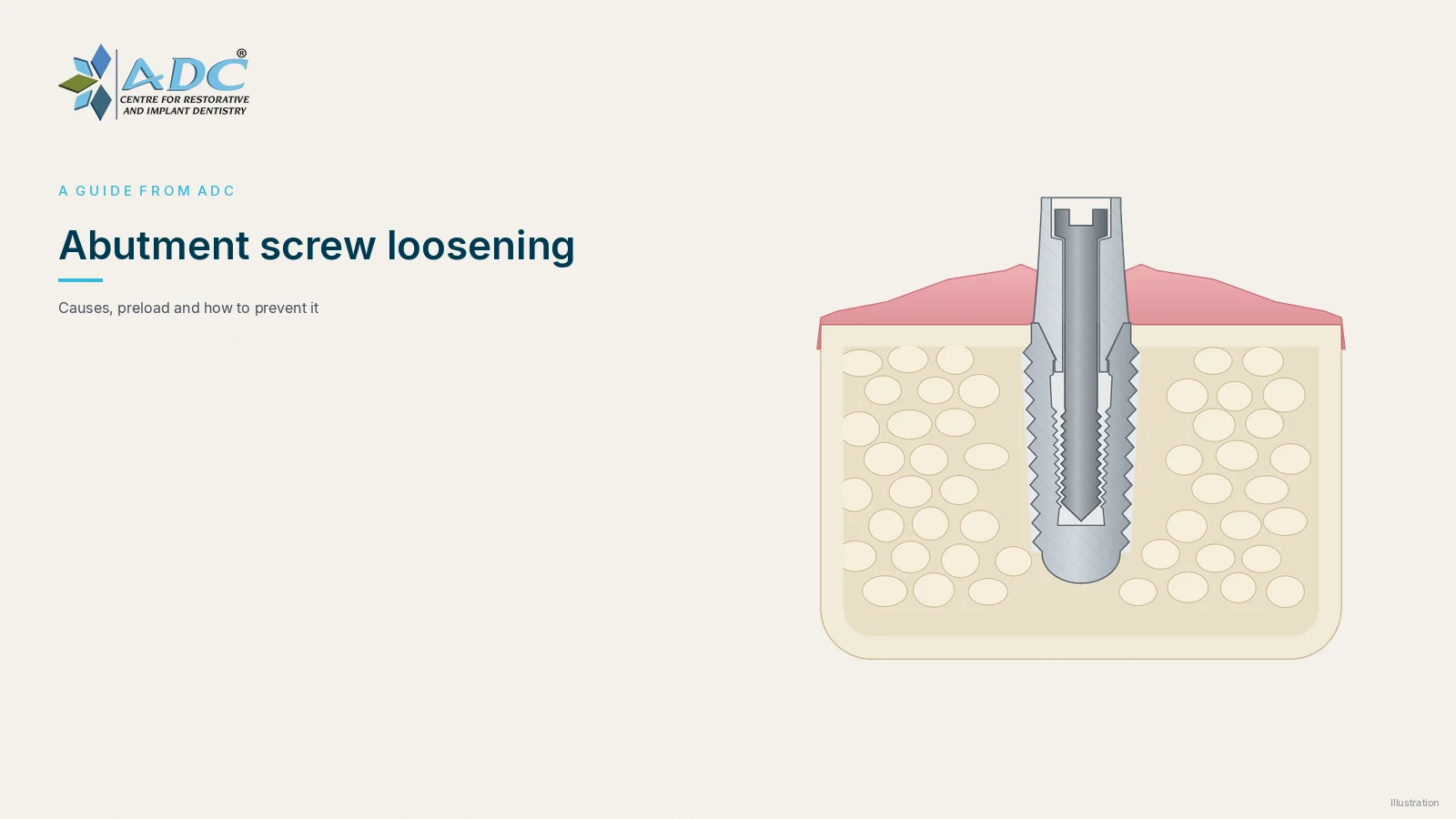
When an abutment screw is tightened, it stretches slightly, like a spring. The elastic recovery of that stretch pulls the abutment and implant together. This clamping force is called preload, and it is what holds the joint closed.
Preload depends mainly on the torque applied, and also on the screw material, thread design, surface finish and lubrication. Much of the applied torque is spent overcoming friction in the threads and under the screw head, so only a part of it becomes preload. The joint stays stable as long as preload is greater than the forces trying to open it. When chewing forces, bending forces or an ill-fitting component overcome the clamping force, the threads slip a little with each cycle and the screw gradually loses tension.
The settling effect
No machined surface is perfectly smooth. When a screw is first tightened, the joint touches only on microscopic high spots. Under load, these high spots flatten and the surfaces move slightly closer together, so the screw loses part of its stretch and part of its preload. This is known as the settling effect or embedment relaxation. If settling is greater than the elastic stretch of the screw, the joint loosens. Settling is the reason many authors recommend retightening the screw a few minutes after the first tightening, to recover the preload lost in the first minutes.
Factors that lead to loosening
Reviews of the literature group the causes into a few areas:
- Inadequate torque. A screw tightened by hand, or with an uncalibrated or worn driver, may never reach its intended preload.
- Component fit. A poor passive fit, a misfitting framework, debris in the connection or components from different systems that are not designed to work together all reduce joint stability.
- Connection design. Reviews report that internal and conical connections with anti-rotational features resist loosening well, while external connections are more prone to it.
- Occlusal and bending forces. Cantilevers, steep cusps, heavy lateral contacts, parafunction and a crown-to-implant ratio that increases leverage all add joint-separating forces.
- Repeated tightening and loosening. Each cycle can wear the thread surfaces and reduce the preload a screw can achieve. Reusing a screw that has been tightened many times, for example during laboratory and try-in stages, adds to the risk.
- Screw condition. A deformed or damaged screw, or a screw thread contaminated with blood, saliva or cement, will not behave as designed.
Prevention: a chairside checklist
- Use the correct components. Use the abutment and screw designed for that implant system, and keep a new screw for the final tightening where the manufacturer recommends it.
- Clean and dry the connection. Remove debris from the implant connection before seating the abutment.
- Verify seating. Confirm complete seating of the abutment, radiographically where the margin is subgingival.
- Torque to the manufacturer's value. Use a calibrated torque wrench and the torque recommended for that screw, never an estimated hand torque.
- Retighten after a few minutes. Retighten to the same value after a short wait to compensate for settling.
- Check the occlusion. Aim for light, centred contacts on implant crowns, reduce cusp inclines and avoid heavy lateral contacts and long cantilevers.
- Manage parafunction. For patients who clench or grind, consider a night guard and plan the restoration with this load in mind.
- Record and review. Note the torque used and the screw details in the clinical record, and check the restoration at recall visits.
When a screw does loosen
A loose screw is a warning sign as well as a mechanical problem. Before simply retightening, it is worth asking why it loosened:
- Remove the crown or access the screw channel and inspect the screw and connection for damage.
- Check the fit of the restoration and the occlusion, including excursive contacts and any cantilever.
- Replace a screw that shows thread wear or deformation rather than reusing it.
- Look for signs of soft-tissue inflammation, which may follow micromovement or leakage at the joint.
- Investigate repeated loosening as a sign of a design, fit or load problem that needs correcting.
If the screw has fractured rather than loosened, management changes completely. The fragment has to be retrieved without damaging the internal threads of the implant, which needs a careful stepwise approach and knowing when to stop.
Frequently asked questions
Is abutment screw loosening the same as implant failure?
No. Screw loosening is a prosthetic complication. The implant may remain well integrated, but loosening should be managed promptly because continued movement can damage the components or lead to screw fracture.
Why retighten an abutment screw after a few minutes?
Because of the settling effect. Part of the preload is lost soon after the first tightening as surface high spots flatten. Retightening recovers some of this preload.
Can I use any screwdriver if I am careful?
Hand tightening cannot reliably reach the intended preload. A calibrated torque wrench with the manufacturer's recommended value is the safer approach.
Learning implant complication management with ADC
The ADC E-Learning Hub is the online training platform for dentists run by Dr. Mohit Dhawan and Dr. Rosy Dhawan. Its courses include Hardware Complications in Dental Implants, the Basic Implantology Course and courses on analog and digital impressions and on long-term implant success beyond osseointegration. Lessons are video-based with downloadable notes, a digital certificate is awarded for each completed lecture and module, and offline clinical classes are also offered, with pre-enrolment online. Browse the full list at All courses. For a worked example of managing a fractured screw, read Retrieving a fractured abutment screw, and for choosing a first course, read Implantology courses after BDS.
This article is general education for dental professionals and students. It is not individual clinical advice, and it does not replace the implant manufacturer's instructions, formal training or individual clinical judgement.
Written by Dr. Mohit Dhawan, M.D.S., Prosthodontist and Implantologist, ADC- Centre for Restorative and Implant Dentistry, Chandigarh. ITI Fellow, ITI Section India.
References
- Huang Y, Wang J. Mechanism of and factors associated with the loosening of the implant abutment screw: a review. Journal of Esthetic and Restorative Dentistry. 2019. https://doi.org/10.1111/jerd.12494
- Nithyapriya S, et al. Systematic analysis of factors that cause loss of preload in dental implants. The Journal of Indian Prosthodontic Society. 2018. https://doi.org/10.4103/jips.jips_294_17



 International Team for Implantology
 ISO 9001:2015 Certified
 OHSAS Certified
 Academy of Osseo-Integration
 Indian Prosthodontics Society
 Indian Endodontic Society
 Women Implantology Network
 Indian Dental Association






 Sensitivity after a new crown: what is usual and when to call the dentist
 Dental implant after tooth extraction: immediate or delayed placement?
 Do you need a crown after root canal treatment?