Patients planning dental implants sometimes hear the name SLActive and ask what it means and whether it matters for them. SLActive implants are dental implants from the Swiss manufacturer Straumann with a chemically modified surface designed to support the early stage of bone healing. This guide explains, in plain words, what the surface is, how implant stability develops after placement, what the research does and does not show, and how the choice of implant fits into treatment planning in Chandigarh.
For background on the implant system itself, read why we use Straumann dental implants.
What are SLActive implants?
A dental implant is a small screw-shaped post, usually made of titanium or a titanium alloy, that is placed in the jawbone to replace the root of a missing tooth. Over the following weeks and months, bone grows onto the implant surface and anchors it. This bonding is called osseointegration (ADA MouthHealthy).
The surface of an implant affects how bone cells respond to it. Straumann's SLA surface is sandblasted with large grit and then acid-etched, which gives it a moderately rough texture. The SLActive surface has the same rough texture, but it is chemically modified: after etching, the implant is kept away from air and stored in a saline solution, so the surface stays strongly water-attracting (hydrophilic) until it is placed. In animal research, and later in small human studies, the modified surface was associated with earlier bone contact in the first few weeks.
SLActive is a surface finish, not a different procedure. The steps of implant treatment are the same whichever surface is used.
Primary and secondary implant stability
Implant stability develops in two stages.
- Primary stability is the mechanical grip on the day of placement, a little like a screw held tightly in wood. It depends on the amount and density of the bone, the implant design and the way the site is prepared.
- Secondary stability is the biological bond that builds up over the following weeks as new bone forms directly on the implant surface.
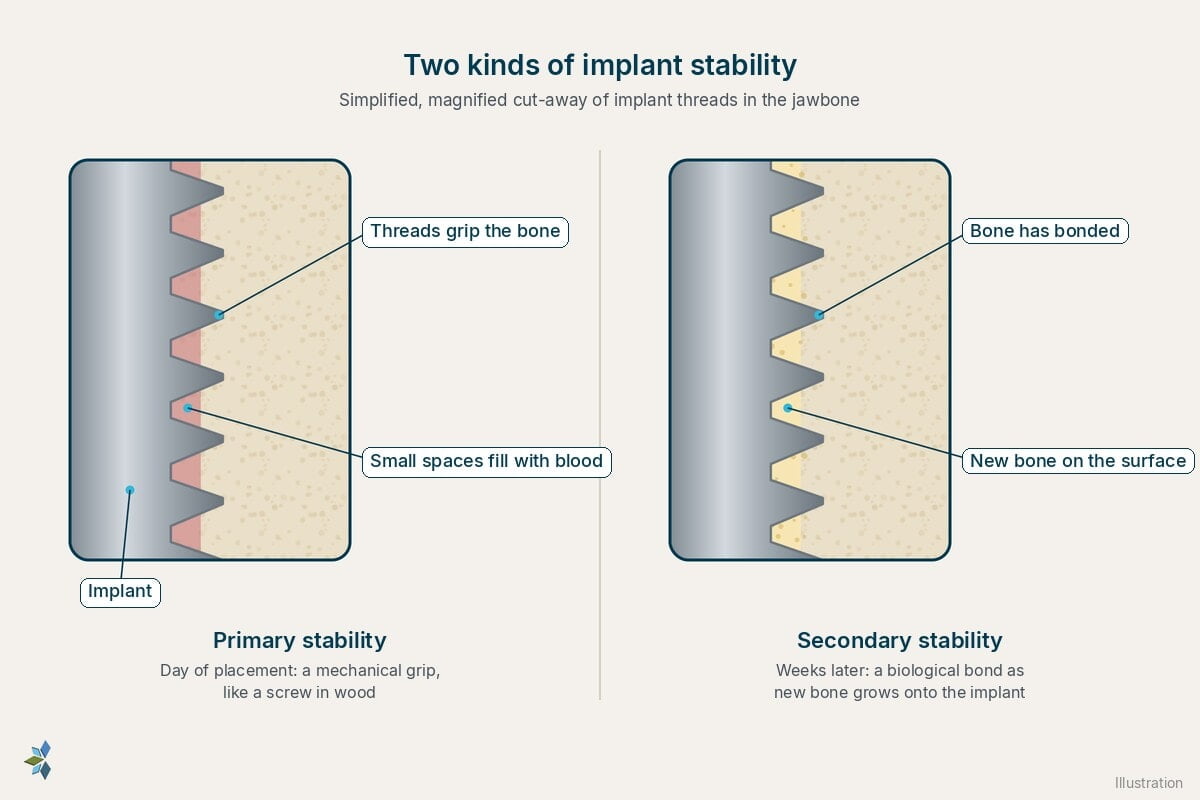
Illustration: primary stability is the mechanical grip on the day of placement; secondary stability is the biological bond that forms as new bone grows onto the implant. Simplified. Not a patient photograph.
To learn more about how this bonding progresses, read about the stages of dental implant osseointegration.
The implant stability dip in early healing
In the first weeks after placement, the bone immediately around the implant remodels. Some of the original mechanical grip is lost before enough new bone has formed, so overall stability can fall for a short time before it rises again. Researchers describe this fall and recovery as a dip in stability during early healing (Raghavendra and colleagues, 2005). The idea behind a chemically modified surface is that, if new bone forms sooner, this dip may be shorter or shallower.
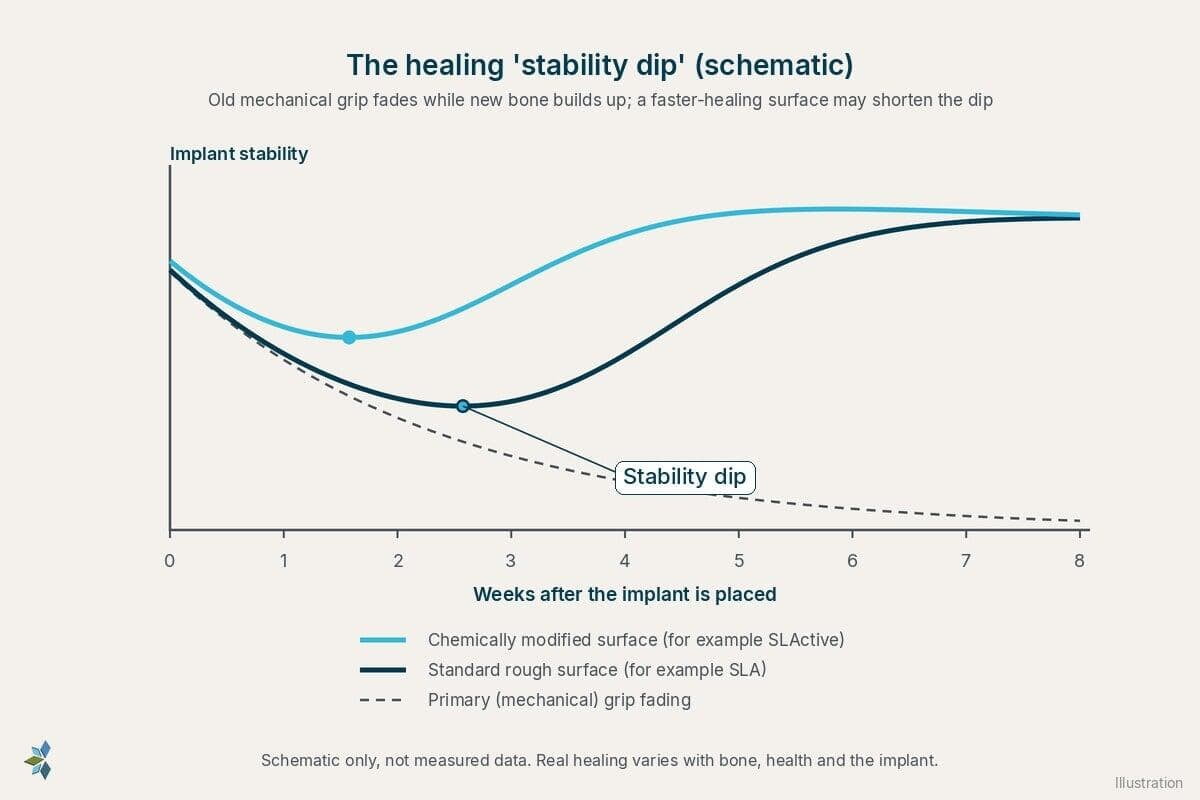
Illustration: a schematic of the early 'stability dip'. It shows the general idea only and is not measured data; real healing varies with the bone, general health and the implant. Not a patient photograph.
What the research shows
The studies below are often cited for this surface.
- Animal research. In a study in miniature pigs, implants with the chemically modified surface had more bone in contact with the surface at two and four weeks than standard SLA implants; by eight weeks the results were similar (Buser and colleagues, 2004).
- Early healing in people. Small test implants were placed in 49 volunteers and removed for examination at intervals. New bone contact was greater on the SLActive surface at two and four weeks, but by six weeks no difference between the two surfaces was reported (Lang and colleagues, 2011).
- Implant stability. In a small randomised pilot study of 31 patients comparing the two surfaces, measured stability stopped falling and began to rise after about two weeks with the modified surface, compared with about four weeks with the standard surface (Oates and colleagues, 2007).
- Poorly controlled type 2 diabetes. In a randomised trial of 24 patients with poorly controlled type 2 diabetes, implant stability was similar for the two surfaces (Khandelwal and colleagues, 2013).
Taken together, these studies suggest earlier bone contact, and an earlier upturn in measured stability, in some situations. The differences were seen mainly in the first weeks. They do not show that the surface makes an implant last longer, and they do not remove the other factors that affect implant success.
What this means for you
If stability recovers sooner, your implant dentist may have more flexibility in some cases. That is not a promise of an earlier crown: the timing is always decided case by case, based on the stability measured or assessed for your implant, your bone and your bite. Allowing enough healing time still matters; see why adequate healing time for dental implants is important.
The implant surface is only one part of a successful result. Others include:
- enough healthy bone, or bone grafting where it is lacking (see dental implants with bone loss)
- healthy gums, with any gum disease treated first
- avoiding smoking (read about smoking and dental implants)
- good control of general health conditions such as diabetes
- careful planning, a well-designed crown and regular maintenance
No implant surface guarantees success. If problems do occur, read about failed dental implants and how they are managed.
SLActive implants at ADC, Chandigarh
At ADC – Centre for Restorative and Implant Dentistry, implant treatment is led by Dr. Mohit Dhawan. Planning includes an examination, your medical history and, where needed, a 3D CBCT scan and a surgical guide. ADC works with the Straumann implant system, and the implant type and surface for your case, including whether an SLActive surface is suitable, are explained at your consultation. Learn more on our dental implants in Chandigarh page or read our complete guide to dental implants. The clinic is in Sector 21, Chandigarh, within easy reach of Mohali, Panchkula and Zirakpur.
For dentists: the ADC E-Learning Hub offers the Beyond Osseointegration course and the Basic Implantology Course. Straumann's 2019 summary of the scientific evidence on SLActive is available as a PDF (a manufacturer document).
Frequently asked questions
Is an SLActive implant a different treatment from a standard implant?
No. The treatment steps are the same. SLActive describes the chemistry of the implant surface, which is designed to support the early stage of bone healing.
Does an SLActive implant mean I get my tooth sooner?
Not automatically. Studies suggest earlier stability in some situations, which can give more flexibility, but the timing of your crown depends on your bone, the stability of your implant and your bite. Your dentist will advise on the timing for your case.
Is SLActive better than other implants?
The studies summarised here compare this surface with Straumann's standard SLA surface. They suggest earlier bone contact in the first weeks, with the difference no longer seen after about six to eight weeks. They do not show that SLActive lasts longer or is better than other implant systems. Long-term success depends on bone, gum health, smoking, general health, planning and maintenance.
Can people with diabetes have SLActive implants?
Many people with diabetes can have implants when the condition is well controlled. One trial in people with poorly controlled type 2 diabetes found similar stability with the standard and modified surfaces. Your dentist will review your health and may liaise with your doctor.
Does the implant system affect the cost?
Yes, the implant system and the parts used are part of the fee, which is explained in your written estimate. Instalment and financing options are available; ask our team for details.
Book a consultation in Chandigarh
This article is general information, not advice for any individual. Please speak with your dentist about your own situation. If you are considering dental implants and would like to understand your options, you are welcome to book a consultation with Dr. Mohit Dhawan at ADC – Centre for Restorative and Implant Dentistry:
- Online booking: ADC Zoho Bookings
- Phone: +91-708-780-0016
- Email: help@theadc.dental
- Clinic: ADC- Centre for Restorative and Implant Dentistry, 1197, Sector 21B, Sector 21, Chandigarh, 160022, India
Mon–Fri 10:00 AM–6:30 PM; Sat 10:00 AM–5:00 PM; Sunday closed. You can also request a consultation online.
Reviewed by Dr. Mohit Dhawan, MDS (Prosthodontics, Crown & Bridge and Implantology).
References
- Buser D, Broggini N, Wieland M, et al. Enhanced bone apposition to a chemically modified SLA titanium surface. J Dent Res. 2004 — PubMed 15218041
- Lang NP, Salvi GE, Huynh-Ba G, et al. Early osseointegration to hydrophilic and hydrophobic implant surfaces in humans. Clin Oral Implants Res. 2011 — PubMed 21561476
- Oates TW, Valderrama P, Bischof M, et al. Enhanced implant stability with a chemically modified SLA surface: a randomized pilot study. Int J Oral Maxillofac Implants. 2007 — PubMed 17974109
- Raghavendra S, Wood MC, Taylor TD. Early wound healing around endosseous implants: a review of the literature. Int J Oral Maxillofac Implants. 2005 — PubMed 15973954
- Khandelwal N, Oates TW, Vargas A, et al. Conventional SLA and chemically modified SLA implants in patients with poorly controlled type 2 diabetes mellitus: a randomized controlled trial. Clin Oral Implants Res. 2013 — PubMed 22145978
- American Dental Association, MouthHealthy. Dental implants — mouthhealthy.org


 International Team for Implantology
 ISO 9001:2015 Certified
 OHSAS Certified
 Academy of Osseo-Integration
 Indian Prosthodontics Society
 Indian Endodontic Society
 Women Implantology Network
 Indian Dental Association




 Sensitivity after a new crown: what is usual and when to call the dentist
 Dental implant after tooth extraction: immediate or delayed placement?
 Do you need a crown after root canal treatment?