Missing teeth can affect your smile, your confidence, your speech and how comfortably you chew. Dental implants are one of the most reliable ways to replace them, and for many people they look and feel close to natural teeth. If you are considering dental implants in Chandigarh, this guide explains what an implant is, who is suitable, the treatment steps, what affects the cost, and how to look after implants so they last.
What are dental implants?
A dental implant is a small screw-shaped post, usually made of titanium or a titanium alloy, that is placed in the jawbone to act as a replacement tooth root. Once the bone has bonded to it, the implant can support a crown, a bridge or a denture.
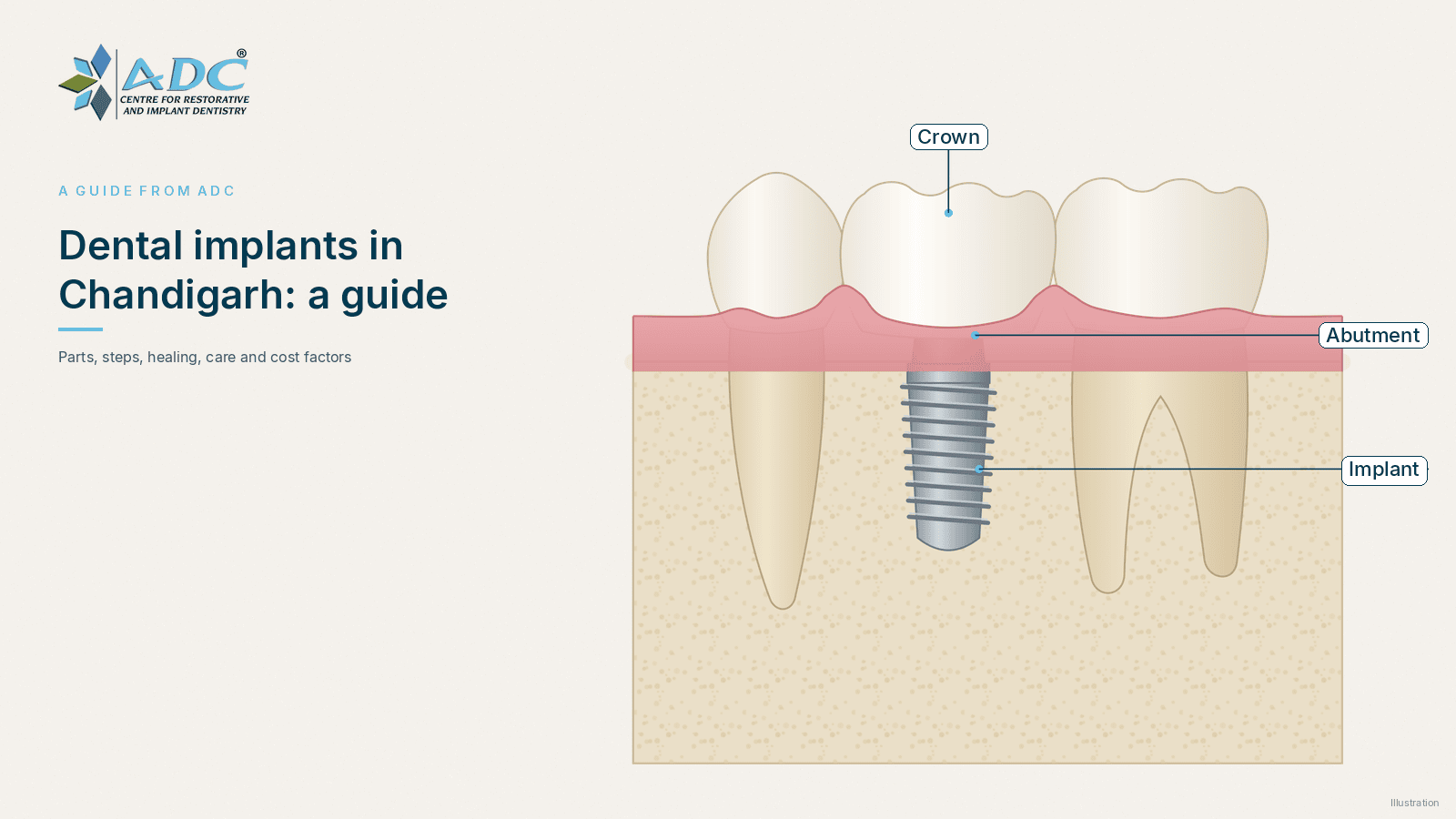
An implant tooth has three parts:
- Implant: the post in the jawbone
- Abutment: the connector that passes through the gum
- Crown: the visible tooth, usually ceramic
Implants can replace a single tooth, several teeth with an implant-supported bridge, or a whole arch with implant-supported dentures or an All-on-4 type fixed bridge. Our dental implants in Chandigarh page describes the treatments offered at ADC.
Who is a good candidate for dental implants?
You may be suitable for dental implants if you:
- have one or more missing teeth, or teeth that cannot be saved
- have healthy gums, or are willing to have gum disease treated first
- have enough jawbone, or are suitable for a bone graft
- have stable general health (conditions such as diabetes should be well controlled)
- can keep up good daily cleaning and regular check-ups
Smoking, uncontrolled diabetes, previous radiotherapy to the jaws and some bone medicines can raise the risk of complications, so your dentist will ask about them. If bone has been lost, procedures such as bone grafting or a sinus lift can often make implants possible.
The dental implant procedure, step by step
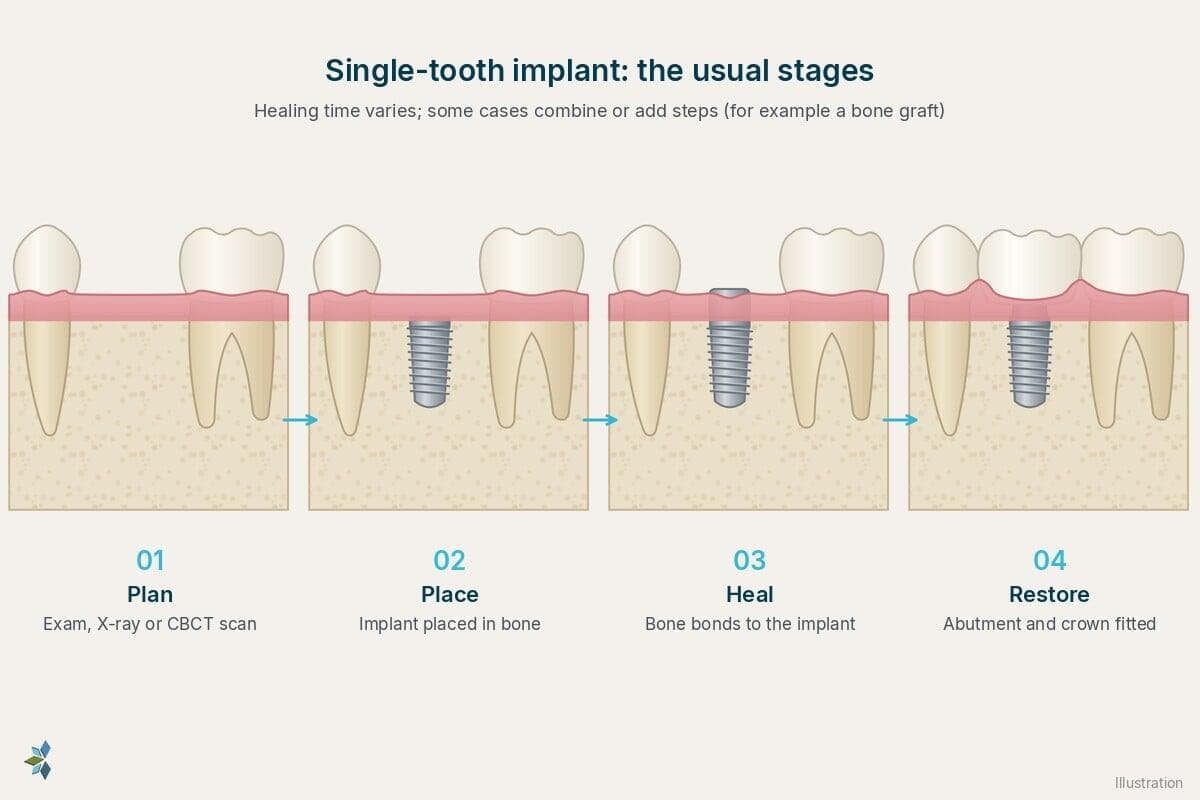
Illustration: the usual stages of a single-tooth implant. Timings vary; some cases add or combine steps. Not a patient photograph.
1. Consultation and planning
Your dentist examines your mouth and takes X-rays and, often, a CBCT (3D) scan to measure the bone and locate structures such as nerves and the sinus. A digital plan helps decide the implant size and position.
2. Implant placement
The implant is placed in the jawbone under local anaesthesia. Sedation may be discussed if you feel anxious (see IV sedation).
3. Healing (osseointegration)
Over the following weeks and months the bone bonds to the implant surface. This often takes around three to six months, depending on the bone and the site. A temporary tooth can be provided in many cases. Read more about the stages of osseointegration.
4. Abutment and crown
Once the implant is stable, an abutment is fitted and a custom crown is made to match your other teeth. In selected cases a temporary crown can be fitted soon after placement (immediate loading); your dentist will advise whether this suits you.
Benefits of dental implants
- A natural look and feel
- Stable chewing and clear speech, without a loose denture
- Neighbouring teeth are not reshaped, unlike a conventional bridge
- The implant loads the jawbone and may help limit bone loss
- With good care, implants can last for many years
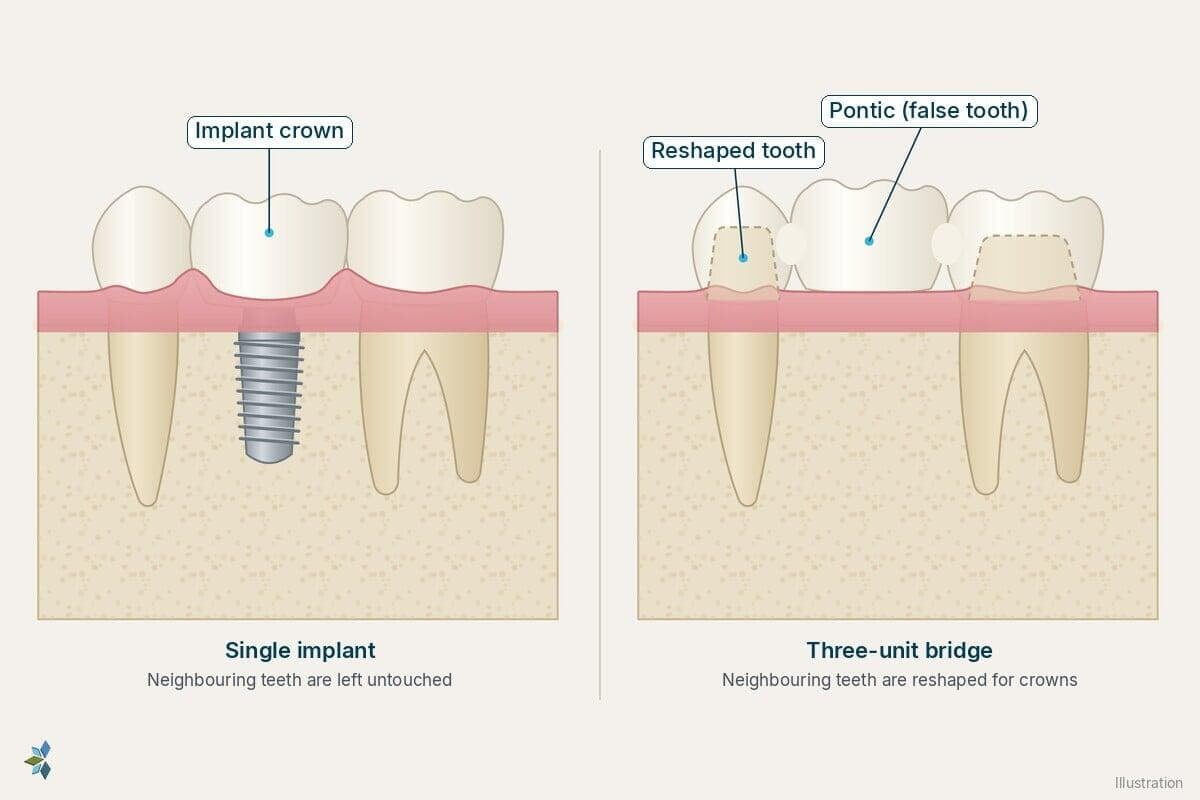
Illustration: a single implant leaves the neighbouring teeth untouched, while a bridge is supported on crowns over reshaped teeth. Not a patient photograph.
If you are weighing implants against dentures, read our guide to dentures vs implants.
Cost of dental implants in Chandigarh
The cost of dental implants in Chandigarh depends on your treatment plan rather than a single fixed price. The main factors are:
- the number of implants and teeth being replaced
- the implant system and the crown material
- extra procedures such as extractions, bone grafting or a sinus lift
- imaging and planning (for example a CBCT scan)
- whether temporary teeth are needed during healing
You will receive a written treatment plan and estimate after your examination. Our article on the factors that affect the cost of dental implants explains these in more detail.
Are dental implants painful?
Implant placement is carried out under local anaesthesia, so you should feel pressure rather than pain. Some soreness, swelling or bruising for a few days afterwards is common and is usually managed with simple painkillers and the instructions you are given. See will a dental implant procedure cause me pain? for more.
Aftercare and maintenance
Implants cannot decay, but the gum and bone around them can become inflamed (peri-implant mucositis and peri-implantitis) if plaque builds up. To protect your implants:
- brush twice a day and clean between teeth and around the implant with floss, interdental brushes or a water flosser
- avoid smoking and tobacco
- attend regular check-ups and professional cleaning
- wear a night guard if you grind your teeth
- contact the clinic if the implant tooth feels loose, or the gum bleeds or swells
Risks and complications
Long-term studies show that most implants are still in place many years later, but, like any surgery, implant treatment carries some risks:
- infection or delayed healing at the implant site
- the implant not bonding to the bone (early failure)
- gum and bone inflammation around the implant in later years
- rarely, nerve injury or sinus problems, which careful 3D planning helps avoid
- wear or loosening of the crown or screw, which can usually be repaired
If problems occur, read our guide to a failed dental implant, or contact the clinic for a review.
Planning implant treatment in Chandigarh
ADC – Centre for Restorative and Implant Dentistry in Sector 21, Chandigarh sees patients from Chandigarh, Mohali, Panchkula and the wider Tricity. If you are travelling from another city or country, see our international patients page for how visits can be planned around the healing stages.
Frequently asked questions
How long do dental implants last?
Many implants last for decades with good care. The crown on top may need replacing after some years because of normal wear.
How long does implant treatment take?
From placement to the final crown, treatment commonly takes around three to six months. It can be longer if a bone graft is needed, or shorter if immediate loading is suitable.
Can I have implants if I have bone loss?
Often, yes. A bone graft, sinus lift or a different implant plan may be suggested after a CBCT scan.
Can implants be placed at any age?
Implants are placed once the jaws have stopped growing. In older adults, general health and bone matter more than age.
Can I get a tooth on the same day?
In selected cases a temporary tooth can be fitted soon after the implant is placed. Your dentist will tell you whether it is safe for you.
Book a dental implant consultation in Chandigarh
To find out whether dental implants suit you, book an assessment with Dr. Mohit Dhawan's team:
- Online booking: ADC Zoho Bookings
- Phone: +91-7087800016
- Email: help@theadc.dental
- Clinic: #1197 Sector 21-B, U.T, Chandigarh 160022
Mon–Fri 10:00 AM–6:30 PM (as published); Sat 10:00 AM–5:00 PM; Sunday closed. You can also read Dr. Mohit Dhawan's profile.
For dentists: ADC's e-learning hub runs a Basic Implantology Course.
Reviewed by Dr. Mohit Dhawan.
References
- American Dental Association, MouthHealthy — Implants
- Howe MS, Keys W, Richards D. Long-term (10-year) dental implant survival: a systematic review and sensitivity meta-analysis. J Dent. 2019 — PubMed 30904559
- Mustapha AD, et al. Smoking and dental implants: a systematic review and meta-analysis. Medicina (Kaunas). 2021 — PMC8780868
- Wang HL, et al. AO/AAP consensus on prevention and management of peri-implant diseases and conditions: summary report. J Periodontol. 2025 — PMC12273748




 International Team for Implantology
 ISO 9001:2015 Certified
 OHSAS Certified
 Academy of Osseo-Integration
 Indian Prosthodontics Society
 Indian Endodontic Society
 Women Implantology Network
 Indian Dental Association






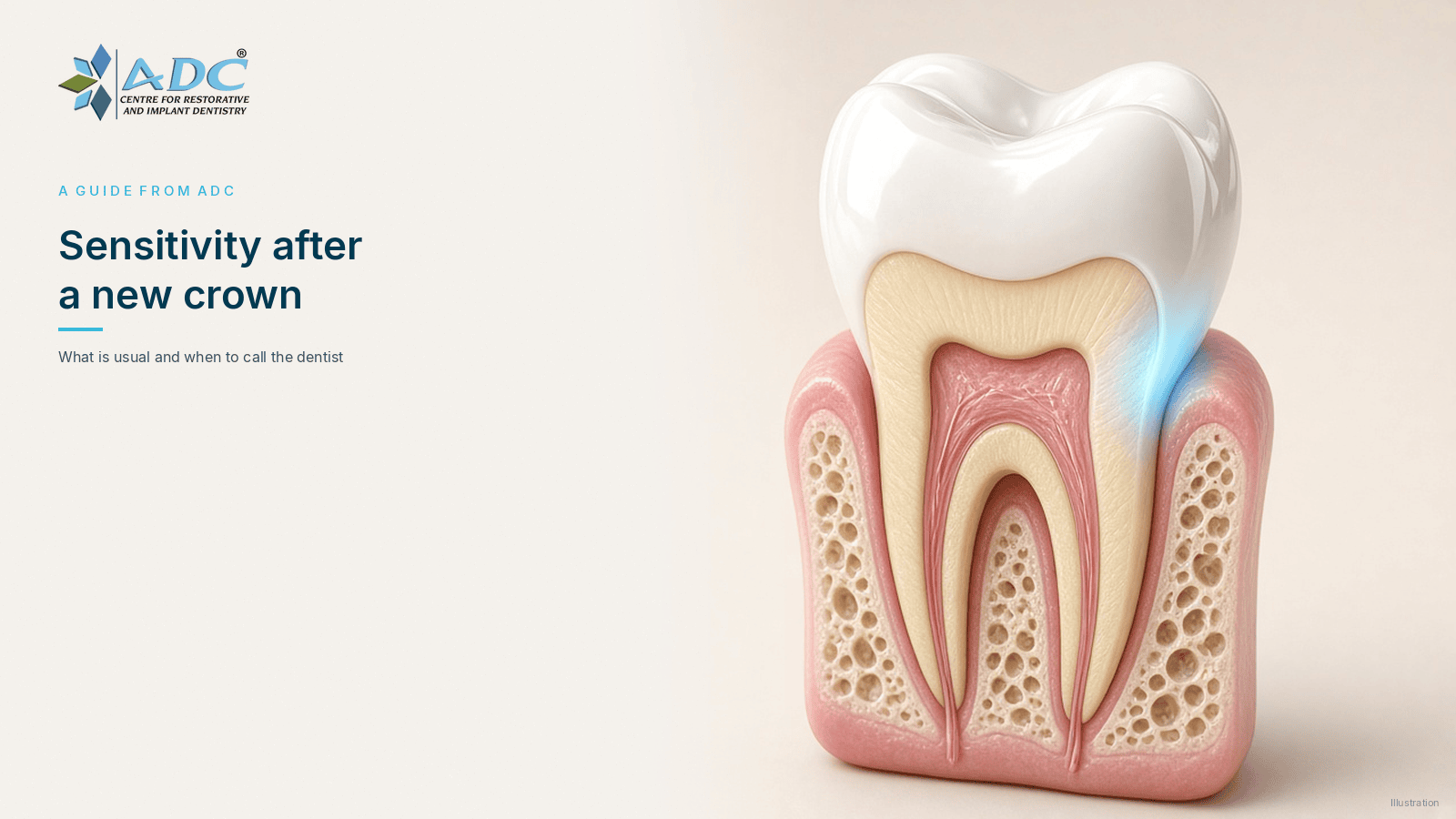 Sensitivity after a new crown: what is usual and when to call the dentist
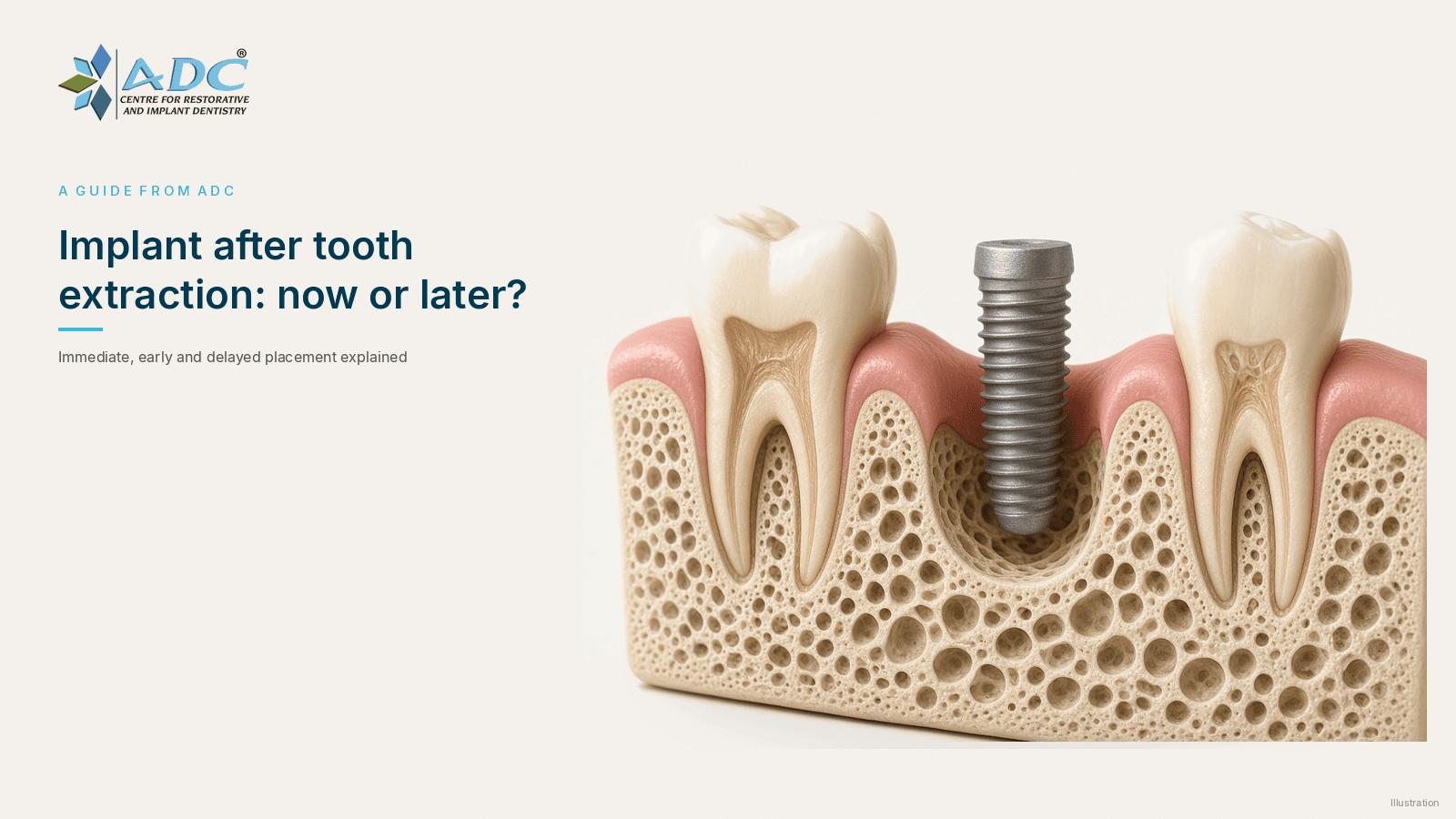 Dental implant after tooth extraction: immediate or delayed placement?
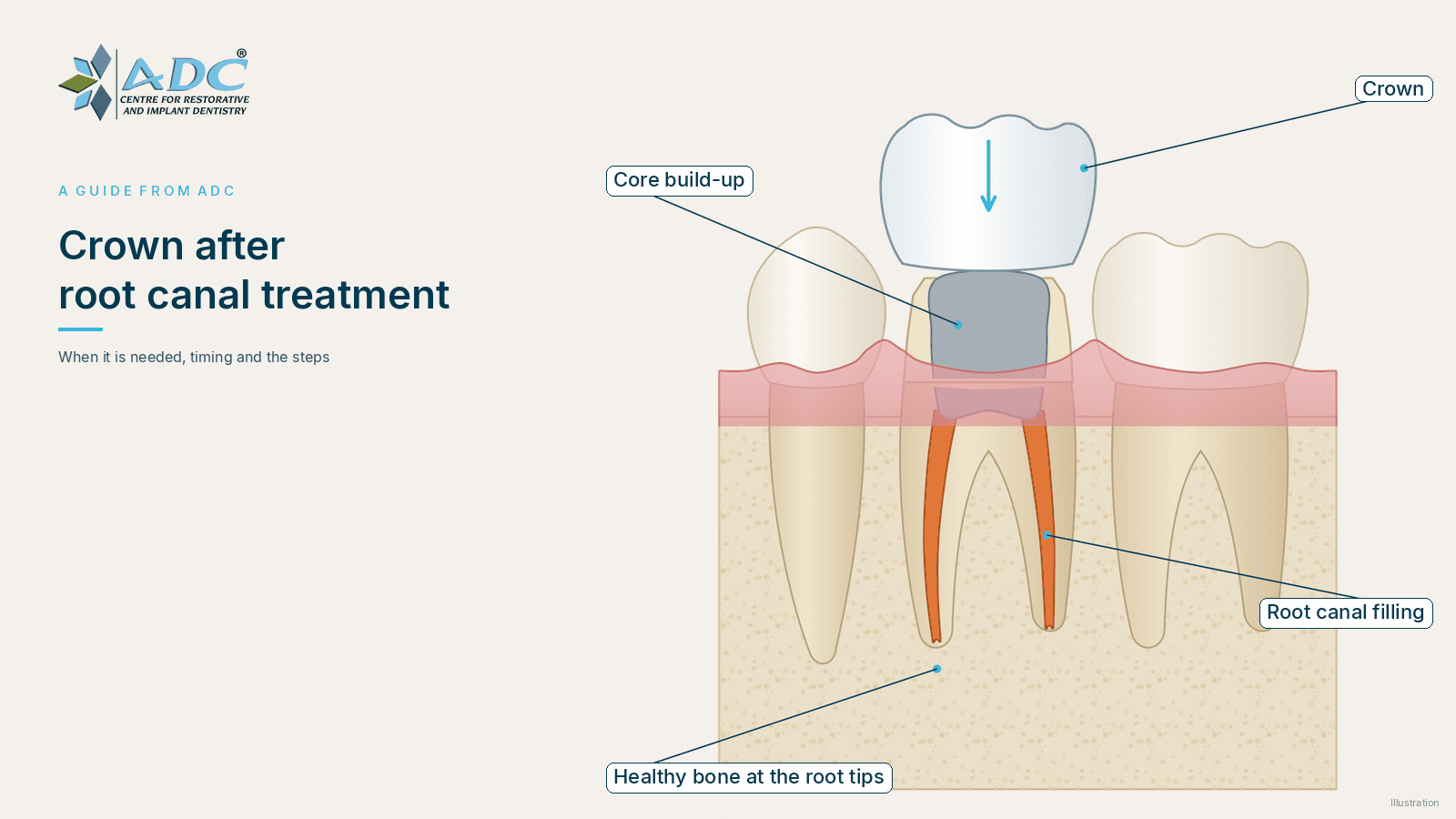 Do you need a crown after root canal treatment?